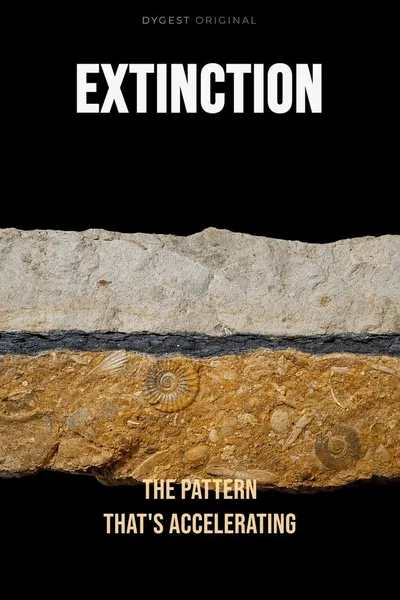
Extinction
The pattern that's accelerating
Description
Roughly 99% of all species that have ever existed on Earth are now extinct. The average species persists for a few million years before disappearing, replaced by descendant species or eliminated entirely in a mass extinction event. Extinction is the norm, not the exception, in the long sweep of evolutionary history life has a way of expanding into available niches, diversifying, and then collapsing when conditions change. Earth has experienced five major mass extinctions in its 540-million-year history of animal life, each wiping out 50-95% of existing species. The dinosaurs are the most famous casualties of the Cretaceous-Paleogene extinction 66 million years ago; the Permian-Triassic extinction 252 million years ago killed roughly 90% of all species and is the closest thing to total biological reset that has occurred.
The current period shows patterns consistent with the beginning of a sixth mass extinction the first driven by a single species rather than by volcanic activity, asteroid impact, or other external cause. Modern extinction rates are estimated at 100 to 1,000 times the natural background rate, with some assessments putting the current rate even higher. More than 40,000 species are classified as threatened with extinction by the IUCN. Specific famous species (northern white rhinoceros, vaquita porpoise, various Amazon amphibians) are in their final populations, functionally extinct or very close. The trajectory, if sustained, would constitute an extinction event comparable in magnitude to previous mass extinctions within centuries rather than the millions of years such events typically take.
Whether this is really the sixth mass extinction, and how it compares to the previous five, is a matter of some scientific debate. The specific comparisons depend on what is counted and over what timeframe. What is not debated is that current rates of species loss are orders of magnitude above natural background and are driven overwhelmingly by human activity. Understanding what extinction actually is, what the current patterns look like, and what the consequences are, is prerequisite to thinking seriously about biodiversity conservation and the broader question of what kind of planet the next century will inherit.
The question we're asking: what is extinction, what is driving the current wave, and what are the consequences?
What we'll see: the pattern through geological time, the current extinction wave, the specific drivers, and the response.
Table of contents
01The pattern through time
The fossil record documents five major mass extinctions in the last 540 million years. The end-Ordovician extinction (roughly 440 million years ago) killed about 85% of marine species, probably through climate change associated with a specific ice age. The late Devonian extinction (roughly 360 million years ago) killed about 75% of species over an extended period, likely from multiple environmental shocks. The end-Permian extinction (roughly 252 million years ago) killed 90-95% of species and is the most severe volcanic activity in what is now Siberia released enormous amounts of CO2 and caused runaway warming, ocean acidification, and anoxia. The end-Triassic extinction (roughly 201 million years ago) killed about 80% of species, probably through volcanic CO2 release and warming. The end-Cretaceous extinction (66 million years ago) killed the dinosaurs and about 75% of species through the combined effects of an asteroid impact and ongoing volcanic activity.

02The current wave
Specific known extinctions in recent centuries provide concrete examples of what current extinction looks like. The dodo went extinct in the late 1600s, killed primarily by introduced species and habitat loss on Mauritius. The passenger pigeon, once possibly the most abundant bird species in North America with billions of individuals, went extinct in 1914 driven to zero by commercial hunting and habitat destruction in a remarkably short period. The Tasmanian tiger (thylacine) went extinct in 1936, killed by bounty hunting and disease. The Yangtze river dolphin went extinct in 2006, eliminated by pollution and boat traffic. The western black rhinoceros was declared extinct in 2011, the last killed by poachers.
The specific IUCN Red List, which formally assesses species extinction risk, now classifies more than 44,000 species as threatened with extinction. This includes roughly 41% of amphibians, 34% of conifers, 26% of mammals, 12% of birds, and substantial percentages of most other well-studied groups. These numbers almost certainly underestimate the total, because most species particularly invertebrates, fungi, and microorganisms have not been formally assessed. Many species that will go extinct in coming decades have probably not yet been scientifically described, which means we will lose them without ever having known they existed.
03The specific drivers
Habitat destruction is the largest single driver of current extinctions. Converting forests to agriculture, draining wetlands, building cities, and fragmenting remaining habitat reduces the area available for species to live. Many species require specific minimum areas of intact habitat to maintain viable populations; when habitat is reduced below this threshold, populations decline toward extinction even without direct killing. Tropical forests, which host most of the world's species, have lost roughly a third of their pre-industrial extent, with continued deforestation ongoing. The specific relationship between habitat area and species number the species-area curve predicts that continued habitat loss will produce continued species loss for decades to come even if other drivers are addressed.
Climate change is an accelerating driver that will eventually become dominant if warming continues. Species have specific climate niches they are adapted to, and shifting climate conditions force them to either move (to maintain their niche), adapt (through evolution), or go extinct. Movement is limited by habitat fragmentation and the specific geography of mountains, water bodies, and human-modified land. Evolution is too slow to keep up with rapid climate change for most species. The result is that climate change is projected to push substantial fractions of current species toward extinction through this century, with specific losses concentrated in Arctic, alpine, and coral reef ecosystems where adaptation options are most limited.
04The response
Conservation has prevented specific extinctions and recovered specific populations, demonstrating that targeted effort can produce results. The California condor, reduced to 22 individuals in the 1980s, now numbers over 500 through captive breeding and reintroduction. The American alligator, nearly extinct in the 1960s, has recovered to stable populations across its range. Humpback whale populations have rebounded substantially since the moratorium on commercial whaling. Specific island bird populations have been saved through intensive management of introduced predators. Each recovery requires substantial resources, sustained effort, and specific favorable conditions, but the examples show that extinction is not inevitable when serious effort is applied.
The challenge is that conservation resources are finite and the number of species at risk is large. Triage decisions which species receive intensive effort, which receive minimal attention are inevitable. Different frameworks have emerged: some prioritize species with the best chance of recovery, others prioritize evolutionary uniqueness, others prioritize ecosystem functions. No framework has achieved universal acceptance, and the choices remain contested.
05Conclusion
Extinction is one of the most basic features of life on Earth, and current rates of species loss represent a substantial acceleration above natural baseline driven overwhelmingly by human activity. Whether this constitutes a sixth mass extinction depends on how one measures and at what timescale one looks, but the specific trajectory is consistent with what previous mass extinctions looked like in their early stages. The specific losses are substantial, the specific causes are well-understood, and the specific responses that would address them are known even where they remain politically difficult to implement.
Related books