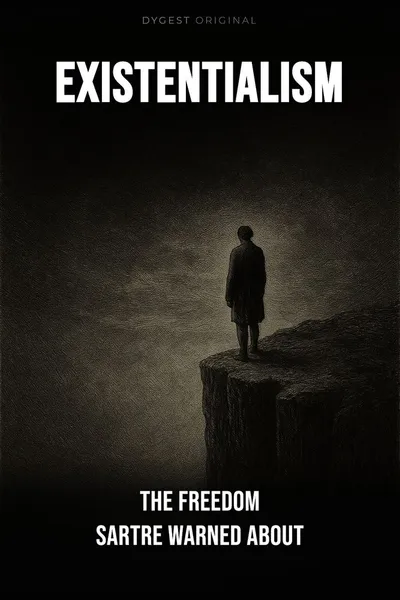
Existentialism
The freedom Sartre warned about
Description
The word existentialism calls up a specific postcard: Sartre and Beauvoir in a Saint-Germain café, black turtlenecks, cigarette smoke, the 1940s bleeding into the 1950s. It is one of the few philosophical movements that comes with an aesthetic attached, and the aesthetic has aged into something close to kitsch. American college freshmen still read The Stranger. Teenagers still decide, around seventeen, that life is absurd. Somewhere between the Camus posters and the coffeehouse décor, the actual claim got buried under its own style.
That claim is not comforting, and it was never meant to be. Sartre's most quoted line, that man is condemned to be free, is almost always cited as an inspirational meme. It was not. The word he chose was condemned. He meant that a human being, thrown into existence without a maker's manual, is stuck with the full weight of choosing what a human being is going to be. No script, no alibi. Freedom here is a sentence, not a trophy.
Existentialism is the name we give, in retrospect, to a century-long argument about what human life looks like once no external order — God, Reason, History, Nature — is giving existence meaning. The argument starts in the 1840s, peaks in 1940s Paris, and keeps coming back every time a civilization runs out of ready-made answers.
● The question we're asking: what was existentialism actually claiming about the human condition, once you strip away the Left Bank aesthetic?
● What we'll see: the nineteenth-century roots, Sartre's core formula and bad faith, the Paris scene as plural argument, and why existentialism keeps returning whenever a culture runs out of scripts.
Table of contents
01The roots before the name
Before there was a word for it, existentialism was an allergic reaction to Hegel. In the 1840s, Hegel had produced a vast system in which individual lives were moments in the self-unfolding of Absolute Spirit through history. Everything that happened belonged to a rational totality marching toward full self-consciousness. It was the most ambitious attempt to guarantee that history made sense since medieval theology. A young Danish theologian named Soren Kierkegaard read it, hated it, and devoted his life to the opposite proposition.
Kierkegaard's objection was personal before it was philosophical. Hegel's system had no room for the particular man Kierkegaard, in Copenhagen in 1843, in love with a woman he could not marry, afraid of his father's God, forced to decide every morning how to live the day. For Hegel, the individual was a specimen. For Kierkegaard, the individual was the only place anything real happened. He invented the concepts existentialism would inherit: anxiety as the dizziness of freedom, the leap of faith, the difference between knowing something abstractly and living it. He published most of it under fake names, so the reader had to work out the question alone.

02Existence precedes essence
The name was given by Sartre in an October 1945 lecture, later published as Existentialism Is a Humanism. It was partly a defense against Catholic and Communist critics who had accused the movement of being nihilistic, bourgeois, or both. Sartre needed to compress the doctrine into a line the press could repeat, and he did: existence precedes essence. The phrase has been quoted so often it looks self-explanatory. It is not. It is the load-bearing claim of the entire philosophy, and everything else hangs from it.
Every other object has its essence before it exists. A paper knife is designed — someone has a concept of what it is for, and only then is it manufactured. For most of Western history, humans were thought to work the same way: God, or Nature, or Reason had a concept of what a human being was for, and each person was an instance of it. Strip away the divine artisan, Sartre said, and the human becomes the one creature whose existence comes first and whose essence is made afterward, by the choices it keeps making. Nobody told you what to be. You become it by living.
03Camus, Beauvoir, and the plural Paris scene
The first thing to notice about the Paris existentialists is that there was no party line. Sartre had the largest platform and the most quotable formulas, but the people around him were not his students and did not always agree. Albert Camus, who won the Nobel in 1957, never accepted the label, and by 1952 he and Sartre had broken off publicly in Les Temps Modernes, over whether Soviet labor camps could be justified by the march of history. Camus thought they could not. Sartre, for a while, thought they could. It was a shared set of problems, not a shared set of answers.
Camus starts from what he called the absurd — the collision between the human demand for meaning and the universe's refusal to provide any. His 1942 essay The Myth of Sisyphus opens with the only philosophical question he thought serious: given that life has no given meaning, why not kill yourself? His answer is that suicide is a capitulation, and the properly human response is revolt — pushing the rock up the hill while refusing both despair and false consolation. The Stranger, assigned in American high schools for three generations, dramatizes a man who has stopped lying to himself about the scripts others perform, and who pays for it.
04The American afterlife and why it keeps returning
By the late 1960s, existentialism had been declared dead by the people replacing it. The French structuralists argued that the subject Sartre had put at the center of everything was itself a product of language, kinship, and the unconscious — not a free chooser at all. Foucault, Lacan, Levi-Strauss built their careers partly by dismantling the existentialist self. In the universities, it became a chapter between phenomenology and poststructuralism, practiced by almost no one. In France, by 1980, it was the philosophy your uncle had believed in.
The American reception has been stranger and more durable. Camus's The Stranger entered the US high-school canon in the 1960s and never left. Walker Percy, a Louisiana novelist and physician whose 1961 novel The Moviegoer is the central text, built an entire body of work around a Southern Catholic version of Kierkegaardian despair, read for sixty years as a native American voice of something nominally European. Saul Bellow, Flannery O'Connor, Ralph Ellison all wrote in conversation with the existentialist vocabulary without always calling it that. American existentialism lives in novels more than seminar rooms.
05Conclusion
Existentialism was not a single doctrine and not a mood. It was a century of thinkers — Kierkegaard, Dostoevsky, Nietzsche, Sartre, Camus, Beauvoir — working the same nerve. The nerve is this: once you stop pretending your life is the execution of a purpose handed to you by something larger, you are left with a freedom that is also a responsibility you cannot hand back, and the hardest work becomes learning to live without the alibis. That is what condemned to be free means, and it explains why the phrase has never stopped sounding like a warning.
Related books