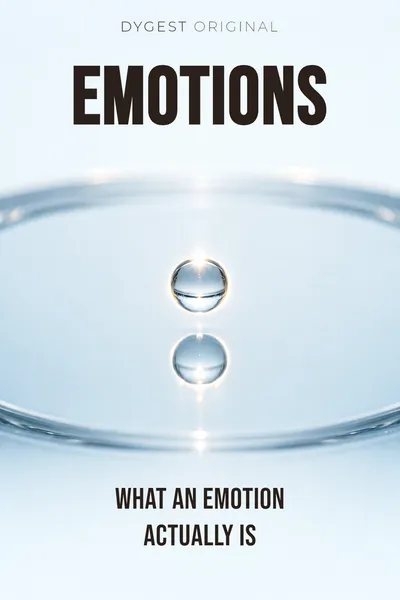
Emotions
What an emotion actually is
Description
A man walks across a narrow footbridge suspended high over a canyon. On the other side, a researcher stops him with a questionnaire and hands him her phone number in case he has questions. Weeks later, the psychologists behind the study — Donald Dutton and Arthur Aron, in 1974 — noticed something odd. The men who crossed the wobbly, terrifying bridge were far more likely to call the woman back than the men who had crossed a low, sturdy one. Their pounding hearts, it seemed, had been filed under the wrong label. The fear of the height had quietly become attraction.
That small experiment points at a question far larger than dating. We treat emotions as the most self-evident things we own. Anger, joy, grief, disgust — we feel them arriving, we name them without hesitation, we act on them, and we assume they are as real and as fixed as the weather. But the bridge study suggests the naming is not automatic at all. The same racing pulse can be read as terror or desire depending on the story we tell ourselves about where it came from. Which raises the awkward possibility that an emotion is not simply a thing that happens to us, but something we assemble.
For more than a century, the people who study feelings for a living have disagreed, sharply and productively, about what an emotion actually is. The argument is not settled, and the stakes are higher than they look — because how we answer changes what we think we can trust about our own minds.
The question we’re asking : When we feel something and give it a name, what exactly are we naming — a signal that fires on its own, or a story we build after the fact?What we’ll see : How the leading theories of emotion have wrestled over the raw material of feeling, and the challenge that unsettles them all.
Table of contents
01Chapter 1 — Where fear happens first
The oldest modern quarrel about emotion is a question of order. When we meet a bear on a trail, which comes first: the fear, or the racing heart and the sprint? Common sense answers instantly — we feel afraid, and so we run. In 1884, the American psychologist William James turned that answer inside out. We do not run because we are afraid, he argued; we are afraid because we run. The body reacts to the bear before the mind has caught up, and what we call fear is our perception of the body already in motion — the pounding chest, the dry mouth, the legs carrying us away. The Danish physician Carl Lange landed on a similar idea around the same time, and the position became the James-Lange theory.

02Chapter 2 — Reading the body's noise
If the body's signals really are as ambiguous as Cannon claimed, then feeling something and knowing what it is become two different tasks. In 1962, Stanley Schachter and Jerome Singer ran an experiment built precisely on that gap. They injected volunteers with adrenaline — which produces the jittery, heart-thumping arousal common to many emotions — but told some of them nothing about what to expect. Left with an unexplained buzz in their bodies, these participants took their emotional cue from the room. Placed with an actor behaving giddily, they reported feeling happy. Placed with an actor acting irritated, they reported anger. The same chemical, the same racing pulse, resolved into opposite emotions depending on the surrounding scene.
03Chapter 3 — One face, one feeling — or not
Against all this talk of interpretation stood a powerful counter-tradition insisting that some emotions are simply built in. Its most influential figure was Paul Ekman, who in the 1960s carried photographs of American faces to a remote group in Papua New Guinea with little exposure to Western culture. Shown a face and a short story, people there matched expressions to situations much as Westerners did. From studies like these Ekman argued for a small set of basic emotions — happiness, sadness, anger, fear, surprise, disgust — each with its own distinctive facial signature, hardwired by evolution and recognizable across every human culture. Charles Darwin had gestured at the idea a century earlier; Ekman gave it data.
The appeal of basic-emotion theory is obvious. It fits the intuition that a smile means joy in Tokyo and Toronto alike, that fear wears the same widened eyes everywhere. It promises that beneath the noise of language and custom, there is a bedrock of universal feelings, discrete and reliable, waiting to be read off the face. For decades this was the dominant picture, and it shaped everything from clinical practice to the design of software that claims to detect emotions from expressions.
04Chapter 4 — The brain as a prediction engine
Out of that wobble comes the most unsettling proposal on the table, associated most closely with the psychologist Lisa Feldman Barrett: the theory of constructed emotion. Its claim is blunt. There are no anger circuits and no fear circuits lying in wait; there is no fingerprint that makes an emotion the thing it is. Instead the brain is a prediction machine, constantly guessing at the causes of the raw signals coming from the body — a churning gut, a fast heartbeat, a flush of heat — and constructing, in the moment, the most useful interpretation. What we experience as anger is the brain making a concept out of bodily commotion and context, drawing on a lifetime of learning about what episodes like this one have meant.
05Conclusion
More than a century after James asked whether we run first or feel first, the field has not crowned a single answer, and that may be the honest result. Each theory caught something the others missed. James was right that the body is not a bystander. Schachter and Singer were right that arousal is ambiguous and needs a story. Ekman was right that faces and feelings carry something across cultures, even if the map is messier than he thought. The constructionists are right that our concepts do more work than we ever noticed, quietly shaping the feelings they claim only to describe.
Related books