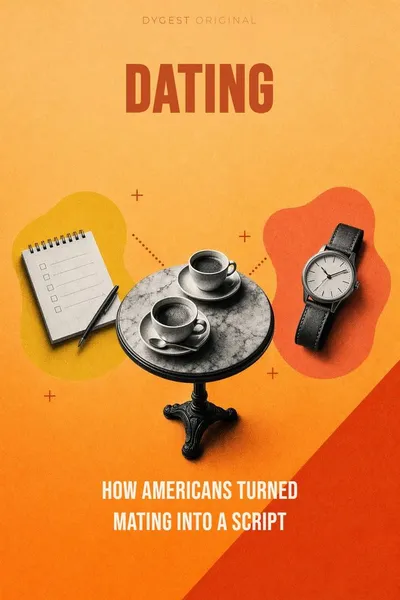
Dating
How Americans turned mating into a script
Description
The word dating, in the sense of two people meeting privately to evaluate each other as potential romantic partners, barely existed before the twentieth century. For most of history, courtship happened at home, supervised by families, and was oriented toward marriage from the start. The modern practice of two relative strangers going out together, spending a few hours alone in public or semi-public venues, deciding whether they want to see each other again, and sustaining this cycle across multiple partners before eventually selecting one — this is a specific cultural invention, mostly American in origin, that emerged between roughly 1900 and 1930 and has since been exported around the world.
The invention required specific conditions: the automobile, the public restaurant, the movie theater, the rise of youth culture, the migration of young adults from family farms to urban areas where parental supervision was impractical. These conditions created both the spaces where dating could happen and the need for it — young people increasingly had to find partners outside the pool their families would have selected from, and needed a social technology for evaluating candidates independently. The technology they developed, largely by accident, became the dating script that has dominated romantic selection for a century.
The script has evolved substantially over the past hundred years. Going steady, pinning, dating around, seeing each other, situationships, exclusive dating — the vocabulary has changed as the expectations have. What has not changed is the basic structure: individuals rather than families make the selection, the selection happens through repeated private meetings rather than formal introductions, and the process is supposed to produce compatibility assessments that lead either to commitment or to moving on. Understanding how this script emerged, what it was designed to solve, and why its current version is producing so much difficulty is one of the more useful lenses on contemporary romantic life.
● The question we're asking: where did dating as we know it come from, and why does the contemporary version feel so difficult?
● What we'll see: the origins, the twentieth-century evolution, the current script, and the specific strain it now produces.
Table of contents
01The origins
Before dating, there was calling. In nineteenth-century America, respectable courtship happened when a young man called on a young woman at her family's home, with her mother or another chaperone present. The suitor's intentions were understood to be marriage from the outset. Serial visits by the same man signaled seriousness. The practice was structured, supervised, and explicitly oriented toward matrimony. It was not dating because the individuals were not alone together in public, and the selection was collaborative between family and young adults rather than primarily individual.
The shift to dating began in the early twentieth century, driven by urbanization and economic change. Young men and women migrating to cities for work were no longer under parental supervision. They met in workplaces, social clubs, and public entertainment venues. The calling system, which required a family home and a family's approval, broke down when the relevant young adults did not have family homes nearby and did not need family approval for their decisions. Something had to replace it. What emerged was the date — a private meeting in public, arranged between the two participants, paid for by the man, centered on entertainment rather than conversation.

02The twentieth-century evolution
The rating and dating complex of the 1920s-30s described a specific college-era pattern where young adults, mostly women, were evaluated by how many different men competed for their attention. Popularity, not progress toward marriage, was the metric. A woman who had many different dates with different partners was more desirable than one who was tied to one partner. The pattern emphasized variety, visibility, and social competition over the stable progression toward marriage that calling had implied. The pattern worked as a specific form of courtship in that it eventually produced marriages, but it worked by a different logic than the systems it replaced.
Going steady emerged as a new norm after World War II, reflecting the shorter window young adults had for selecting partners and the specific post-war conditions (GI Bill, housing, economic expansion) that encouraged earlier marriage. A couple went steady by declaring exclusive dating — she wore his pin or class ring, they were known as a unit, they went to events together. The practice made serial short-term dating less common and created the specific arc of teen romance that dominated the 1950s. The age of first marriage was historically low in this period, and going steady was the cultural script that produced it.
03The current script
The contemporary dating script in the US and similar cultures has specific recognizable features. It begins with matching, typically through apps, though occasionally through traditional means. First dates are lower-stakes, shorter, and often daytime (coffee, drinks) than the multi-hour dinners of previous generations. The decision to continue is mutual and explicit in a way it was not in earlier eras. Subsequent dates establish interest progressively, often following specific patterns (exclusivity conversation, defining-the-relationship conversation, meeting friends, meeting family) that have become nearly universal. The script gives each phase a name and a set of expectations, which provides structure but also rigidity.
The situationship — a relatively new term — describes a relationship with romantic and sexual elements but without traditional commitments. The partners are close enough to be each other's primary connection but have not defined the relationship in ways that would create explicit obligations. Situationships are common among young adults who want connection without commitment, are uncertain whether the other is worth it, or face specific obstacles. The term captures something real about modern dating, even as it produces difficulties when partners want different levels of definition.
04The current strain
The strain the current script produces is substantial. Individuals bear the full cognitive and emotional load of selecting partners from essentially infinite candidate pools. The traditional sources of candidate filtering — family, community, church, workplace, proximity — have weakened, leaving the apps and the person's own filters as the primary selection mechanism. The filters individuals use are often inaccurate predictors of long-term compatibility (attraction, chemistry, first-date impressions), which means the selection process has to iterate many times before producing a match that actually works. Each iteration has specific emotional costs that accumulate over years of dating.
The specific phenomenon of the ghosting economy — where participants disengage without explanation rather than formally ending interactions — is a feature of app-enabled dating that previous generations did not have to navigate. Ghosting is easier than rejection because it does not require the specific emotional work of explaining oneself, and because the volume of candidates makes each individual disengagement feel less consequential. The receiver of the ghosting experiences it differently, as a specific form of emotional injury that ambiguous disengagement produces. The accumulation of these experiences shapes how participants approach subsequent dating, often toward more protective and less trusting patterns.
05Conclusion
Dating as a practice is barely a century old, is specifically American in origin, and has been reinvented multiple times as social conditions changed. The current script — app-based matching, low-stakes early dates, progressive commitment stages, extended duration — is the latest version, shaped by technology, delayed marriage, women's economic independence, and the specific cultural expectations modern relationships carry. It provides real flexibility that earlier scripts did not, and imposes real costs that earlier scripts did not have. Whether the current balance is worth the costs is a question each participant has to answer based on their specific experience.
Related books