Dams
The infrastructure now being removed
Description
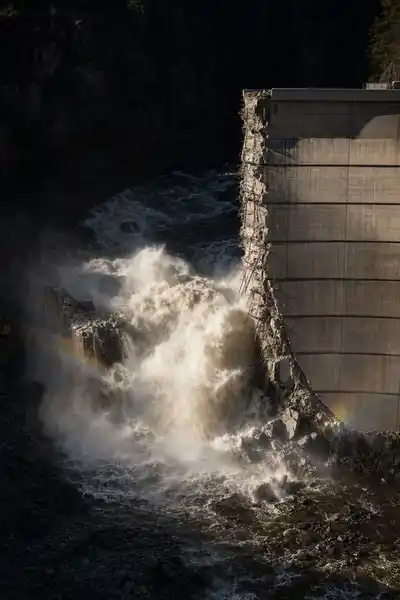
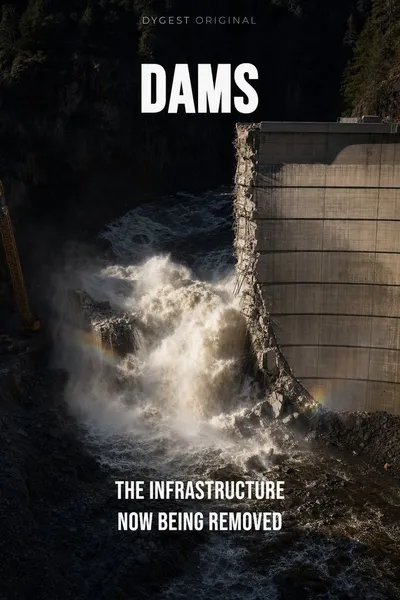
On 28 August 2024, a controlled blast at the base of the Iron Gate Dam on the Klamath River sent a brown wall of accumulated sediment downstream toward the Pacific. Iron Gate had been holding the river back since 1962. Two months earlier, the larger J.C. Boyle, Copco 1 and Copco 2 dams upstream had been similarly breached. By October, salmon were swimming through stretches of river that had been impassable for over a hundred years. The Klamath removal — four dams, 64 metres of accumulated dam height, $500 million in costs, three decades of negotiation — was the largest dam removal in United States history.
The Klamath story is striking partly because of its scale and partly because of what it represents. The Yurok and Karuk Tribes, whose cultures are tied to the salmon the dams had blocked, had been arguing for removal for decades. Their alliance with conservation groups, fishing communities, and eventually PacifiCorp produced an agreement that took fifteen years from signing to physical completion.
The dams of the twentieth century were not built to be removed. They were built as monuments to what engineering could accomplish — controlling floods, generating power, irrigating arid land, supplying water to growing cities. The Hoover Dam, the Tennessee Valley Authority, the Three Gorges Dam, the Aswan High Dam — these were among the largest infrastructure projects in human history. What has changed is the calculation about whether each particular dam continues to be worth its accumulating costs. The Klamath answer was that four specific dams were not. This is the story of what dams did, what they cost, and what comes after.
The question we're asking: what did the twentieth-century dam-building era accomplish, and what is the calculus that has produced the recent removals?
What we'll see: the boom, the costs that arrived later, the Klamath, and the larger question of what to keep.
Table of contents
01The boom
Large dam construction accelerated globally after the First World War and especially after the Second. By 1950, the world had roughly 5,000 large dams, defined as those over 15 metres tall. By 2000, the number was approximately 45,000. The largest concentration was in China, which built more than half of all large dams ever constructed. The United States, India, Brazil, and the Soviet Union were the other major builders. The basic logic was similar everywhere: rivers were resources, and dams were the technology to convert that resource into agricultural production, industrial power, and protection from floods.
In the United States, the dam-building era was organized around two federal agencies. The Bureau of Reclamation, founded in 1902, built dams in the western states to support irrigation. The Army Corps of Engineers built dams across the country for flood control and navigation. The Tennessee Valley Authority brought hydropower and economic development to the Appalachian South. By the 1960s, these agencies had built more than 80,000 dams across American watersheds. The Hoover Dam, completed in 1936, was the most famous.

02The costs that arrived later
By the late twentieth century, the cumulative ecological damage from large dams had become impossible to ignore. Rivers below dams typically experience reduced sediment loads, altered temperature regimes, simplified channel structure, and the loss of seasonal flow variability that many native species depend on. The Colorado River below the Glen Canyon Dam ran about 4 degrees Celsius cooler than it had historically because the reservoir released cold water from depth, eliminating habitat for several native fish species. Salmon populations on the Pacific coast collapsed because dams blocked migration routes and altered the river conditions the fish needed.
The economic case for many older dams also weakened. Hydropower remained valuable, but the marginal cost of generation from new sources natural gas, then wind, then solar fell steadily. Reservoirs were oversold in their original water rights, leading to chronic shortages. Sedimentation gradually filled reservoirs, reducing storage capacity. Maintenance costs rose as concrete aged. Some structures became liability problems the Oroville Dam spillway crisis in 2017, which forced the evacuation of 200,000 Californians, illustrated what could happen when ageing infrastructure met unusual storm flows.
03The Klamath in detail
The Klamath runs from southern Oregon through northern California into the Pacific. Before the dams, it was the third-largest salmon river on the American West Coast, with an estimated 1 million Chinook returning each year. The river also supported coho salmon, steelhead, lamprey, and species important to the Yurok, Karuk, Hoopa Valley, and other tribes. The salmon runs were not just food. They were central to the ceremonial calendar, the kinship structure, and the identity of these communities.
Construction of the four dams between 1918 and 1962 cut the river in half from a salmon perspective. The fish could no longer reach their upper-basin spawning grounds. The 2002 fish kill, in which 30,000 to 70,000 adult salmon died in the lower river from disease outbreaks linked to low flows and warm water, became a galvanizing event. The tribes had been pushing for change for decades, but the kill made the consequences impossible to ignore. Negotiations among the tribes, PacifiCorp, the states of Oregon and California, the federal government, and conservation groups began in earnest in the early 2000s.
04What to keep
The Klamath removal does not herald the end of dams. The world still has roughly 60,000 large dams in operation. China continues to build new ones. Brazil is constructing the Belo Monte complex on the Xingu River. Hydropower remains a significant share of global electricity generation. The question is not whether dams in general are worth keeping but which specific dams in which contexts continue to be worth their costs. That is a question with thousands of separate answers, depending on local hydrology, current demands, the condition of the structure, and the value of what the dam blocks.
The dams most likely to be removed share several features. They are old, often built before 1960, with maintenance costs rising. They have marginal current uses — small hydroelectric output that could be replaced by other generation, recreational lakes that could be replaced by other recreation, irrigation rights that have been oversold. They block significant ecological values, particularly migratory fish, that would recover if passage were restored. They have local constituencies — tribes, fishing communities, conservation groups — willing to invest the years required to negotiate removal.
05Conclusion
The Klamath removal is a small event measured against the global stock of dams. It is also significant measured against what was thought possible thirty years ago. Four large dams have been physically removed from a major American river, the salmon are returning, and the communities that argued for the removal have lived to see it accomplished. The institutional, financial, legal and engineering work required illustrates how much effort is involved in undoing infrastructure that took years to build.
Related books