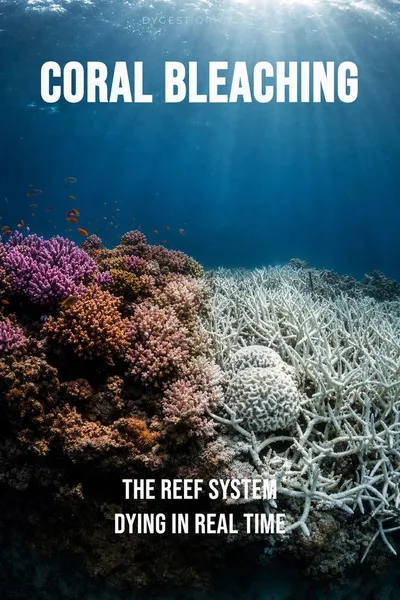
Coral bleaching
The reef system dying in real time
Description
In March 2016, marine biologist Terry Hughes flew over the northern Great Barrier Reef, looking down at hundreds of kilometres of coral that had turned bone-white. Hughes had been studying reefs for thirty years. None of his previous surveys had prepared him for this. The bleaching was severe, continuous, extending for hundreds of kilometres. Over the following months, his team documented that roughly two-thirds of the corals in the northern third of the reef had died. The footage from those flights went around the world. Hughes himself admitted he had cried.
The 2016 Great Barrier Reef bleaching event was not the first. Mass bleaching, in which large areas of coral expel the symbiotic algae they depend on and turn pale, had been documented since 1979. The first global bleaching event occurred in 1998. What was different about 2016 was the scale, the severity, and what came next. The reef bleached again in 2017, then in 2020, 2022, and 2024. The intervals shrunk. Reefs that had recovered in five to ten years from earlier bleaching now had no time to recover before the next event hit.
Coral reefs are among the most biodiverse ecosystems on the planet, supporting roughly a quarter of all marine species in less than one percent of the ocean. They protect coastlines from storms, sustain fisheries that feed hundreds of millions of people, and underpin tourism economies in dozens of countries. Bleaching is the visible part of a slower transformation taking place across tropical seas. This is the story of what bleaching is, what we know about it, and what it does and does not predict.
The question we're asking: what is happening on coral reefs, and what does the data tell us about what comes next?
What we'll see: the chemistry of bleaching, the global events, the difference between bleaching and death, and the reefs that remain.
Table of contents
01A relationship under stress
Coral reefs are built by tiny animals called polyps that secrete calcium carbonate skeletons over thousands of years. The living coral tissue covering a healthy reef is only a few millimetres thick, but the polyps host single-celled algae called zooxanthellae inside their cells. The algae photosynthesize and provide the coral with most of its food. The coral provides the algae with shelter and the nitrogen waste they need. This symbiosis allows reefs to thrive in nutrient-poor tropical seas. It is also what makes them vulnerable.
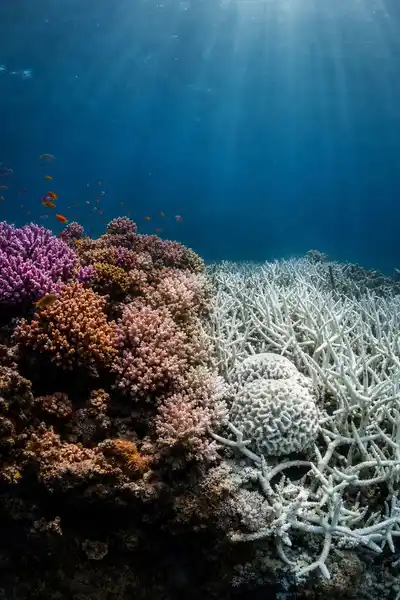
When the water becomes too warm usually one to two degrees above the long-term summer maximum, sustained for several weeks the symbiosis breaks down. The coral expels the zooxanthellae, which give the tissue its colour, leaving the white skeleton showing through. This is bleaching. Bleached coral is not dead. The polyps are still alive, but without their algae they cannot feed properly. If the heat stress passes within a few weeks, the coral can take up new zooxanthellae and recover. If the stress continues, the coral starves.

02The Hughes years
Terry Hughes is a British-born marine ecologist who has been at James Cook University in Townsville since 1990. He runs the ARC Centre of Excellence for Coral Reef Studies. The 2016 aerial surveys were a coordinated response by his team and the Australian Institute of Marine Science. The data became the basis for a series of papers that fundamentally shifted scientific understanding of what bleaching does.
The first major paper, published in Nature in 2017, documented that the 2016 bleaching had been driven by ocean temperatures elevated by ongoing climate change rather than just El Niño variability. The geographic pattern matched satellite heat stress with high precision. The paper also reported that local management — water quality, fishing pressure, reef protection — made very little difference to the bleaching response. Reefs in well-managed protected areas bleached at the same rates as unprotected ones if they experienced the same heat. This was hard for reef conservation, which had focused on local management.
03Bleaching is not death
The most important thing to understand about coral bleaching is the distinction between bleaching and mortality. A reef that has bleached can recover. A reef that has died cannot. Early news coverage often blurred this, treating bleached corals as already dead. Mortality after bleaching depends on heat dose, species, prior history, and recovery conditions. After 2016, the northern Great Barrier Reef lost roughly 50% of its hard coral cover, but the central and southern sections recovered substantially within five years. By 2022 the system had partially recovered in some areas and continued declining in others.
The reefs that have done worst are those exposed to repeated heat stress without time to recover. The fastest-growing coral species can return to pre-bleaching cover within five to ten years if conditions remain stable. The slower-growing massive corals — Porites and similar genera that form the structural backbone of reefs — take decades to centuries to rebuild lost biomass. When bleaching events occur every two to three years, the structural species cannot keep up. The reef stays alive but loses its three-dimensional complexity, which is what fish and invertebrates depend on.
04What remains
Reefs are not uniformly distributed. Some regions have warmed faster, and some have features that may make them more resilient. The reefs of the Coral Triangle Indonesia, the Philippines, Papua New Guinea and the Solomon Islands are the most biodiverse on the planet and have so far experienced less severe bleaching than the Great Barrier Reef. Some Pacific reefs in cold-water upwellings have shown unexpected resilience. Red Sea reefs, which experience some of the warmest baseline temperatures of any reef system, appear to harbour corals that may be naturally adapted to the temperatures the rest of the world is approaching.
Mesophotic reefs, at depths between 30 and 150 metres, sit below the thermocline and are buffered from the worst surface heating. Some scientists have proposed they may serve as refugia. The hypothesis is partial. Mesophotic reefs have different species compositions, different light environments, different ecological dynamics. They are not simply backup copies of the shallow systems. They may preserve some species through warming events, but the shallow reefs cannot be reconstructed from the deeper communities alone.
05Conclusion
Coral reefs are one of the few ecosystems where the planetary changes underway are visible in real time, on the scale of years. The bleaching events of 2016, 2017, 2020, 2022 and 2024 form a sequence happening in front of an unusually well-instrumented scientific community. We have aerial photography, satellite records, decades of baseline data, and researchers like Terry Hughes who have been documenting the system since before the worst of it began. The result is a high-resolution record of a major ecosystem being transformed.
Related books