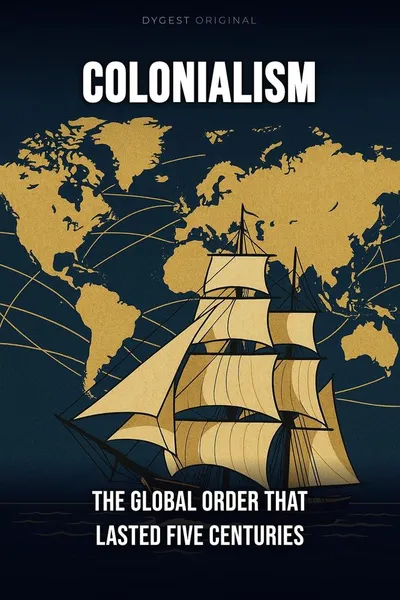
Colonialism
The global order that lasted five centuries
Description
For roughly five hundred years, from Columbus's first landing in 1492 to the British handover of Hong Kong in 1997, a handful of European powers ruled most of the world outside Europe. At the peak, around 1914, the European empires and their American successor controlled or exercised decisive influence over roughly eighty-five percent of the world's land surface and most of its population. The British Empire alone was the largest political entity in human history. This fact is so routinized that its strangeness is easy to miss. For most of recorded history before 1500, no civilization was in a position to rule most of the rest. For about five centuries, one set of civilizations was. Then, for reasons still partly contested, the arrangement ended.
Its effects on the contemporary world are still visible everywhere. The borders of most non-European states were drawn by European administrators. The official languages of much of the world are European. The legal systems, educational institutions, and government structures of the former colonies are largely European inheritances. The economic patterns of specialization and resource extraction that the colonial period established have taken generations to unwind and in many cases have not been unwound. Whatever else the contemporary global order is, it is substantially a product of five centuries of European expansion.
The moral evaluation of colonialism has been argued intensely for decades. The harder question, which the political argument often obscures, is what colonialism actually was — a coherent project with identifiable logic, or a chaotic accumulation of different kinds of expansion. Both answers have truth. The enterprise that took the Spanish to Mexico, the Portuguese to Brazil, the Dutch to Indonesia, the French to West Africa, and the British almost everywhere was not one thing. It was also not nothing. The structures it produced shape the world we have inherited, and the effects cannot be undone by being morally evaluated.
● The question we're asking: what was European colonialism, how did it shape the world, and what did it leave behind?
● What we'll see: the phases of expansion, the economic and political logic, the costs for the colonized, and the ongoing legacy.
Table of contents
01The phases of expension
The first wave, roughly 1492 to 1650, was Iberian. Spanish and Portuguese expeditions, driven by missionary zeal, royal ambition, and the search for precious metals, established presences in the Americas, coastal Africa, and parts of South and Southeast Asia. The Spanish conquest of the Aztec and Inca empires between 1519 and 1533 was demographically catastrophic — the indigenous population of the Americas collapsed by perhaps ninety percent over the following century, largely from Eurasian diseases. The Portuguese trade network along the African and Asian coasts established the pattern of European coastal trading posts later powers would extend.
The second wave, roughly 1650 to 1800, was Dutch, English, and French, and more commercial. The great chartered companies — Dutch East India in 1602, English East India in 1600, French in 1664 — were private enterprises with quasi-sovereign powers authorized to conduct trade, administer territory, and wage war on behalf of national interest. They built the infrastructure of European presence across much of Asia without much direct involvement from their home states. The slave trade, which would transport roughly twelve and a half million Africans to the Americas, was one of the principal commercial activities of the period.

02The economic and political logic
The economic logic shifted over five centuries but retained common features. The early period was driven by the search for precious metals and spices, the commercial logic of high-value low-volume trade. The middle period added plantation economies — Caribbean, Brazilian, and later American Southern sugar, tobacco, cotton, and coffee — using forced labor, primarily enslaved Africans. The late period added extraction of industrial raw materials — rubber, cotton, copper, oil — for the factories of metropolitan Europe, and captive markets for manufactured goods. Each phase structured the colonized economies around the needs of the imperial metropole rather than the colonial population.
The political logic was intertwined with the economic but not reducible to it. Imperial expansion served the domestic political interests of the European states and served ideological purposes historians have only recently begun to take seriously. The civilizing mission, as French and British administrators called it, was not simply cynical packaging. Many colonial officials and missionaries genuinely believed they were engaged in civilizational uplift, and this belief shaped the institutions they built — schools, hospitals, legal systems. That the project caused enormous harm despite sincere intentions is one of the harder moral questions the colonial period raises.
03The costs for the colonized
The demographic costs were enormous and uneven. The Americas suffered the largest catastrophe — a population collapse of roughly eighty to ninety percent over the first century of contact, caused primarily by Eurasian diseases. Smallpox, measles, and influenza killed tens of millions in waves that often preceded direct European contact. The slave trade killed perhaps two million Africans in transit and removed twelve and a half million from their home societies, with cascading effects that took centuries to process. The direct violence of conquest and administration killed additional millions over the five-century span, with the twentieth-century German, Belgian, and French colonial regimes among the most lethal.
The economic costs took several forms. The most direct was resource extraction — the silver of Potosí, the gold of South Africa, the rubber of the Congo, the oil of Iraq and Iran — that flowed to the metropoles and built European prosperity. The structural cost was the organization of colonial economies around primary-product exports to metropolitan markets, producing a specialization pattern hard to escape after independence. Many former colonies remain, seventy years after decolonization, primary-product exporters shaped by the positions they occupied in the colonial division of labor. Whether this is evidence of a durable colonial trap or of postcolonial states not yet building capacity to escape it is contested.
04The ongoing legacy
The economic legacy is most visible in the persistent gap between the former imperial core and the former colonized periphery. The wealthiest countries are, with exceptions, former imperial powers and their settler offshoots. The poorest are, with exceptions, former colonies, particularly in Africa. Whether this gap is best explained as direct colonial inheritance, a consequence of postcolonial policy choices, or a complex interaction is one of the major debates in development economics. The answer is probably some combination. The debate has not been settled.
The political legacy is visible in the institutional design of most postcolonial states. The state apparatus, legal system, military organization, educational curriculum, and administrative language were inherited from colonial administrations and have proved remarkably durable. Independence produced a transition from colonial rule to national rule using the colonial state's institutions, with the colonial boundaries intact. This is not necessarily a bad outcome — functioning institutions are better than the alternatives — but it means the colonial period is, in some ways, still structurally present.
05Conclusion
Colonialism still matters because the contemporary international order is substantially a product of it. The global distribution of wealth and power, the borders and institutional structures of most non-European states, the cultural and linguistic patterns of global communication — all were produced, in large part, by five centuries of European expansion. Understanding the contemporary world without understanding its colonial history is like understanding a landscape without understanding its geology. The structures are visible. The processes that produced them are not, unless one looks.
Related books