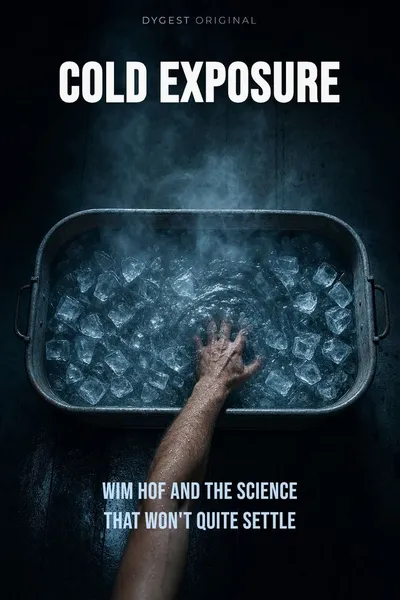
Cold exposure
Wim Hof and the science that won't quite settle
Description
On a winter day in 2011, a Dutch man named Wim Hof walked into a laboratory at Radboud University Medical Center in Nijmegen and was injected with a small dose of E. coli endotoxin. The compound, lipopolysaccharide, reliably produces flu-like symptoms in healthy volunteers and was being used as a controlled inflammatory challenge. Hof had told the researchers he could control his immune response through breathing exercises and meditation. The infectious disease physician Peter Pickkers, who led the lab, was skeptical but agreed to the test. Hof's inflammatory response, measured by TNF-alpha, IL-6, and IL-10, was substantially blunted. A 2014 randomized follow-up with twelve volunteers trained in Hof's protocol showed similar attenuation.
The studies launched Hof — already known as the Iceman for his record-setting cold exposure feats — into a different orbit. He had been a curiosity to that point, a man who climbed Mount Kilimanjaro in shorts and ran a half-marathon barefoot above the Arctic Circle. After Radboud, he was something more: a person whose protocol had produced a measurable physiological effect in a peer-reviewed study. The Wim Hof Method — breathing exercises, cold exposure, meditation — became a global wellness phenomenon. Millions of people now take cold showers each morning attempting to access whatever effects Hof and his trainees had demonstrated.
What the science actually says is more complicated than either the wellness narrative or the skeptical dismissal suggests. Some effects associated with cold exposure replicate cleanly in independent studies. Others do not. The Hof protocol combines several distinct interventions, and disentangling which component is doing what has proved harder than the popular framing implies. The protocol delivers on some claims and falls short on others. The arc of cold exposure research is a useful study in how a single charismatic practitioner can drive scientific attention to a topic the field then struggles to settle.
The question we're asking: what does cold exposure research actually show, and how should we read the gap between Wim Hof's results and replicated science?
What we'll see: the Radboud study, the breathing-vs-cold question, what replicates, and what the wellness adoption gets right and wrong.
Table of contents
01The endotoxin study
The Radboud trial began as a single-subject demonstration. In December 2011, Hof underwent the standard endotoxin challenge while practicing his breathing protocol. His core temperature, heart rate, and inflammatory cytokines were measured throughout. The published case report described an attenuated inflammatory response, lower symptom severity, and rapid resolution — outcomes that, if real, suggested the protocol could modulate innate immune function in ways the researchers had not previously thought possible.
The case report, published in 2012, was a scientific oddity. Single-subject studies generally do not change consensus. The Radboud team's response was to design a randomized controlled trial. They recruited 24 healthy male volunteers, randomized half to a 10-day Hof training protocol and half to a control condition, and ran the same endotoxin challenge on all of them. The results, published in PNAS in 2014, showed the trained group had substantially reduced inflammatory response lower TNF-alpha, IL-6, and IL-8 and reported fewer flu-like symptoms.

02What cold exposure does
The physiological effects of cold exposure have been studied for decades, separately from the Hof framing. Acute cold exposure immersion in cold water, ice baths, or cold showers produces a stereotyped response: vasoconstriction of peripheral vessels, increased heart rate, elevated catecholamines, and a measurable rise in metabolic rate as the body works to maintain core temperature. The metabolic rise involves activation of brown adipose tissue, a specialized form of fat that generates heat through uncoupled mitochondrial respiration. Brown fat was thought to be functionally absent in adults until imaging studies in the 2000s confirmed its presence and metabolic activity in cold-exposed humans.
The brown fat finding generated scientific interest because it suggested a mechanism by which cold exposure could improve metabolic health. Activated brown fat consumes glucose and lipids to produce heat, which could improve insulin sensitivity and reduce ectopic fat accumulation. Several studies have shown improved insulin sensitivity in subjects undergoing repeated cold exposure protocols, with effects most pronounced in subjects with pre-existing metabolic dysfunction. The magnitude is modest meaningful in research but not transformative.
03What replicates and what does not
The components of the Hof protocol that have replicated cleanly in independent studies are the easier ones to explain biochemically. The acute catecholamine and cortisol response to the breathing exercises is reliable and large in magnitude — comparable to what one would see in moderate stress. The brown fat activation in cold exposure replicates well across studies. The improvement in metabolic markers with chronic cold exposure replicates, with the modest effect size mentioned above. The reduction in inflammatory response under endotoxin challenge has not been replicated outside the Radboud lab, but the original studies have not been overturned.
Other claims associated with the broader cold exposure movement have replicated less cleanly. The claim that cold exposure improves mood beyond a transient adrenaline-driven effect has limited supporting evidence. Claims about immune system strengthening beyond the specific endotoxin context are not well supported by trials. Claims about cognitive enhancement, longevity benefits, or specific disease prevention have not been demonstrated in randomized trials of cold exposure protocols. The popular framing has often outpaced the evidence.
04From experiment to practice
The Wim Hof phenomenon is interesting partly because of its sociology. Hof blends scientific framing with mystical claims, has trained tens of thousands of practitioners through a certification program, and has been the subject of multiple documentaries. His commercial operation runs alongside his scientific collaborations. The combination has made him an unusual case study in how a single individual can drive a research program forward by serving as a willing experimental subject and recruiting others to his protocol.
The wellness uptake has been broader than Hof himself. Cold plunge tubs are now standard equipment in high-end gyms. Andrew Huberman's podcast and similar science-adjacent media have promoted cold exposure protocols to large audiences. Cold therapy has become part of the recovery and longevity industry. The branding tends to emphasize the strongest claims and most dramatic visuals over the more modest evidence base. The result is a practice that some researchers consider promising and others consider overhyped, with both views supportable from the same literature.
05Conclusion
Wim Hof's 2011 walk into the Radboud laboratory produced a real scientific finding that has not been overturned and has not been cleanly replicated outside the original group. The interpretation of that finding what mechanism is responsible, how generalizable it is, how much of the protocol is doing the work remains contested. The brown fat and autonomic tone effects of cold exposure are well established. The broader claims about mood, immunity, and longevity are not. The honest position is that cold exposure is a measurable physiological intervention with some replicating effects, that the popular framing has outpaced the evidence, and that the field has not yet produced the kind of settled science that would justify the most enthusiastic recommendations.
Related books