Cognitive dissonance
Festinger and the cult that didn't end
Description
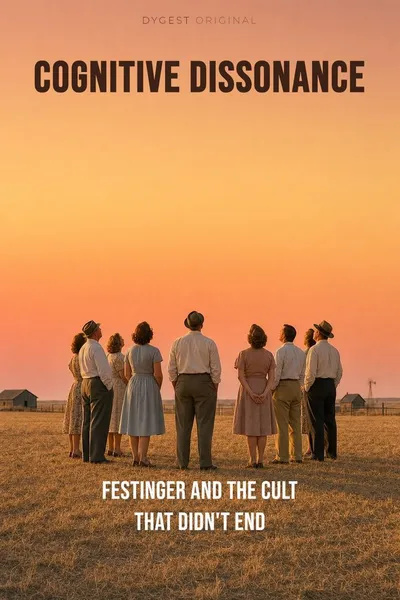
In late September 1954, a small notice in The Lake City Herald, a Chicago-area newspaper, caught the eye of a thirty-five-year-old social psychologist named Leon Festinger. A suburban housewife named Dorothy Martin had announced that the world would end on December 21 of that year. North America would be destroyed by a great flood, but a flying saucer from the planet Clarion would arrive in time to rescue the small group of believers gathered in her living room. The Herald played the story as light human interest. Festinger, who had been developing a theory about how people manage contradiction between belief and evidence, saw it as a clean experimental opportunity. He and two graduate students, Henry Riecken and Stanley Schachter, joined the group under cover, posing as fellow believers.
The Seekers, as Martin’s group called themselves, were a textbook case of what Festinger wanted to study. They had committed publicly and irreversibly to a prediction. They had quit jobs, given away possessions, and severed family ties on the strength of Martin’s automatic-writing transmissions from the Guardians of Clarion. December 21 came. The saucer did not arrive. The flood did not happen. The world remained intact. What Festinger expected was a quiet dissolution: the group would dissolve in embarrassment, drift away, and stop talking about flying saucers. What he observed was the opposite. Martin received a new message at 4:45 a.m. on December 21. The little group of believers, by the power of their faith, had spread so much light that God had decided to spare the planet. Within hours, the Seekers were calling reporters and proselytizing to anyone who would listen.
The book that emerged from the field study, When Prophecy Fails, appeared in 1956 and laid the foundation for what would become one of the most generative theories in social psychology. Festinger’s 1957 monograph A Theory of Cognitive Dissonance gave the framework its name. The idea was simple in outline: when belief and evidence collide, people change one or the other. When the belief is too costly to abandon, the perception of evidence shifts to accommodate it. The seventy years since have produced thousands of experimental studies refining and contesting the original claim. Cognitive dissonance, as theory and as observation, has held up better than almost any other explanatory framework in social psychology.
The question we’re asking: what did Festinger see in the Lake City living room, what did the laboratory work that followed actually establish, and how does the framework look after seventy years?
What we’ll see: the cult and the field study, the 1957 monograph, the key experiments, and what survives.
Table of contents
01A flying saucer, a Chicago suburb, and the long night of December 21
Dorothy Martin was a fifty-four-year-old housewife who had been receiving automatic-writing transmissions from a being she called Sananda. The messages described an impending cataclysm and the saucer that would rescue the chosen. Festinger, then at the University of Minnesota, had been working on a theory about dissonance reduction for several years. The Herald notice arrived as a piece of data. The team had three weeks to insinuate themselves into the group before the predicted apocalypse.
The infiltration was awkward. Riecken and Schachter posed as people who had also been receiving messages from the Guardians. The cover stories were rough and occasionally improvised; at one point one of the researchers had to manufacture a vision on the spot when a believer asked what Sananda had told him. The fieldwork raised serious ethical questions, which Festinger acknowledged later. The team had inflated the size of the group by their own presence and had been forced, at times, to perform belief in a way that may have reinforced it. The observations are also some of the most carefully documented field notes in the history of social psychology.

02The theory the field study turned into
The 1957 monograph A Theory of Cognitive Dissonance presented the framework in clean form. Festinger argued that when a person holds two cognitions — beliefs, attitudes, or perceptions of behavior — that are inconsistent, the inconsistency produces psychological discomfort unpleasant enough that the person is motivated to reduce it. There are three ways to do so: change one of the cognitions, add new cognitions that bridge them, or reduce the importance of the dissonance. The theory predicted that people, under pressure of inconsistency, would do whatever was easiest given the constraints.
The Seekers’ behavior fit the framework precisely. The cognition that the world would end on December 21 had been costly to hold. The cognition that the world had not ended on December 22 was incontrovertible. The cheapest path to consistency was not to abandon the belief, which would have required acknowledging that years of sacrifice had been wasted, but to reinterpret it: the prophecy had been correct, the prayers had worked, the flood had been averted by the very faith that had predicted it. The reinterpretation closed the inconsistency without forcing the believers to confront the cost of having been wrong.
03The seventy-year experimental program
The decades that followed produced what may be the most extensive research program in social psychology. The basic finding has been replicated across cultures, settings, and populations. The induced-compliance, free-choice, and effort-justification paradigms have all generated reliable data showing that people, under conditions of inconsistency, modify their attitudes to fit their behavior rather than the reverse.
The effort-justification studies have a special place in the literature. Elliot Aronson and Judson Mills, in 1959, showed that students who had to undergo an embarrassing initiation in order to join a discussion group later rated the group more positively than students who had joined without the initiation. The more the entry had cost them, the more valuable the group had to be to justify the cost. The pattern has been replicated in contexts ranging from fraternity hazing to military boot camps to religious conversion. The investment, once made, generates the belief that justifies it.
04What survives, and what is harder
Cognitive dissonance has had an unusual career: a theory that became a folk concept while remaining empirically alive. The popular usage has drifted from the original meaning. When a journalist describes a politician as suffering from cognitive dissonance, the usage tends to mean something like hypocrisy or contradiction, without the specific claim that the discomfort is producing observable attitude change. The technical sense, in the experimental literature, is narrower and more specific. The framework predicts behavior in specifiable conditions; it does not describe a general human tendency to be inconsistent.
The replication literature on dissonance, like the rest of social psychology, has had a difficult decade. The induced-compliance paradigm continues to produce effects, but the effect sizes are smaller in well-powered replications than in the original 1950s and 1960s studies. The free-choice paradigm has been criticized for confounds that may inflate apparent dissonance effects. The core finding survives; the specific quantitative claims of some classic studies have narrowed.
05Conclusion
Leon Festinger died in 1989, having largely turned away from social psychology in the last decades of his career toward archaeological and historical questions. He left a framework that has shaped how social psychologists think about attitude change, decision-making, and the management of belief under threat for two generations. The Seekers’ all-night vigil in 1954 turned out to be the founding scene of a research program that is still producing data seventy years later.
Related books