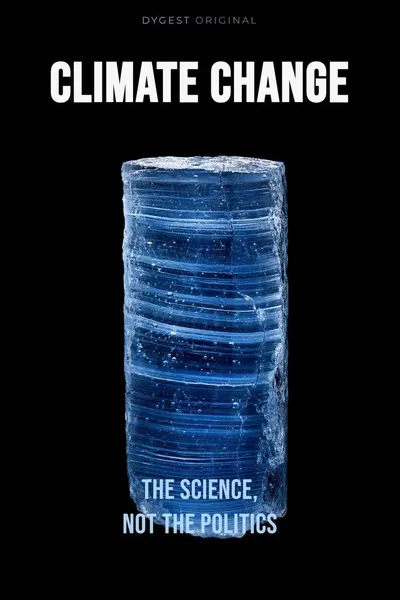
Climate change
The science, not the politics
Description
The physics of climate change has been understood since the nineteenth century. Joseph Fourier, in the 1820s, calculated that Earth should be much colder than it actually is, and proposed that the atmosphere must trap heat what we now call the greenhouse effect. John Tyndall, in the 1860s, measured which gases produced this effect in laboratory experiments. Svante Arrhenius, in 1896, calculated that doubling atmospheric carbon dioxide would raise Earth's temperature by several degrees. His math was remarkably close to current estimates. The basic science has been settled for more than a century. What has not been settled, and what produces the political argument, is what to do about it.
The confusion between the science and the politics has distorted public conversation for decades. The science itself that human activity, primarily burning fossil fuels, is warming the planet at a rate that will produce substantial consequences has been the working consensus of climate scientists for at least forty years and is not a matter of serious technical debate. The IPCC, which has been synthesizing the science for governments since 1988, has grown steadily more confident in its assessments across successive reports. The evidence base direct temperature measurements, ice cores showing historical atmospheric composition, satellite observations, ocean heat content, ecological shifts is overwhelming and mutually reinforcing across multiple independent lines of evidence.
What makes climate change unusually difficult as a policy problem is not scientific uncertainty but the specific structure of the problem. The costs of emissions are diffuse, delayed, and global; the benefits of avoiding them are abstract and accrue to future generations in other countries. The institutions required to coordinate action across nations, decades, and sectors do not really exist. Individual actions barely move aggregate outcomes. The politics of climate have therefore been bogged down for decades not because the science is unclear but because the collective action problem is genuinely hard. Understanding what the science actually shows, separate from the political argument about what to do, is the prerequisite to thinking clearly about both.
The question we're asking: what does the climate science actually show, and what does it mean for what comes next?
What we'll see: the mechanism, the evidence, the projections, and the policy challenge.
Table of contents
01 The mechanism
The greenhouse effect works because specific gases in the atmosphere absorb infrared radiation that Earth radiates back to space, re-emitting some of it downward and thus trapping heat. Water vapor is the strongest greenhouse gas in absolute terms, but its concentration is determined by temperature (more heat leads to more evaporation leads to more water vapor) rather than being directly under human control. Carbon dioxide is the most important gas that humans are adding, because it has a long atmospheric lifetime (centuries to millennia) and its concentration has risen directly with fossil fuel combustion. Methane, nitrous oxide, and various industrial gases contribute further. The specific physics of why these gases absorb infrared but not visible light is well-established and measurable in any physics lab.
Human emissions have increased atmospheric CO2 from roughly 280 parts per million in the preindustrial era to over 425 ppm in 2025 a 50% increase, higher than the atmosphere has seen in at least three million years based on ice core and other paleo-climate records. The rate of increase is also unusual; the atmosphere has not gained carbon this fast in any previous natural transition recorded in the paleo record. Methane concentrations have roughly tripled over the same period from their preindustrial baseline. These are not contested numbers; they are direct measurements from instruments that have been running for decades.

02 The evidence
Direct temperature measurements from thermometers dating back to the mid-nineteenth century show unambiguous warming. Land-based measurements, sea surface temperatures, and atmospheric satellite measurements all show the same pattern. Multiple independent research groups (NASA, NOAA, UK Met Office, Japan Meteorological Agency) have produced their own analyses and reached essentially the same conclusions. The warming is not uniform it has been faster over land than ocean, faster in the Arctic than the tropics, and faster in specific seasons but the aggregate picture is clear and has held up against decades of skeptical scrutiny.
Ice cores provide a crucial independent line of evidence. Bubbles of ancient atmosphere are trapped in Antarctic ice as it accumulates, allowing direct measurement of past CO2 concentrations going back hundreds of thousands of years. The records show tight coupling between CO2 and temperature across glacial cycles, consistent with the greenhouse theory. They also show that current CO2 levels are higher than any point in the ice core record, which spans roughly 800,000 years. Older records from other sources extend the comparison further back and confirm that current levels are unusual on very long timescales.
03 The projections
Climate models project future warming based on different assumptions about future emissions. The IPCC uses specific emissions scenarios labeled SSP1-1.9 (very low emissions), SSP2-4.5 (moderate emissions), SSP5-8.5 (very high emissions), and intermediate options. Under moderate emissions (roughly what current policies produce), the IPCC projects roughly 2.7°C of warming by 2100. Under aggressive emissions reduction, warming could be limited to 1.5-2°C. Under current trajectory with no new policies, warming could reach 3-4°C. These are not precise predictions but ranges that reflect model spread and emissions uncertainty.
The specific impacts of different warming levels are substantially different. At 1.5°C of warming (roughly the current level plus a modest further increase), impacts include increased heat waves, more intense precipitation events, shifted agricultural zones, and specific stress on coral reefs and Arctic ecosystems. At 2°C, these impacts intensify and some become more widespread — substantial sea level rise by mid-century, more frequent extreme weather, larger agricultural disruption. At 3°C, the impacts become substantially more severe widespread coral reef collapse, substantial human displacement, large agricultural losses in specific regions. The specific relationship between warming and impacts is not linear; the marginal harm of additional warming increases rather than staying constant.
04 The policy challenge
The fundamental policy challenge is that climate change is a collective action problem at global scale. No individual, company, or country can solve it alone; emissions reductions benefit everyone while costs fall on the actor making them. This produces classic free-rider problems. International agreements (Kyoto Protocol, Paris Agreement) have tried voluntary commitments, but enforcement is weak and the commitments are not collectively sufficient to meet stated temperature targets. The politics of binding cooperation on long-timescale shared problems remains essentially unsolved.
The economic aspects are complicated. Fossil fuels have been the cheapest form of energy throughout industrial history and are deeply embedded in transportation, electricity, heating, industry, and agriculture. Replacing them requires substantial investment with transition costs falling unevenly across sectors and income levels. Economists broadly agree carbon pricing taxes or cap-and-trade systems is the most efficient policy tool, but the political difficulty of raising energy costs has made it hard to implement at scales commensurate with the problem.
05 Conclusion
The science of climate change is settled in its basics. Human emissions are warming the planet at rates that will produce substantial consequences across this century, with specific impacts becoming more severe as warming increases. The mechanism is well-understood, the evidence is overwhelming and drawn from dozens of independent lines, and the projections span a range that depends primarily on future emissions decisions rather than scientific uncertainty. Understanding the science clearly, separate from the politics, is the prerequisite to thinking seriously about response.
Related books