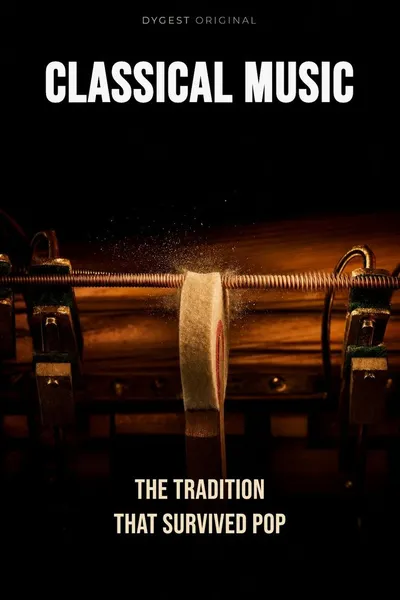
Classical music
The tradition that survived pop
Description
The phrase classical music covers about a thousand years of European notated music. That is too much for any description to capture. What the term usually means in practice is a more specific thing: the body of work running from roughly Bach in the early eighteenth century through about 1950, plus the institutional apparatus orchestras, conservatories, opera houses, concert halls that emerged alongside it and still performs it. That tradition is what concert programs mostly play.
Classical music has a strange position in contemporary culture. It is no longer the default sound of educated life, the way it was for most of the nineteenth century. The audience for live performance has aged and shrunk in absolute terms. Younger listeners arrive at it less often and through narrower channels. At the same time, the music is more accessible than at any previous moment. Recordings of every major piece are free or nearly free. Performances by world-class orchestras are streamed in full. The number of people who have access to the canon has never been larger, even if the number who actively engage with it has not.
What that adds up to is a tradition in a stable but reduced position. It has not died, despite a century of obituaries. It has not regained its old centrality either, and almost certainly will not. What it has done is settle into a niche that turns out to be more durable than the obituaries predicted. The reasons for that durability are worth thinking through, partly because they say something about how cultural traditions actually persist when they stop being mass culture.
The question we're asking: what classical music is, why it survived, and where it sits now.
What we'll see: the church and court, the concert hall, the modernist rupture, and the present niche.
Table of contents
01From church to court
The European music tradition that became what we now call classical began as functional music for two institutions: the Catholic Church and the courts of the European nobility. Composers were employees. Bach spent most of his working life as a Lutheran church musician in Leipzig, producing cantatas for weekly services on a schedule that left little room for posterity. Haydn worked for thirty years for the Esterházy family, supplying symphonies, operas, and chamber music for whatever the household required. The figure of the composer as independent artistic genius is largely a nineteenth-century invention. For most of the tradition's history, composers wrote for specific occasions and specific patrons.
The technical scaffolding the tradition built up over those centuries was substantial. The system of major and minor keys, with the logic of harmonic motion and resolution that runs through most Western tonal music, was settled by the early eighteenth century and is still the harmonic grammar most listeners hear without thinking. The basic instrumental ensembles string quartet, symphony orchestra, the keyboard plus voice or instrument combinations were standardised around the same period. Notation became precise enough that a piece could be performed centuries later by musicians who had never heard it. The infrastructure of the tradition was unusually durable.

02The concert hall
The public concert hall as we know it a building dedicated to instrumental music, with rows of seats facing a stage, a paying audience expected to listen in silence is largely a nineteenth-century construction. Earlier music had been heard in churches, palaces, opera houses, and various more casual settings. The dedicated concert hall created a new social practice. People bought tickets to sit still for ninety minutes and listen with attention to a piece of music as a self-contained aesthetic object. Several things had to be in place for that to make sense, and the nineteenth century put them there.
One was the canon. By around 1850, the idea that there were a small number of great composers from the past whose work deserved repeated performance Bach, Handel, Mozart, Beethoven, Schubert had taken hold. Concert programs started to look backward as well as forward. The tradition started to think of itself as a tradition. Music history became a subject taught at conservatories. The score of a Beethoven symphony was treated as a fixed text to be performed faithfully, not adapted or shortened. The classical canon, in roughly the form we still have it, dates from this period.
03The modernist rupture
The rupture came around 1908. Arnold Schoenberg, working in Vienna, took the chromatic harmony that late Romantic composers like Wagner and Mahler had been pushing toward its limit, and crossed the line into what he called the emancipation of the dissonance. The pieces he wrote from this period onward dispensed with the tonal centre that had organised European music for three hundred years. By 1923 he had developed the twelve-tone system, in which every piece was built from a fixed ordering of all twelve chromatic pitches, with no note privileged over any other. The classical tradition's harmonic foundation had been deliberately rebuilt.
Schoenberg's project produced extraordinary work the Variations for Orchestra, A Survivor from Warsaw, the unfinished opera Moses und Aron and was extended by his students Berg and Webern. It also produced a problem the tradition has not really solved. The audience that supported the late Romantic concert hall did not follow the music into atonality. It found the new work difficult, alienating, and often actively unpleasant to listen to. The composers and the institutional infrastructure agreed that this was the future of serious music. The audience did not. The gap that opened between the avant-garde and the listening public has not closed since.
04The present position
Classical music today occupies a position that is smaller than its nineteenth-century centrality but more stable than the obituaries have suggested. The major orchestras still play. The opera houses still produce. The conservatories still train musicians at a level the tradition has rarely seen, and the average technical standard of orchestral playing in 2025 is probably higher than at any earlier point. The audience is older, smaller, and more concentrated in cities than it used to be. The funding is mixed ticket sales, subscriptions, philanthropy, in some countries substantial state subsidy. The model is precarious in places but it has not collapsed.
Recording has changed the listener's relationship to the music more than any other factor. A nineteenth-century listener might hear a particular symphony three or four times in a lifetime. A contemporary listener can hear thirty different recordings of the same symphony in an afternoon. This is mostly a gain. It is also a different practice from the concert-going for which the repertoire was written. The intimate, repeated, headphones-based encounter with a recorded performance is what most engagement with classical music now actually is. The concert hall is the supplementary form, not the primary one.
05Conclusion
Classical music is in a position that no historical analogy quite fits. It has lost the centrality it had in the nineteenth century. It has not been replaced by a comparable tradition of large-scale notated music. It coexists with the popular music that took over its position, sometimes uneasily, often at a polite distance. It produces new work the concert audience does not entirely follow and performs old work it does. The mixture is unstable in detail but durable in shape.
Related books