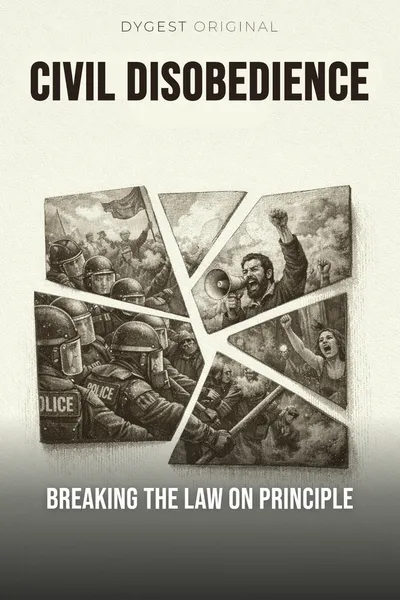
Civil Disobedience
Breaking the law on principle
Description
In July 1846, a thirty-year-old writer living in a cabin by a pond outside Concord, Massachusetts, walked into town to pick up a mended shoe and got arrested instead. Henry David Thoreau had refused, for six years, to pay a poll tax he owed the state. His objection was not to the amount. It was to what the money funded: a government that enforced slavery and was prosecuting a war against Mexico he considered naked aggression. The constable took him to the county jail. He spent a single night there before someone — probably his aunt — paid the tax over his objection, and he was released, annoyed to be let out.
That one night produced a lecture, and the lecture produced an essay that Thoreau first delivered in 1848 and published in 1849. It circulated quietly at first, then not quietly at all. The argument was simple and unsettling: when a law requires you to be an agent of injustice, you are obligated to break it, and to accept the consequences of breaking it. A man could not, Thoreau wrote, wash his hands of a wrong his taxes paid for. Conscience outranked the statute.
The idea did not stay in New England. It travelled to a lawyer in South Africa, to a preacher in Alabama, to a jail in Birmingham, to protest movements on every continent. It also acquired a set of rules nobody had written down in 1849 — because the moment large numbers of people started breaking laws on principle, a hard question arrived with them. Not every act of defiance is civil disobedience. Some of it is just crime, and some of it is revolution. Where exactly is the line?
The question we’re asking : When does breaking the law become a duty rather than a crime — and what keeps that duty from becoming a license?What we’ll see : How one night in jail became a doctrine, how it was turned into a mass strategy, and where the doctrine draws its own hard limits.
Table of contents
01Chapter 1 — A night in a Concord jail
Thoreau was not a natural organizer. He was a solitary, prickly man who preferred walking to meetings, and his tax refusal was not part of any campaign. It was an individual act of withdrawal. The state of Massachusetts levied a poll tax — a flat charge on adult men — and he simply stopped paying it, year after year, until the constable finally lost patience. The gesture was small, almost domestic. What made it matter was the reasoning he attached to it afterward.
The essay we now call Civil Disobedience did not use that title in his lifetime; it appeared as Resistance to Civil Government. Its core claim was that a citizen's first allegiance is to conscience, not to the machinery of the state. Government, Thoreau argued, is at best an expedient, and most of the time an inconvenient one. When it becomes the instrument of injustice — when it hunts the escaped and funds the invader — the honest response is not to petition politely and wait. It is to refuse participation, materially, now.

02Chapter 2 — The paradox that keeps the idea honest
There is something structurally strange at the heart of the idea, and Thoreau half-saw it. Civil disobedience is a form of lawbreaking that still takes law seriously. The person who runs a red light because they are late is breaking a law and hoping not to be caught. The person who sits at a segregated lunch counter is breaking a law and hoping, in a sense, to be caught — because the arrest is the argument. One treats the law as an obstacle. The other treats it as an audience.
That distinction does a lot of quiet work. It means the disobedient is not rejecting the very notion of law; they are appealing to a higher standard of law against a particular unjust one. When you accept the penalty, you signal that you respect the legal order enough to submit to it even as you defy one of its rules. You are not a bandit and you are not a rebel demanding the whole system fall. You are a citizen saying: this specific rule is illegitimate, and I will pay to say so.
03Chapter 3 — The strategy Gandhi and King built out of it
Thoreau's essay might have remained a curiosity of American letters if it had not reached the right readers. Mohandas Gandhi encountered it while working as a lawyer in South Africa in the early 1900s, during his campaigns against discriminatory registration laws. He later said Thoreau confirmed and named something he was already reaching for. But Gandhi did the thing Thoreau never attempted: he turned an individual gesture into a mass method. What had been one man declining to pay became tens of thousands refusing in unison — the salt march of 1930, the boycotts, the deliberate, disciplined filling of colonial prisons.
Gandhi added the element that Thoreau had left implicit: rigorous nonviolence, held even under beating. He called the practice satyagraha, roughly "holding firmly to truth," and drilled his followers to accept blows without returning them. The refusal to strike back was not only ethics; it was tactics. Violence lets the state answer on its strongest ground — force. Disciplined suffering forces the state to reveal its brutality against people who are visibly doing nothing but standing, sitting, marching.
04Chapter 4 — The line between breaking a law and breaking the law
Once civil disobedience became a recognized political tool, thinkers had to specify what actually qualified — because the label is powerful, and power attracts imitation. Almost everyone who breaks a law now reaches for the phrase. The philosophical tradition, from John Rawls onward, tried to draw the boundary, and the conditions it settled on are essentially a formalization of what Thoreau did by accident and Gandhi and King did on purpose.
The first condition is that the act be public and open. Secret lawbreaking is evasion; civil disobedience is a communication, so it must be visible. The second is nonviolence, or at least the deliberate avoidance of harm — because the appeal is to the community's sense of justice, and violence forfeits that appeal. The third is the acceptance of legal consequences, the willingness to be arrested and punished, which distinguishes the disobedient from the ordinary criminal and marks their continued fidelity to the legal order as a whole. The fourth is that it appeals to shared principles the wider public already professes — not a private grievance, but a claim that the community is violating its own stated values.
05Conclusion
Thoreau spent one night in a cell and thought he had made a private point about conscience. What he had actually done was sketch the terms of a practice that would be refined for the next century and a half: break the unjust law openly, refuse to answer force with force, and accept the penalty as the price of the claim. Gandhi scaled it, King moralized it into a doctrine, and philosophers eventually wrote down the rules that all three had honored in the flesh.
Related books