Cinema
The art form of the twentieth century
Description
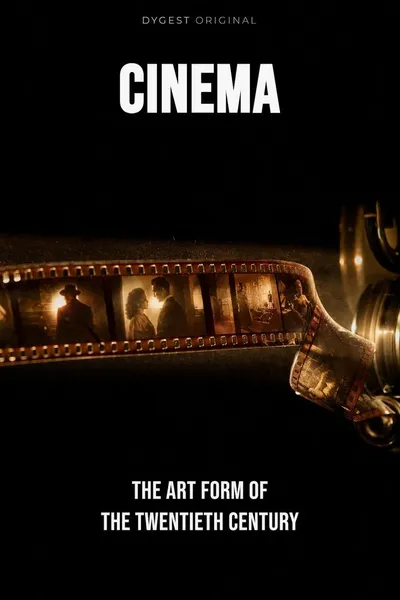
Cinema is the only major art form whose entire history fits inside the twentieth century. Painting, music, theatre, the novel — each had centuries of accumulated grammar before the modern era arrived. Cinema started in 1895, in a Paris cafe, with a few dozen seconds of factory workers leaving their shift, and within seventy years it had produced Citizen Kane, Tokyo Story, 8½, and 2001: A Space Odyssey. Few inventions have moved that quickly from novelty to mature art.
Part of what makes cinema strange is that it is also an industry, on a scale most arts never had to deal with. A film usually requires a crew of hundreds, equipment worth millions, and a distribution apparatus to reach an audience at all. The economics shaped the form. Hollywood became a machine that produced not only films but the categories we still use to talk about them genre, star, blockbuster, franchise. European cinema spent half a century defining itself against that machine while quietly depending on it.
We are now in a moment where the centrality of cinema to cultural life is no longer obvious. The thing called a movie still exists, but the conditions under which people watch it phones, laptops, fragmented attention, algorithmic feeds are not the conditions cinema was designed for. Whether what we have now is the same art form running in a different distribution channel, or a different art form that happens to share a name, is genuinely unclear. The question is worth taking seriously.
The question we're asking: how cinema became the central art of the twentieth century, and what's left of it now.
What we'll see: the early reel, the studio system, the European auteurs, and the fragmented present.
Table of contents
01The first reel
On 28 December 1895, the Lumière brothers projected a series of short films at the Salon Indien du Grand Café in Paris. The audience paid one franc to see workers leaving the Lumière factory, a baby being fed, and a train arriving at La Ciotat station. Each clip lasted under a minute. The films had no story, no editing, no camera movement — just a fixed frame onto a single piece of recorded reality. The novelty was that the images moved. That was the entire content. Within a year, Lumière operators were filming and projecting on every continent.
The shift from novelty to narrative happened quickly. Georges Méliès, a Paris stage magician, started building stories in front of his camera within months fantasies, trick films, the famous A Trip to the Moon in 1902. D.W. Griffith in the United States introduced the techniques of crosscutting, close-ups, and sustained narrative tension that became the basic grammar of feature filmmaking. By 1915, Griffith's The Birth of a Nation ran three hours, told a complex story across multiple locations, and demonstrated that film could do something theatre could not. That the film was also a piece of explicit racist propaganda is part of cinema's origin story too.

02The studio system
Hollywood between roughly 1930 and 1948 ran on a model that would now be recognised as industrial. Five major studios — MGM, Paramount, Warner Bros., RKO, and 20th Century Fox each owned production facilities, distribution networks, and the theatres where films played. They had stars under long-term contracts, directors as salaried employees, and writers' rooms turning out scripts on schedule. The studios produced roughly 400 features a year. Most were forgettable. A small fraction were great. The system was set up to make both.
The year 1939 is sometimes treated as the peak. Gone with the Wind, The Wizard of Oz, Stagecoach, Mr. Smith Goes to Washington, Wuthering Heights, Ninotchka all released the same year, all from major studios, all still watchable. The peak is partly real and partly an artefact of how memory selects from a large output, but it points to a fact about the studio system that is worth registering: a tightly run industrial process, with all its compromises and absurdities, produced an extraordinary amount of durable work in a short window.
03The European auteurs
While Hollywood was building its industrial model, European cinema was developing a different relationship to the form. The Italian neorealists Rossellini, De Sica, Visconti came out of the war making films on the streets of Rome with non-professional actors, available light, and stories about ordinary people that Hollywood would not have touched. Bicycle Thieves in 1948 has almost no plot, in the conventional sense, and is one of the films almost everyone who thinks seriously about cinema returns to. The neorealist influence on later filmmaking, from Iran to Senegal to the American independent scene, is hard to overstate.
The French New Wave in the late 1950s did something that, in retrospect, was decisive. A group of young critics who had been writing for Cahiers du Cinéma Truffaut, Godard, Rohmer, Chabrol, Rivette picked up cameras and started making films that broke the rules they had spent years analysing. Breathless in 1960, with its jump cuts and its handheld street shooting, looked nothing like a Hollywood film and very little like a French one either. The auteur theory, which the Cahiers writers had been developing for a decade, became the framework through which serious cinephiles read films for the next half-century.
04The fragmented present
The thing that has changed most about cinema in the last twenty years is not the films themselves but the conditions under which people watch them. The cinema as a building a dark room, a single screen, a few hundred strangers watching the same thing at the same time was central to the form for a hundred years. It is no longer central. Most films now are seen on televisions, laptops, and phones, often with the viewer doing something else at the same time. The economic consequences for theatrical exhibition have been severe. The aesthetic consequences are still being worked out.
The streaming era has produced a peculiar abundance. There has never been more video content available, and the platforms that distribute it have substantial budgets Netflix alone has spent more on original production in a year than the entire studio system did at its peak. Some of the work is genuinely good. The Coen brothers, Cuarón, Scorsese have all made major films for streaming services. But the relationship between platform and work is different. A film made for a streaming service is content in a queue, optimised for a recommendation algorithm, designed to retain attention against an infinite scroll. Whether that context is compatible with what cinema used to be is open.
05Conclusion
Cinema for most of the twentieth century combined the largest audiences with the most ambitious formal experiments. It was the medium where Bergman and the studio system, Tarkovsky and the popcorn matinee, the festival film and the genre picture, all coexisted and sometimes even spoke to each other. That coexistence is harder to find now. The audiences that used to share a film as a common reference are fragmented across platforms. The infrastructure that funded the middle of the industry has thinned out.
Related books