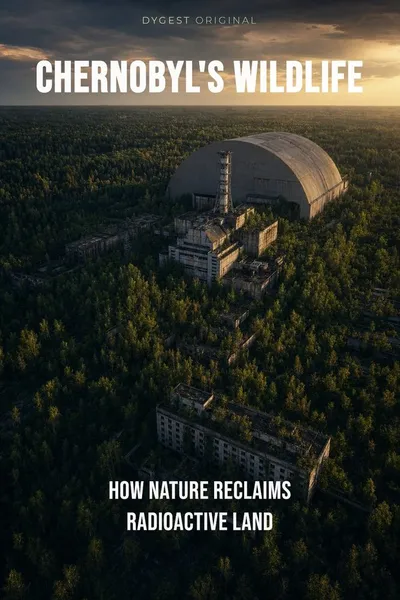
Chernobyl's wildlife
How nature reclaims radioactive land
Description
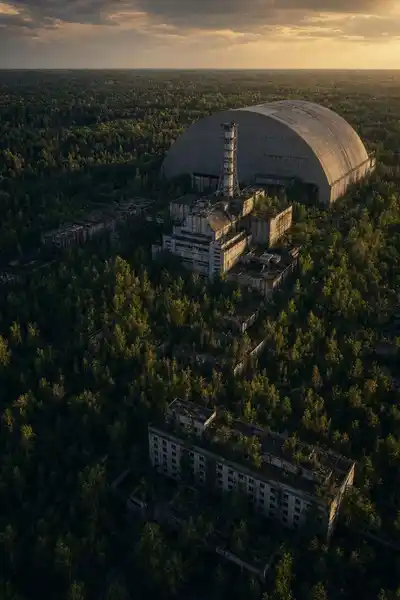
In April 2014, a Belarusian camera trap photographed a brown bear in the woods near the village of Babchin. Brown bears live in many parts of eastern Europe; what made the image striking was the location. Babchin is inside the Polesie State Radioecological Reserve, the Belarusian half of the Chernobyl Exclusion Zone, abandoned by humans after the April 1986 reactor explosion. Bears had not been documented in this part of Belarus in over a century. By the time the camera trap recorded one, the zone was already populated by wolves, lynx, elk, and wild boar. The land declared uninhabitable by humans had become one of the largest unmanaged wildlife refuges in Europe.
This was not the outcome anyone predicted in 1986. The accepted assumption was that radioactive contamination would produce a dead zone — a long-term wasteland where mutation and ecological damage would prevent recovery for centuries. Some of that assumption has held up. Some has not. The story of what happened in the 30-kilometre exclusion zone is a story of two intertwined arguments: how much damage radiation does to ecosystems, and how much damage humans do, and which of the two matters more on the timescale of decades.
Two scientists in particular have shaped the debate. Tim Mousseau, a biologist at the University of South Carolina, and Anders Møller, a Danish ecologist based in France, have spent over twenty years documenting what they describe as significant biological damage in the zone. Other researchers, looking at the same areas with different methods, have reached different conclusions. The disagreement matters because what we believe about Chernobyl's ecosystems shapes what we believe about radiation, recovery, and the relative footprint of human activity.
The question we're asking: what does an abandoned, contaminated landscape teach us about how nature responds to disturbance?
What we'll see: the disaster, the unexpected rebound, the scientific debate, and what the zone has become.
Table of contents
01The day everything left
The explosion at Reactor 4 on 26 April 1986 was the result of a poorly designed safety test. The plume of radioactive material reached an altitude of more than a kilometre and was carried by winds across Belarus, Ukraine, Russia, Scandinavia and central Europe. The Soviet government delayed evacuation of nearby Pripyat by 36 hours, and the broader 30-kilometre exclusion zone was established over the following weeks. Roughly 116,000 people were evacuated in 1986, and another 220,000 in subsequent years. The zone was sealed and declared closed to permanent habitation.
The first ecological assessments documented severe damage in the most contaminated areas. A pine forest near the reactor turned reddish-brown within weeks and was nicknamed the Red Forest. Most of the trees died. Soil microorganisms were reduced. Many small mammals showed elevated mortality. For about a decade, scientific access to the zone was restricted, and most reports about its biology came from controlled studies of soil samples and individual species.

02The Mousseau and Møller years
Starting in the early 2000s, Tim Mousseau and Anders Møller began long-term field studies in the exclusion zone, focusing on bird and small mammal populations. They established standardized transects, measured radiation at fine spatial resolution, and counted individuals across hundreds of points. Their findings, published over more than a hundred papers, consistently reported that bird populations declined as local radiation levels rose, that some species showed elevated rates of physical abnormalities, that life spans were reduced for several taxa, and that effects were detectable even at radiation levels previously thought too low to cause biological harm.
Their work was not universally accepted. Other research teams, working in the same areas with different methods, reported smaller effects or none. Some criticism focused on statistical methods. Some focused on the difficulty of separating radiation effects from other variables. Some focused on what was being measured. Mousseau and Møller emphasized individual-level damage: tumours, abnormalities, reduced fitness. Other researchers emphasized population-level outcomes: how many wolves there are, how the elk herd is doing, whether the ecosystem is functioning.
03Wolves and horses and birds
The wolves of the exclusion zone are the most charismatic example. A 2015 study led by Jim Beasley at the University of Georgia estimated wolf densities up to seven times higher than in nearby uncontaminated reserves. Subsequent genetic work by Cara Love at Princeton, published in 2024, suggested that Chernobyl wolves had developed some genetic markers associated with cancer resistance — though whether this is adaptation to radiation or simply selection within the existing wolf gene pool remains open. The wolves are also leaving the zone, dispersing outward and breeding with populations in surrounding regions.
In 1998, Ukrainian biologists released a small group of Przewalski's horses — the wild ancestor of domestic horses, extinct in the wild for decades — into the zone. Despite poaching in the early years, the population grew. By 2025 the zone supported several hundred horses, the largest free-ranging population in Europe. They expanded into former villages, using abandoned farmsteads for shelter in winter, and graze the open meadows, preventing the area from being entirely overtaken by forest and maintaining a habitat mosaic that benefits other species.
04What the zone teaches
The most useful framing of Chernobyl's wildlife is comparative. Compare the zone to the surrounding agricultural landscapes of Ukraine and Belarus. Those landscapes are subject to pesticide use, fertilizer runoff, monoculture cropping, hunting pressure, road construction, urban edge effects, and the accumulated stresses of intensive land use. The biomass of large mammals per square kilometre in those landscapes is far below the biomass in the zone. The implication is that, for large mammals at the population scale, ordinary human activity does more measurable damage than the residual radiation of one of the worst nuclear accidents in history.
This is not a statement that radiation is harmless. It is a statement about relative magnitudes. The radiation in the zone has biological costs that researchers have documented carefully. Those costs accumulate at the cellular level. They reduce the fitness of individuals and the long-term viability of some populations. But the costs are smaller, on a per-square-kilometre basis, than the costs of agricultural intensification across most of eastern Europe. The zone is not pristine. It is contaminated. It is also, paradoxically, much wilder than the lands surrounding it.
05Conclusion
Chernobyl's wildlife is not a simple story. It is not the redemption arc that some early reporting suggested, in which nature triumphantly reclaimed a wasteland. It is also not the dead zone that the immediate aftermath suggested. It is a contaminated landscape full of measurable biological harm, populated by thriving wild populations whose presence is made possible by the absence of the human activity that would otherwise pressure them. The zone is both damaged and wild, and the two facts coexist.
Related books