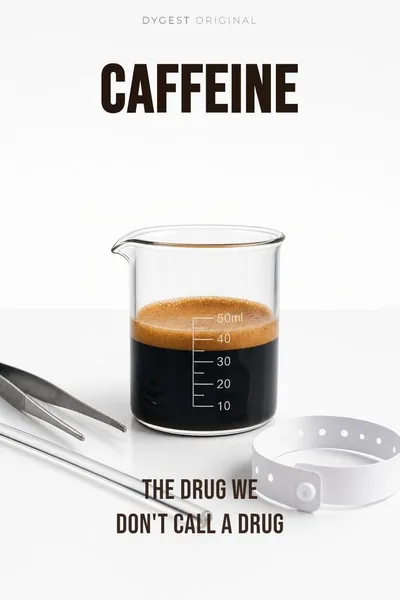
Caffeine
The drug we don't call a drug
Description
Sometime in the fifteenth century, a Sufi sheikh in the Yemeni highlands named Ali ibn Umar al-Shadhili noticed that his followers were having trouble staying awake during their nightly prayers. The story is hard to verify, but the substance involved is not in dispute. Coffee brewed from the roasted beans of the Coffea arabica plant was being used in Yemeni monasteries as a stimulant to extend wakeful religious practice. The drink moved from the Sufi orders to Mecca, then to Cairo, then to Istanbul, then to Venice, then to London. Within two centuries it had become a global commodity. Today, around 80% of the world's adults consume caffeine regularly, making it the most widely used psychoactive drug in human history.
The molecule, 1,3,7-trimethylxanthine, has a peculiar structural property: it looks remarkably like adenosine, one of the brain's principal sleep-regulating neurotransmitters. When caffeine reaches the brain, it occupies the receptors adenosine would otherwise dock with, without producing the downstream effects adenosine would. The result is not that the brain becomes more alert — that framing is approximately wrong. The signals that would have produced the experience of tiredness are blocked from reaching the systems that would interpret them. Caffeine does not wake us up. It hides our sleepiness from us.
This is a more interesting fact than the casual coffee drinker usually appreciates. The substance most of us treat as a benign morning ritual is, by any reasonable definition, a psychoactive drug — physically addictive, with a measurable withdrawal syndrome, dose-response effects on alertness, and substantial individual variation in metabolism. The reason we don't think of it as a drug is largely cultural. The arc by which caffeine became socially acceptable, while structurally similar substances did not, is a useful case study in how the line between drug and beverage is drawn.
The question we're asking: what is caffeine doing pharmacologically, and why have we decided this drug is acceptable when others aren't?
What we'll see: the Yemeni origin, the adenosine mechanism, the cultural sorting, and what current research says about long-term consumption.
Table of contents
01From Yemen to global commodity
Coffee's documented spread begins in the Yemeni port of Mocha in the fifteenth century. The plant itself is native to the Ethiopian highlands, where it had been used for centuries as a stimulant chewed in raw form. The roasting and brewing techniques that produced the modern beverage developed in Yemen, and Mocha became the major export point. From the Yemeni Sufi orders, coffee passed into general use, then traveled with pilgrims to Mecca, where it was briefly prohibited in the sixteenth century by religious authorities concerned about its stimulant properties.
The European introduction came through Venice in the early seventeenth century. The first London coffeehouse opened in 1652, and within a few decades there were several thousand of them, serving as informal news distribution points, business venues, and political meeting places. Lloyd's of London began as a coffeehouse. The early stock exchange operated out of one. The British East India Company executives met in coffeehouses to coordinate trade. The drink was associated with sobriety, intellectual activity, and commerce, in deliberate contrast to the alcoholic taverns it competed with. The cultural framing was set early.

02The adenosine story
Adenosine is one of the brain's homeostatic regulators of sleep pressure. As we are awake, adenosine accumulates in the central nervous system as a metabolic byproduct of cellular activity. The longer we are awake, the more adenosine builds up, and the more strongly it activates the receptors that generate the subjective experience of sleepiness. When we sleep, the adenosine is cleared from the system. The cycle resets. The sleepier we feel after a long day, the higher our adenosine concentration.
Caffeine is a competitive antagonist at adenosine receptors. The molecule fits the receptor binding site closely enough to occupy it, but does not activate it. While caffeine is in the system, the adenosine cannot dock and produce its sleep-pressure signal. The accumulated sleep pressure remains this is the part most caffeine consumers don't fully appreciate but it cannot reach the brain regions that would interpret it. The half-life of caffeine in adults is around five hours, with substantial individual variation. After eight hours, around a quarter of the dose is still circulating. After twelve hours, an eighth.
03The cultural sorting
Pharmacologically, caffeine sits in the same general category as nicotine, amphetamines, and several stimulant drugs that are tightly regulated. It produces tolerance, dependence, and withdrawal. It has measurable effects on alertness, mood, and motor function. The reason it is sold in supermarkets while nicotine and amphetamines are not is not a question with a clean pharmacological answer. The cultural sorting happened over centuries and reflects historical accident as much as risk profile.
Coffee was acceptable in Europe in part because it competed with alcohol in a moral landscape that was increasingly favoring sobriety. Beer, wine, and spirits were the dominant beverages in early modern Europe, partly because water was unsafe in many cities. Coffee boiled, sterile, and stimulating rather than depressant was framed as an antidote to drunkenness. Protestant work-discipline cultures embraced it in particular. The same molecule, in a different cultural register, might have been treated as suspect. In Mecca it briefly was.
04What current research says
The epidemiology of caffeine has produced a generally reassuring picture, with caveats. Large prospective cohort studies including pooled analyses from the Nurses' Health Study, the Health Professionals Follow-up Study, and several European cohorts — have associated moderate coffee consumption (three to four cups per day) with lower all-cause mortality, lower cardiovascular mortality, and lower incidence of type 2 diabetes, Parkinson's disease, and several cancers. The associations are observational and could be confounded by lifestyle factors, but they are consistent enough that a causal contribution cannot be ruled out, and the implications run against the older view that coffee was cardiac risk.
The caveats matter. Pregnancy is a clear case where caffeine intake should be limited, with most guidelines recommending under 200 mg per day. Sleep architecture is reliably degraded by afternoon caffeine consumption, even in habitual users who report no subjective effect. Anxiety disorders are exacerbated by caffeine in many patients, and the molecule appears to lower the threshold for panic attacks in susceptible individuals. The rapid growth of high-caffeine energy drink consumption among young people has produced a measurable rise in emergency room presentations.
05Conclusion
Caffeine is the drug nobody talks about as a drug. It is consumed daily by most of the adult population, it produces measurable dependence and withdrawal, it has a clear receptor mechanism, and it sits in the same broad pharmacological category as substances we treat with tighter regulation. The cultural sorting that placed it in supermarkets rather than pharmacies happened over centuries and reflects the historical timing of its introduction, the moral economy of seventeenth-century Europe, and the relatively benign harm profile of its delivery vehicle. The molecule itself is not unique among stimulants. Its social position is.
Related books