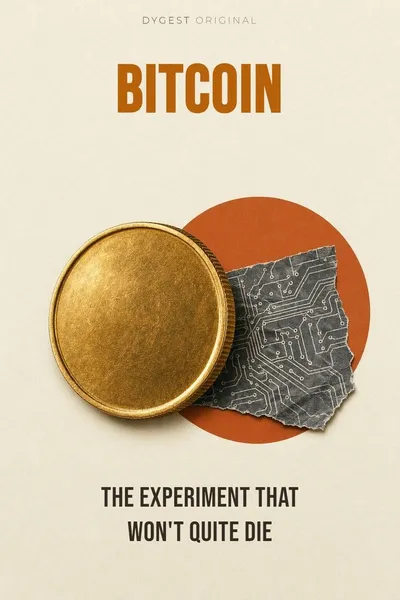
Bitcoin
The experiment that won't quite die
Description
In October 2008, a pseudonymous author under the name Satoshi Nakamoto published a nine-page paper titled Bitcoin: A Peer-to-Peer Electronic Cash System. The paper described a method of creating digital money without any central authority, using cryptography and a distributed network to prevent double-spending. The idea had been floated for decades, but earlier attempts had failed on technical or economic grounds. Satoshi's particular combination proof-of-work, the blockchain, fixed supply worked. The first Bitcoin block was mined in January 2009. The currency was roughly worthless for its first year, then began a volatile climb that has continued, with multiple eighty-percent crashes along the way, for sixteen years and counting.
Bitcoin has repeatedly been declared dead. Major financial publications have written obituaries after each major crash 2011, 2014, 2018, 2022 arguing that the experiment had demonstrated its unworkability and that reasonable investors should move on. The obituaries have been wrong every time. Bitcoin has recovered from each crash, reached new highs, and attracted new investors who were not investors before. The pattern has been durable enough that the dismissive position has become harder to maintain, even for observers who remain skeptical about what exactly Bitcoin is useful for.
What Bitcoin actually is remains contested. The original vision electronic cash for peer-to-peer payments has largely failed. Bitcoin is rarely used for everyday transactions because the network is too slow and the fees too variable. The surviving thesis is that Bitcoin is digital gold a scarce, portable, censorship-resistant store of value, useful as a hedge against currency debasement and political instability. This thesis has substantial support among its advocates, substantial skepticism from most mainstream economists, and a price history that could plausibly support either interpretation depending on which years you emphasize.
The question we're asking: what is Bitcoin, why has it survived, and what does the experiment tell us about the nature of modern money?
What we'll see: the mechanism, the competing theses about its purpose, the concrete uses, and the specific risks the next decade will test.
Table of contents
01The mechanism
Bitcoin is, at its core, a public ledger a list of all transactions that have ever occurred on the network, maintained not by any central party but by the collective computation of thousands of independent nodes. Each batch of transactions is bundled into a block and added to the end of the chain of prior blocks. The chain is cryptographically secured, meaning it is computationally infeasible to alter past transactions without redoing the work of all subsequent blocks. This is what makes the ledger immutable in practice.
The creation of new Bitcoin is governed by proof-of-work mining. Computers compete to solve a mathematical puzzle, and the winner gets to add the next block and collect a reward in newly-issued Bitcoin. The difficulty of the puzzle adjusts automatically so that a new block is added roughly every ten minutes. The mining reward halves every four years, on a predetermined schedule, producing a supply curve that slows over time and caps at twenty-one million coins in the early 2140s. The fixed supply is the feature its advocates most emphasize unlike fiat currencies, Bitcoin cannot be created at the discretion of a central authority.

02The competing theses
The original thesis, articulated in Satoshi's paper, was that Bitcoin would function as electronic cash for peer-to-peer transactions. This has not happened at scale. The Bitcoin network can process roughly seven transactions per second, compared to tens of thousands for traditional payment networks. Fees rise when the network is congested, and confirmation times are too slow for retail use. The Lightning Network, a secondary layer designed to enable fast, cheap transactions, exists but has seen limited adoption. For most everyday purposes, Bitcoin is a worse payment system than existing alternatives.
The digital-gold thesis has largely replaced the cash thesis as the dominant interpretation. On this view, Bitcoin is valuable not as a medium of exchange but as a store of value a scarce, portable, verifiable asset that can serve as a hedge against monetary debasement, political confiscation, or financial-system collapse. The argument draws parallels to gold, which functions similarly and holds substantial value despite being useful for few practical purposes. Advocates argue that Bitcoin is better than gold because it is more portable, more divisible, and harder to confiscate. Skeptics argue that it lacks gold's thousands of years of track record.
03The concrete uses
Despite the failure of the cash thesis, Bitcoin has specific uses where it works substantially better than alternatives. The first is cross-border value transfer in contexts where the banking system is slow, expensive, or unavailable. Someone sending money to relatives in a country with capital controls or failed banking can use Bitcoin to move value in minutes at modest cost. The use case is real but not massive in dollar terms. Traditional remittance services have lowered their own costs in response, narrowing Bitcoin's advantage for most corridors.
The second use is holding assets outside the reach of specific political jurisdictions. Residents of countries with unstable currencies Argentina, Venezuela, Turkey, Lebanon have used Bitcoin to preserve wealth when their local currencies were losing value rapidly. The thesis is the same as using dollars in high-inflation environments, but Bitcoin offers the additional feature of being accessible from anywhere with an internet connection and resistant to capital controls. The actual adoption in these contexts is hard to measure, but there is enough anecdotal and on-chain evidence to suggest it is substantial.
04The specific risks
Bitcoin faces several specific risks that could substantially change its trajectory. The first is regulatory. Major governments have the power to significantly restrict Bitcoin through laws targeting exchanges, banks that interact with them, and individuals who hold the asset. China has banned Bitcoin mining and trading multiple times. The US has moved toward regulatory clarity more than prohibition, but this could change. A coordinated G7 crackdown on Bitcoin banning institutional holding, taxing it punitively, restricting exchanges would substantially impair the network. Whether such coordination occurs is a political question that could go either way.
The second risk is technical. The proof-of-work mining that secures the network consumes substantial electricity comparable to the annual consumption of some small countries. The environmental criticism has produced regulatory pressure and reduced institutional enthusiasm in some contexts. Alternative consensus mechanisms (proof-of-stake, most notably Ethereum's) consume far less energy. Bitcoin's technical community has resisted changing the consensus mechanism, viewing the mining as essential to the security model. Whether energy concerns eventually force a change, or whether they just constrain Bitcoin's growth, is an open question.
05Conclusion
Bitcoin matters because it is the most significant monetary experiment of the past half-century the first serious attempt to create a money that operates outside the framework of central banks, national currencies, and the financial system generally. Whether the experiment succeeds or fails in the long run, it has already generated enormous amounts of information about how such systems might work, what their limits are, and what demand exists for them. The experiment has produced a sixteen-year track record, multiple near-death experiences followed by recoveries, and a growing community of institutional and retail participants. The information generated is valuable regardless of whether Bitcoin itself survives the next decade.
Related books