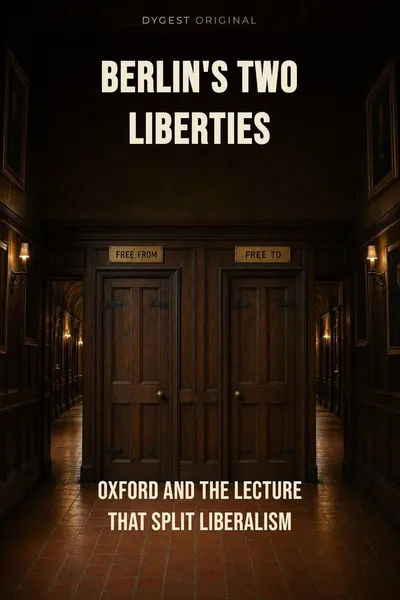
Berlin’s two liberties
Oxford and the lecture that split liberalism
Description
On October 31, 1958, in the Examination Schools of Oxford University, a fifty-year-old philosopher named Isaiah Berlin delivered his inaugural lecture as Chichele Professor of Social and Political Theory. The lecture was titled “Two Concepts of Liberty.” It was published as a sixty-page essay the following year and would become, almost immediately, one of the most-cited works of twentieth-century political philosophy. The argument Berlin made in the lecture was structurally simple: that the concept of liberty, which the liberal tradition had treated as a single value, was in fact two different and partially incompatible values, and that the political history of the modern world had been substantially shaped by the failure to keep them distinct.
The two concepts Berlin identified became known, after his terms, as negative liberty and positive liberty. Negative liberty was the absence of external interference the freedom from constraint, the space within which a person could act without being prevented by others. Positive liberty was the capacity to act according to one’s own purposes, to be the author of one’s own choices, to realize one’s higher self against the lower impulses that might capture it. The two concepts sounded, on first hearing, like complementary aspects of a single value. Berlin’s argument was that they were not. They pointed in different political directions, supported different institutional arrangements, and, when one of them was taken to its conclusion, frequently came into direct conflict with the other.
The lecture’s argument was, on its face, an exercise in political philosophy. It was also, less explicitly, a political intervention. Berlin had been born in Riga in 1909 to a Jewish family that fled to England after the Russian Revolution. He had served in the British Embassy in Washington and Moscow during the Second World War. His personal experience of Soviet communism had been intimate, and the argument of the lecture was, in significant part, a philosophical analysis of how a value many readers admired the positive liberty of self-realization, of authentic agency, of becoming what one was capable of becoming could be deployed to justify the kind of totalitarian state that the Soviet experiment had produced. The argument was philosophical. The stakes were political.
The question we’re asking: what did Berlin actually argue in the Oxford lecture, what was at stake in the distinction between the two liberties, and how has the framework aged after sixty-seven years?
What we’ll see: the Oxford context and the political moment, the structure of the argument, the debates that followed, and what survives.
Table of contents
01A Riga-born Oxford don and the postwar Cold War
Isaiah Berlin’s intellectual formation had been unusually international. He had been born in Riga in the late Russian Empire, lived through the Russian Revolution as a child in Petrograd, and emigrated to England at eleven. His writing on Marx, the Russian intelligentsia, and historical determinism had given him a particular position in postwar Anglo-American philosophy. He was an Oxford don who knew Soviet politics from the inside, a philosopher who read Russian fluently, and a public intellectual who took the political implications of philosophical positions more seriously than most of his analytical colleagues.
The political moment was specifically the Cold War. The Soviet Union had crushed the Hungarian Revolution in 1956. Khrushchev’s de-Stalinization speech had been delivered the same year. Berlin’s lecture was an intervention in the debate among Western intellectuals about Soviet communism. It argued that the political failures of Soviet communism were not accidental departures from Marxism; they were the predictable consequences of a particular conception of liberty embedded in continental European thought for over a century.

02Negative liberty and what it means to be free from
The first concept Berlin developed in the lecture was what he called negative liberty. The negative concept of liberty answers the question: in what area is the subject left to do or be what he is able to do or be, without interference by other persons? Berlin’s answer was that the negative concept identified freedom with the absence of obstacles imposed by others. A person is free, in the negative sense, to the extent that no other person is preventing him from doing what he wants to do. The wider the area of non-interference, the wider the negative liberty.
The intellectual tradition for the negative concept was the British liberal tradition from Hobbes through Locke through Mill, concerned primarily with limiting the scope of legitimate state action. The state had certain functions protection from violence, enforcement of contracts, maintenance of order and beyond those, no business interfering with the choices of its citizens. Mill’s On Liberty (1859) was the canonical statement.
03Positive liberty and the dangers of self-realization
The second concept Berlin developed was positive liberty. The positive concept of liberty answers the question: what or who is the source of control or interference that can determine someone to do, or be, this rather than that? The positive concept identifies freedom not with the absence of obstacles but with self-mastery with being the author of one’s own choices, in the deepest sense, against the various forces that might otherwise shape them. To be positively free is to be the source of one’s own action, to act on one’s own purposes, to realize one’s higher self against the lower impulses that would capture it if left unchecked.
The intellectual tradition of positive liberty was, in Berlin’s account, primarily continental and primarily idealist. It ran from Rousseau through Kant through Hegel through Marx, with side-currents in romantic philosophy and in the various German idealist movements. The arguments developed in that tradition had been concerned with the conditions under which a person could be said to be the genuine author of her actions. The conditions turned out to be substantial. A person captured by her own passions, her ignorance, her addictions, her false beliefs such a person could not be said to be genuinely free, on this account, even if no other person was preventing her from acting on those passions. Real freedom required the kind of inner ordering that allowed the higher self to govern the lower.
04Sixty-seven years on, and what survives
The lecture has had three distinct careers. The first has been within academic political philosophy, where the distinction has become a default reference point. Charles Taylor’s “What’s Wrong with Negative Liberty?” (1979) argued that negative liberty alone is insufficient. Quentin Skinner’s “Liberty Before Liberalism” (1998) argued for a third republican concept. Philip Pettit’s work on freedom as non-domination developed an alternative framework. The Berlin framework has remained the starting point for these debates.
The second career has been in political argument. The distinction has been deployed by liberals and conservatives in opposing directions. Conservative readers have taken the lecture as a defense of negative liberty against activist government. Liberal readers have taken it as a more cautious defense that recognizes both kinds. Marxist readers have taken it as a partisan Cold War tract.
Related books