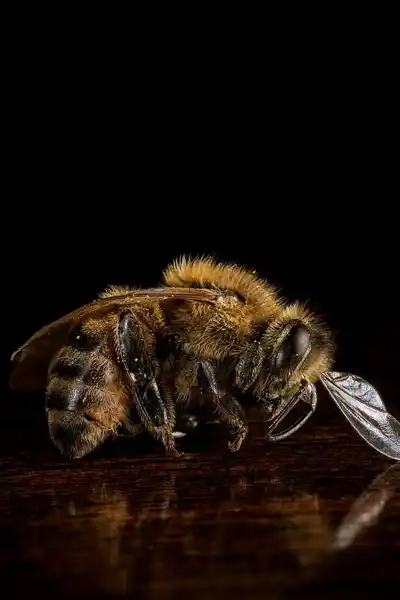
Bees
Why the pollinators are disappearing
Description
In November 2006, a Pennsylvania commercial beekeeper named David Hackenberg drove his truck full of hives down to Florida for the winter pollination season. Hackenberg ran one of the larger eastern operations, with roughly three thousand hives travelling around the country pollinating crops. When he checked his hives in Florida a few weeks later, the bees were gone. Not dead in the boxes, not visibly sick — gone. The frames were full of honey. The queen was still there. There were almost no adult workers. Twenty million bees had simply vanished from his operation.
Hackenberg called his entomologist, Dennis vanEngelsdorp at Penn State, who had been hearing similar reports. Within months the phenomenon had a name — Colony Collapse Disorder, or CCD — and a place in the public conversation as the harbinger of an ecological catastrophe. Honeybees were vanishing. Pollinators were collapsing. The food system was at risk. The story made it onto magazine covers, films, and political speeches. It also acquired competing explanations: pesticides, parasites, viruses, cell phones, GMOs, climate change, malnutrition. Most turned out to have some truth to them.
Two decades on, the story is messier than the original framing suggested. Honeybee colonies in the United States have continued to suffer high winter losses, but the total number of managed hives has held roughly steady because beekeepers have learned to replace lost colonies. Wild bees, which receive less attention than honeybees, are in worse trouble. The threats involve no single villain. The story of how we figured this out is also the story of how a complicated ecological problem becomes legible to the public, and how the public framing both helped and hindered the science.
The question we're asking: what actually happened to the bees, and what does the multi-causal answer mean for ecosystems that depend on pollinators?
What we'll see: the missing hives, the suspects, the wider pollinator story, and what it has changed.
Table of contents
01The empty boxes
Hackenberg's losses in 2006 were not the first time beekeepers had seen something like this. Records of similar mass disappearances exist sporadically going back to the nineteenth century. What was different about 2006-2007 was the scale and the synchrony. By spring 2007, beekeepers across more than two dozen American states reported colony losses averaging 30%, with some operations losing 90% or more. Adult workers left and did not return. The brood and queen were typically present. Predators and scavengers, which would normally move into an abandoned hive within days, sometimes left these hives alone for weeks.
Vanishing colonies were a serious problem because the American honeybee population had become deeply entangled with agriculture. California's almond industry alone, by 2007, required roughly 1.7 million colonies — more than half the country's commercial hives to be trucked into the orchards each February. Almonds, blueberries, apples, cucumbers, and dozens of other crops depended on pollination services. The industry providing those services had become more concentrated, dominated by a few hundred commercial operators following the bloom calendar.

02The pesticide debate
Of all the suspects, neonicotinoid insecticides drew the most attention. Neonicotinoids are synthetic pesticides developed in the 1980s and 1990s, designed to be applied as seed coatings. The chemicals are absorbed by the growing plant and expressed in its tissues, including pollen and nectar. They are highly toxic to insects and bind to nicotinic acetylcholine receptors with effects that persist at sub-lethal doses. By 2010, neonicotinoids had become one of the most widely used insecticide classes in the world.
The case built up over the following decade. A 2012 study by Mickaël Henry's team in France showed that bees exposed to field-realistic doses of thiamethoxam had reduced ability to find their way back to the hive. Subsequent work demonstrated effects on bumblebee colony growth, queen production, and immune function. The European Food Safety Authority concluded in 2013 that several neonicotinoids posed unacceptable risks, and the EU imposed a partial moratorium later expanded into a near-total outdoor ban. The chemical industry pushed back, arguing the studies were not realistic of actual field conditions.
03The wider pollinator story
The honeybee, Apis mellifera, is one species among more than twenty thousand worldwide. The fixation on honeybees in the CCD coverage obscured a more important story about the rest of the pollinator community. Native solitary bees, bumblebees, hoverflies, butterflies, moths, beetles, and wasps do most of the pollination of wild plants and a substantial share of crop pollination, often more efficiently per visit than honeybees. Data on these other pollinators has been harder to assemble, because nobody tracks bumblebees the way commercial beekeepers track hives. What evidence exists is alarming.
A 2017 study by German entomologists working with amateur insect collectors documented a 76% decline in flying insect biomass in nature reserves over 27 years, using data from sticky traps operating since 1989. Subsequent studies in Britain, Denmark, the United States and elsewhere have found similar patterns, with the steepest drops in agricultural landscapes. The phrase insect apocalypse entered public conversation around 2017-2018.
04What is being done
The response to the pollinator crisis has been sprawling and partial. The European neonicotinoid bans are the most visible regulatory action. Several jurisdictions have established pollinator-friendly mandates for highway verges, public lands, and agricultural set-asides. Conservation organizations have promoted residential pollinator gardens and bee hotels. Agricultural research has focused on integrated pest management strategies that reduce pesticide use without sacrificing yields. The United States Department of Agriculture and the European Commission both fund pollinator monitoring programmes that aim to fill the data gaps that made the original CCD episode so confusing.
The honeybee situation has also stabilized somewhat, in that the total number of managed colonies in the United States has remained roughly constant since 2008 despite continued high winter losses. Beekeepers have adapted by splitting strong colonies in spring to replace lost ones and by improving Varroa management practices. Commercial operations have learned to provide supplemental nutrition during seasons when natural forage is poor. The almond industry's pollination needs are still being met, though at higher costs than a decade ago. The system has become more managed and less self-sustaining — it works as long as beekeepers keep working hard, but is more fragile than it looks.
05Conclusion
The bee story is a useful case study in how scientific complexity meets public attention. The simple version bees are dying, here is why turned out to be wrong in its specifics. The honest version is that bees are under multiple stresses that interact, that the most affected species are not the ones that made it onto magazine covers, and that the broader insect community is in worse condition than the famous bees. None of that is comforting. But understanding the real shape of the problem is the first step toward responding to it usefully rather than performatively.
Related books