Atoms
Matter's building blocks
Description
Around 400 BCE, in the Greek colonial town of Abdera, a thinker named Democritus argued that if you kept cutting a piece of matter in half, you would eventually reach something you could not cut any further. He called it atomos — uncuttable. It was a beautiful guess, and for more than two thousand years that is all it was. There was no instrument that could confirm or deny it, no experiment that could reach that small. The idea survived the way good ideas sometimes do, half-remembered, quoted by Roman poets, ignored by most of the people who mattered, waiting for a world that could actually do something with it.
When that world finally arrived, it did not confirm the Greek picture so much as complicate it beyond recognition. The thing we still call the atom turned out to be splittable after all, mostly empty space, built from smaller things that were themselves built from smaller things. Every time physicists thought they had reached the bottom, the floor opened again. And each new floor came with a new set of rules, stranger than the last, until the most accurate description of matter we possess reads less like a list of ingredients than like a set of relationships nobody expected.
We tend to teach this as a tidy staircase: Democritus, then Dalton, then a shining physics we've supposedly finished. The real story is messier and more interesting, because the deeper physicists went, the more the questions multiplied rather than resolved. Matter's building blocks turned out to be a moving target — and the closer we look, the more it becomes clear how much of the target is still missing.
The question we’re asking : How did a philosophical hunch about uncuttable matter become the most tested theory in science — and why does it still leave so much unexplained?What we’ll see : How the atom went from a guess to a measured object to a doorway onto everything we still can't see.
Table of contents
01Chapter 1 — A Greek guess with no way to test it
Democritus did not invent atomism alone. He inherited it from his teacher Leucippus, about whom we know almost nothing, and together they proposed something radical for their moment: that everything is made of tiny, indivisible particles moving through empty space, and that the differences between wood and water and bone come down to the shape and arrangement of these particles. There was no void in the dominant philosophy of the time — Parmenides had argued that nothingness could not exist — so claiming that atoms moved through emptiness was already a provocation.
The trouble was that the theory explained everything and predicted nothing you could check. It was reasoning from the armchair, elegant and unfalsifiable. Worse, it had a formidable opponent. Aristotle, whose influence would dominate Western thought for the better part of two millennia, rejected atomism outright. He preferred a world of four elements — earth, water, air, fire — that could be endlessly divided, and a cosmos with no empty space at all. When Aristotle won the argument, atoms lost, and they stayed lost.

02Chapter 2 — Weighing the invisible
The turn came at the start of the nineteenth century, in the unglamorous work of chemistry. John Dalton, a self-taught English schoolteacher and Quaker, was studying how gases combine, and he kept running into a peculiar regularity. When elements reacted to form compounds, they did so in fixed, whole-number ratios of weight. Hydrogen and oxygen made water in the same proportion every time. Carbon and oxygen made two different gases, and the amounts of oxygen involved sat in a simple ratio to one another.
Dalton drew the obvious conclusion around 1803: matter comes in discrete units, each element has its own kind of atom with its own characteristic weight, and compounds form when these atoms join in fixed numbers. This was the Greek idea reborn, but with a crucial difference. Dalton's atoms carried numbers. They had weights you could measure, or at least compare, and those numbers explained the laboratory results. For the first time, the atom paid its way — it did work no other theory could do.
03Chapter 3 — The atom cracks open
Almost as soon as atoms were confirmed to exist, they began to fall apart. In 1897, J.J. Thomson at Cambridge showed that a mysterious ray inside vacuum tubes was actually a stream of tiny, negatively charged particles — electrons — that were far lighter than any atom and seemed to come out of atoms themselves. The uncuttable thing had parts. Thomson pictured the atom as a diffuse positive blob with electrons scattered through it, a model affectionately remembered as plum pudding.
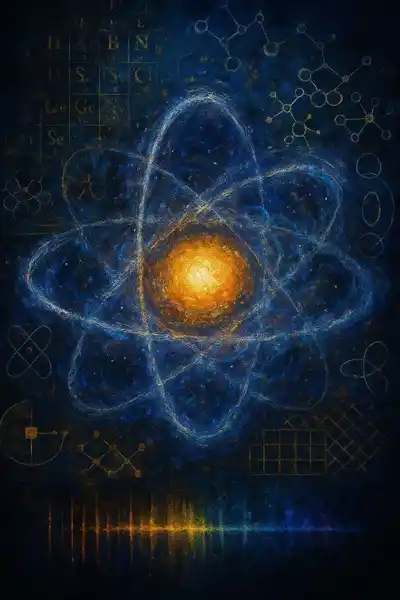
That picture did not last a decade. Around 1909, Ernest Rutherford's team in Manchester fired positively charged particles at a thin sheet of gold foil, expecting them to pass gently through. Most did. But a tiny fraction bounced almost straight back, which Rutherford said was as astonishing as a shell rebounding off tissue paper. The only explanation was that nearly all of an atom's mass sat in a minuscule, dense, positively charged core. The atom was mostly empty space, with a nucleus at its center and electrons somewhere out in the void around it.
04Chapter 4 — The particle census and its gaps
By the mid-twentieth century, physicists had powerful new tools — particle accelerators that smashed matter together at enormous energies — and what came out was a mess. Dozens of new particles appeared, so many that the physicist Enrico Fermi is said to have grumbled that if he'd wanted to memorize this many names, he'd have become a botanist. The neat atom of proton, neutron, and electron had become a bewildering zoo, and it badly needed an organizing principle.
That principle arrived in the 1960s. Murray Gell-Mann and, independently, George Zweig proposed that protons and neutrons were not fundamental at all but built from still smaller things, which Gell-Mann named quarks. Over the following decades this idea grew into the Standard Model — the framework that now organizes all known matter into a small set of quarks and leptons, held together by force-carrying particles. It is, by any measure, the most precisely tested theory in the history of science, matching experiment to a staggering number of decimal places. The 2012 detection of the Higgs boson at CERN filled in its last predicted piece.
05Conclusion
Twenty-four centuries after Democritus, we can weigh individual atoms, image them, split them, and rearrange them. We know the word he chose — uncuttable — was wrong, and gloriously so, because everything interesting about matter has turned out to live in the cutting. The atom was not the bottom. It was a doorway, and behind it were nuclei, and behind those quarks, and behind those a set of questions that the finest theory ever built cannot answer.
Related books