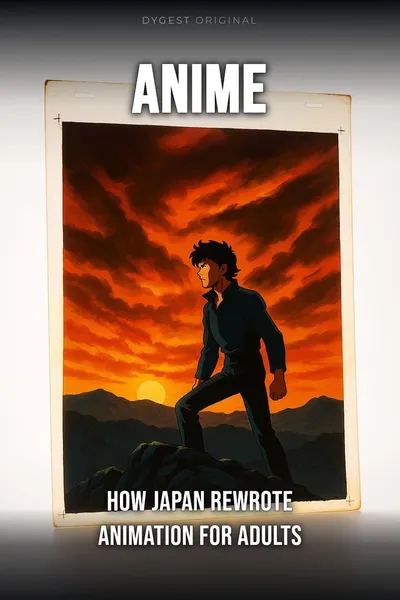
Anime
How Japan rewrote animation for adults
Description
For most of the twentieth century, the American animation industry operated on a single unquestioned premise: animation was for children. Disney had established the grammar, Hanna-Barbera had industrialized it for television, and the occasional adult-skewing work Bakshi's Fritz the Cat, Spiegelman's Maus, the prestige wing of the art-house circuit was classified as a niche exception rather than a challenge to the premise. Animation was a genre, and the genre was family entertainment. This was settled wisdom in Burbank in 1985. It was already completely wrong in Tokyo.
Japan, for reasons having more to do with postwar economics than aesthetic theory, had spent thirty years building an animation industry on a different assumption. Anime was from the start a medium addressed to all ages simultaneously. It covered every genre fiction could cover science fiction, romance, war, sports, horror, domestic drama, philosophy and it treated the adult audience as a normal, commercially important part of the viewership. By the 1990s, the gap between what Japanese animation was doing and what American animation was doing had grown into a structural difference. Then the gap started to close, in the direction of Japan.
The story of how that happened is the story of the single most successful cultural export of postwar Japan. It involves a medical student who became a cartoonist, a generation of directors who pushed the form into ambition American animation would not attempt for forty years, and a streaming-era convergence in which anime became the default prestige animation format worldwide. Understanding how means starting with Osamu Tezuka.
The question we're asking: how did an underfunded Japanese television industry produce the form that now dominates global animation?
What we'll see: Tezuka's revolution, the 1980s-90s maturation, the Miyazaki breakthrough, and the streaming-era global takeover.
Table of contents
01Tezuka and the postwar foundation
Osamu Tezuka trained as a doctor, never practiced medicine, and spent his working life producing, at industrial volume, the manga that defined the Japanese comics industry. His Astro Boy manga began in 1952 and adapted a set of Disney conventions the big eyes, the expressive faces, the cinematic panel pacing into a specifically Japanese register. When Tezuka moved into animation in 1963, producing Astro Boy as Japan's first weekly animated television series, he imported the same grammar. He also imported a production economics that turned out to be fundamental to everything that followed.
The economics were forced by the budget. Tezuka's studio, Mushi Production, could not afford the frame rates American animation used Disney features animated on twos at 24 frames per second, with full drawings for most actions. Mushi animated on threes or fours, held still drawings while mouths moved, reused cycles, cut corners that American studios would have considered unacceptable. The result was a style of limited animation that emphasized expressive pose over fluid movement, dramatic framing over kinetic continuity, and sound design and voice performance over animation as such. Every subsequent Japanese studio inherited these constraints and the aesthetic solutions they generated.

02The 1980s and the medium's maturation
The 1980s were the decade in which anime became an adult medium in the form the world now recognizes. The pivotal title was Mobile Suit Gundam, a 1979 television series that reinvented the giant-robot genre as a serious war drama, with morally ambiguous characters, political complexity, and a body count that included sympathetic figures. Its initial broadcast was a ratings disappointment. The model kits of the show's mecha sold so aggressively, however, that Bandai rebuilt the franchise's commercial model around toys rather than ad revenue, and Gundam became one of the most durable franchises in global entertainment still generating over a billion dollars a year in its late forties.
Alongside the television work, the direct-to-video market the original video animation, or OVA, format opened space for more experimental, higher-budget projects that did not need to conform to broadcast censorship or family scheduling. The result, across the 1980s, was an explosion of adult-skewing animation. Akira, Katsuhiro Otomo's 1988 feature, used the largest animation budget Japan had ever assembled to deliver a post-apocalyptic science fiction epic that became the first anime to succeed theatrically in American art-house cinema. Ghost in the Shell in 1995 continued the pattern. The Wachowskis cited it as the direct inspiration for The Matrix.
03Miyazaki and the breakthrough to legitimacy
The cultural legitimation of anime in the West happened in two stages. The first was the critical and commercial success of Studio Ghibli, and specifically the work of Hayao Miyazaki. Ghibli, founded in 1985 by Miyazaki, Isao Takahata, and producer Toshio Suzuki, committed to feature-film animation at a level of craft and ambition that equalled or exceeded anything being produced by Disney. Totoro in 1988 established the studio's signature. Princess Mononoke in 1997 became Japan's highest-grossing film up to that point. Spirited Away in 2001 won the Academy Award for Best Animated Feature the first non-English-language film to do so and became the highest-grossing Japanese film of all time.
Miyazaki's importance is not only that he made excellent films, which is sometimes the whole of the argument in English-language criticism. His importance is also that he shifted the conversation about what animation could be as a form. Spirited Away was reviewed by critics who had never previously reviewed an animated film, discussed at festivals that had never programmed one, and assigned in film-school curricula that had never treated animation as a first-class subject. The edifice of assumptions about animation as children's entertainment cracked at the top. Disney distributed Ghibli in the West. The two animation philosophies sat side by side on the same shelves, and the comparison was not flattering to Disney.
04The streaming era and the global takeover
Netflix entered anime distribution in 2015 and built, over the next decade, the dominant global pipeline for Japanese animation. Crunchyroll, acquired by Sony in 2021, runs a parallel subscription service focused entirely on anime and reported over fifteen million paid subscribers in 2024. Disney+, HBO Max, and Amazon Prime all now carry anime as a dedicated category. In 2023, anime-related exports generated more revenue for Japan than its traditional steel industry reported figures place the content industry's overseas revenue above twenty billion dollars and growing at over fifteen percent a year.
The production effects of the new distribution reality have been mixed. Budgets for flagship series have risen substantially as streaming platforms compete for exclusives. Small studios have gone out of business or been absorbed into larger conglomerates. The working conditions of Japanese animators notoriously brutal, with rookie salaries sometimes below the Tokyo poverty line have not improved in proportion to the revenue the industry now generates, and have become the subject of increasing international concern. The labor question is the single biggest unresolved issue facing anime as an industry today.
05Conclusion
Anime matters not because it is Japanese, though that is part of it, and not because it is animated, though that is also part of it. It matters because it is the clearest available proof that animation is a medium, not a genre that it can carry adult fiction, serious philosophy, tragic drama, and political argument with the same weight live-action film has carried them with for a century. American animation spent sixty years assuming the opposite. The Japanese industry built an enormous cultural corpus in the gap that assumption created, and that corpus is now reshaping what animation means globally.
Related books