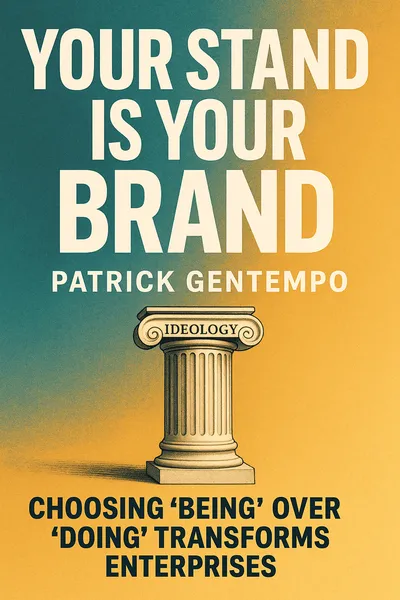
Your stand is your brand
Choosing "being" over "doing" transforms enterprises
Description
Today's business leaders should ask themselves "Who should we be?" rather than "What should we sell?" Your stand - your values and beliefs - will become your brand. People will notice and react to what you stand for. Run your company based on values that resonate with you. Have a purpose beyond profits. Aim to change the world and attract like-minded customers.
Taking a stand means clearly knowing and expressing your values, regardless of judgment. You've likely focused on what to do rather than who to be. Understanding the importance of drawing a line around your beliefs is critical. Your stand doesn't have to be epic battles. With integrity and passion, incredible success will follow. As Patrick Gentempo states, "It happened for me."
Table of contents
01 Your guiding principles
The 5-P Expansion Sequence is a framework that starts with defining your Purpose and Principles, then identifying your People, creating your Product, and culminating in Prosperity. It ensures your actions are rooted in your core values for meaningful success.
1-Philosophy
Whether we realize it or not, we all have a personal philosophy that defines how we think and apply critical thought to achieve success. Every person has a basic philosophy—the question is whether we have consciously defined it. How we think and use thinking is fundamental to everything we do, so by forming concepts we enter the realm of philosophy. Despite perceptions of philosophy as abstract and impractical, it is highly practical for individuals and businesses. We need a structure from which to think and act, and our philosophy provides that framework.
Contradictions between beliefs and actions can be destructive. For example, the founders of the failed Chutes fast food chain wrongly assumed McDonald’s success was due to fast service. People actually liked the taste, and speed was secondary. Due to this faulty philosophy, Chutes failed while McDonald’s grew. Contradictions may be internal deceptions or external errors about reality. The U.S. healthcare system spent $3.65 trillion in 2018, about $11,212 per person, yet health declines.
There is an assumption medicine equals healthcare, but it does not. More medicine brings worse results, showing a philosophical contradiction. Economic issues follow from philosophical ones. To apply a philosophy effectively, consider that outcomes stem from our premises and the proof we see, multiplied by actions we take, divided by contradictions encountered. Analyzing these components systematically develops a functional philosophy. Defining core beliefs, reasons behind them, and plans to act on them simplifies the process. A clear personal stand becomes a personal brand, whether agreed with or not.
2- Purpose
Being purpose-driven in business and in life provides the rocket fuel to propel a company to excel. Purpose doesn’t materialize from nowhere; it stems from philosophy. Humans uniquely can choose a purpose, which then serves as true north, guiding you through decisions and options instead of having circumstances force them upon you. To fully experience humanity and build a business that impacts the world, alignment around a shared purpose is essential, rallying stakeholders and empowering teams to greater heights. Many consultants overlook that purpose flows from philosophy; it's not a sudden epiphany.
Your philosophy shapes your sense of purpose. Your purpose acts as an inner compass setting, orienting you toward goals beyond mere survival. Without purpose, you lack direction and are subject to external forces pushing and pulling you. Purpose fuels progress by clarifying why you do what you do. Consider the company culture. How do your policies and teams live out your values? Look at your business model too. If your purpose rings true and you deliver value, financial success will follow.
Appointing an oversight team can initiate cultural change, but sustaining it requires a mindset shift at all levels. Purpose must permeate every interaction, not serve as a one-time checklist item. It’s a continual journey to align systems and employees with your north star. When such clarity of mission aligns all stakeholders, each person understands their contribution to the overall vision, sparking their best work.
3-Psychology
The emotional state we experience when something happens is dictated by our personal psychology. Two people can share an identical experience yet have completely opposite emotional reactions. This difference in emotion is caused by the difference in personal philosophy held by each individual.

02 Releasing your philosophy's power
To maximize one's philosophy, it must be expressed in its purest form. This means identifying the core essence of one's beliefs and purpose and letting that shine through. It requires finding one's own "Miles Davis" - the jazz legend who translated the contents of his soul into music with utmost authenticity. There are many consultants who teach others' success formulas. However, real breakthroughs come from expressing one's own inner truth, not mimicking external models. This is the power of brand purity.
In 1977, Steve Jobs and Steve Wozniak sought funding to launch Apple. Investor Mike Markkula met them and returned with a one-page "Apple Marketing Philosophy" document. It listed three core values - empathy, focus and impute. Empathy meant understanding customers' needs better than anyone. Focus meant eliminating less important things to excel at chosen pursuits. Impute acknowledged that people judge books by covers, so Apple products must be presented creatively.
Though simple, these values built the world's most valuable company by eliminating the inessential. Apple exemplifies brand purity, but its exact methods cannot be copied. Success means finding one's own "Miles Davis," not mimicking Apple.
03 Embracing creative change
Complacency leads to the death of a business. To avoid this, companies must periodically destroy what already works in order to build something even better for the future.
The most creative act is to tear down your current business model so a more powerful version can emerge later on. Nothing in business lasts indefinitely. If you are not advancing, you are already falling behind whether you realize it or not. Therefore, it is vital to regularly practice creative destruction - burning everything to the ground and starting completely fresh.
A perfect case study is New York City's Eleven Madison Park, voted the number one restaurant globally. For years, Eleven was considered one of New York's premier dining establishments. The owners worked tirelessly to earn the coveted three-star rating from Michelin, bestowed on only about one hundred restaurants worldwide. Achieving three stars cements a restaurant's reputation for life. Recently, Eleven was not only rated as a three star restaurant but actually voted the very best restaurant on earth. With this recognition, Eleven could easily have commanded long wait lists and increasingly higher prices for years to come.
As Patrick Gentempo notes, the natural business move after being named the world's top restaurant would be to raise prices and "monetize it to the max." However, Eleven's co-owners Daniel Humm and Will Guidara opted to close up shop entirely in order to start over from scratch. Though counterintuitive, their reasoning was that staying stagnant means losing your edge. As Humm himself stated, closing at the height of demand was likely not the wisest financial decision but still a bold and admirable move.
To commemorate this impressive act of creative destruction, Humm and Guidara melted down the restaurant's pots and pans and used that material to forge a new step at Eleven's entrance. The symbolism is that patrons now literally step over the past and directly into the future with each visit. In Gentempo's view, only trailblazers willing to burn everything down could have first built Eleven into the world's premier restaurant. Whether this gambit pays off is yet to be seen, but the sheer audacity commands respect. More importantly, the owners' total lack of attachment to the status quo is what enables true innovation. It is impossible to confidently build the future when clinging to the past.
Related books