World on the Edge
Planet or profit
Description
Lester R. Brown spent decades reading the planet the way a banker reads a balance sheet, and by 2011, when he published World on the Edge, he had concluded that the numbers no longer added up. The founder of the Worldwatch Institute and later the Earth Policy Institute, Brown wasn't a doom merchant by temperament; he was an agronomist who counted grain harvests, water tables, and topsoil, and the counting kept coming back short. His book opens on a quiet accusation: modern civilization is running an economy that consumes its natural capital as if it were income, and an economy that does that always, eventually, hits the wall.
What makes the argument land is that Brown refuses to keep environment and economy in separate rooms. A collapsing fishery, an aquifer pumped dry, a wheat crop scorched by an unseasonal heat wave — these aren't sad ecological footnotes. They show up as bread prices, as food riots, as governments that lose the ability to govern. Brown's through-line is that the ecological ledger and the economic ledger are the same ledger, and we've been keeping only half of it. The bill for the missing half arrives as instability.
The book was written as a warning that still leaves the door open. Brown had watched societies before — the Sumerians, the Mayans — undermine the soil and water that fed them, and he saw the same signatures appearing at global scale. But he also believed the response could be fast, if we treated it the way the United States treated 1942: as a mobilization, not a policy debate. That tension, between a civilization already overdrawn and a rescue that is still technically possible, runs through every chapter.
The question we’re asking : Can a civilization that treats natural capital as free income avoid the collapse that overdrawn societies have always faced?What we’ll see : How Brown reads the planet as an economy running a deficit, where the food and water accounts are already failing, and what kind of emergency mobilization he thinks might still save the books.
Table of contents
01Chapter 1 — The civilization behind on its interest payments
Brown's central image is deceptively dry: an economy has two kinds of assets, income and capital, and confusing them is how you go broke. For most of history, humanity lived off the interest that natural systems threw off — fish that reproduced faster than we caught them, forests that grew back, groundwater that recharged. Somewhere in the twentieth century, driven by a population that quadrupled and an economy that grew far faster, we crossed a line. We began drawing down the principal. Brown calls this consuming natural capital, and his whole book is an accountant's insistence that this cannot go on indefinitely, no matter how good the quarterly figures look.
The evidence he assembles is not abstract. Three-quarters of ocean fisheries were being fished at or beyond capacity. Forests were shrinking, grasslands turning to desert, soil eroding faster than it formed across much of the planet's cropland. Each of these, in Brown's framing, is a withdrawal from an account we did not open and cannot easily refill. The trouble is that gross domestic product, the number we actually watch, records the withdrawal as growth. Cut down a forest and sell the timber, and GDP rises; the vanished forest appears nowhere. Our books are rigged to make liquidation look like prosperity.

02Chapter 2 — When the land stops answering
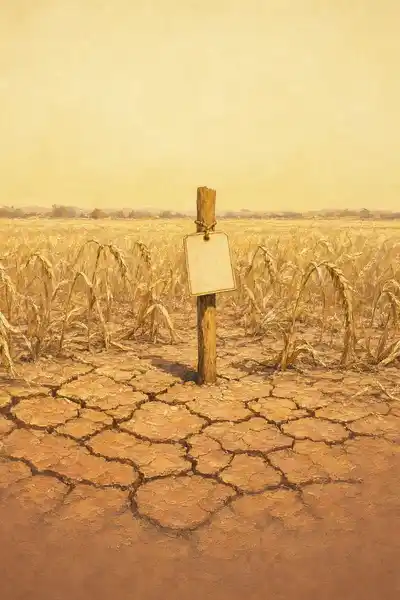
If Brown has a single obsession, it's soil and the harvests that depend on it, and this is where his agronomist's eye is sharpest. The planet's cropland is a thin, slow-made skin, and across vast stretches — the North American plains, the loess plateaus of China, the fields of the Sahel — it is blowing and washing away faster than nature rebuilds it. Two new dust bowls, he warned, were forming: one across northern China and Mongolia, one across sub-Saharan Africa. These are not metaphors. They are dust storms large enough to darken cities and strip the productive layer from land that feeds hundreds of millions.
Layered on top of erosion is the harder blow of a warming climate. Brown drives home a relationship most people never learn: crop yields fall sharply once temperatures climb past a certain threshold during the growing season. As a rough rule he cited, each degree Celsius of warming above the norm during the growing season can cut grain yields by around a tenth. A heat wave that would once have been a bad summer becomes, in a hotter world, a harvest failure. The 2010 Russian heat wave, which slashed the country's grain crop and prompted an export ban, was for Brown a preview, not an anomaly.
03Chapter 3 — Water tables, food prices, and failing states
The most alarming account in Brown's ledger is groundwater, because it is invisible until it's gone. Across India, China, the United States, the Middle East, and beyond, farmers have drilled millions of wells and pumped aquifers far faster than rain can recharge them. Brown estimated that a substantial share of the world's people were being fed with grain grown by overpumping — food produced on borrowed water. This is a bubble within the bubble. When an aquifer is depleted, pumping doesn't taper gently; it stops, and the irrigation it supported stops with it. The grain that water grew vanishes from the world's supply, all at once.
Brown connected these dry facts to the daily reality of billions through a single number: the price of grain. As harvests strain against depleting water and eroding soil, and as more grain is diverted to feed livestock and fuel cars, the surplus that once cushioned bad years thins out. Prices spike. For a well-off household, a jump in the cost of wheat is an annoyance. For a family in a poor country that already spends most of its income on food, it is the difference between eating and not. This is where the environmental ledger and the human one finally merge.
04Chapter 4 — The wartime scramble Brown wants
Step back from the individual crises and Brown's real thesis comes into focus: the environmental emergency is, at bottom, an economic accounting error, and it can be corrected with economic tools if we choose to use them. The reason we liquidate forests, aquifers, and climate stability is that the market prices tell us they are nearly free. The price of a gallon of gasoline, he argued, reflects the cost of pumping and refining it but almost none of the cost of the climate disruption, the respiratory illness, or the eventual cleanup it causes. Get the prices to tell the truth — largely by shifting taxes from income onto carbon and other environmental damage — and the whole economy reorients itself toward what it should have valued all along.
But Brown did not believe pricing alone, arriving through ordinary politics, would move fast enough. His signature move is the analogy to 1942. When the United States entered the Second World War, it converted its economy in a matter of months — automobile plants stopped making cars and started making tanks and aircraft, the whole industrial base retooled at a speed nobody thought possible. Brown's contention was that the climate and resource crisis demands exactly that register of response: not incremental targets for mid-century, but a wartime-scale mobilization to cut carbon emissions dramatically and quickly, restore soils and forests, stabilize population, and rebuild the natural systems the economy runs on.
05Conclusion
Brown ends where an accountant would: with the sober recognition that the correction is coming either way, and only the terms are still ours to set. We can restructure the economy deliberately — pricing in the true costs, shifting the tax burden, mobilizing at the speed of a war — or we can let depleted aquifers, failing harvests, and collapsing states restructure it for us, on far harsher terms. The Sumerians and the Mayans did not get to choose their timing. Brown's wager was that we still can, but that the window narrows with every year we treat the alarm as background noise.
Related books