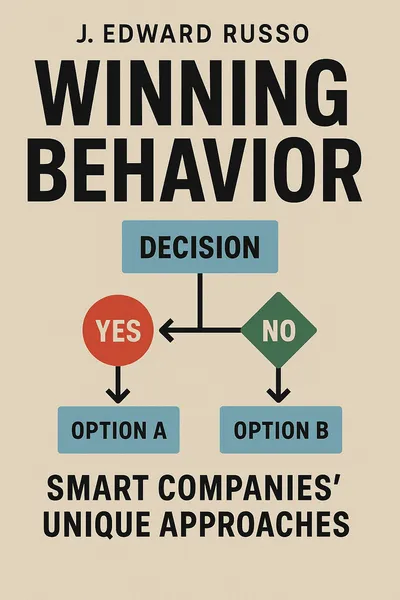
Winning behavior
Smart companies' unique approaches
Description
Effective decision-making requires a structured process. First, accurately frame the problem to determine the viewpoint. Next, thoroughly gather intelligence on all knowable and currently unknowable facts. Then, reach a conclusion that flows logically from the framing and facts.
Finally, systematically learn from implementation to improve future decisions. Additionally, taking time upfront to determine the right questions provides direction. Following through to apply lessons learned completes the process. With this robust approach of framing, intelligence gathering, concluding, learning, directing questions, and applying lessons, businesses can make sound decisions quickly.
Table of contents
01 Preparation - set the course
Making sound decisions is a critical skill in life, yet many people do not approach decision-making systematically. By taking time to thoroughly assess the situation before deciding how to decide, you can set yourself up for better choices. An initial assessment allows you to step back, examine the bigger picture, gather pertinent information, and determine the best decision-making process before diving in.
A good initial assessment involves answering several key questions upfront: What is the heart of this decision? Should it be made alone or with input from others? How much time is needed? What past experiences or decisions can inform this one? What are my own biases and perspectives, and what other viewpoints would be constructive? Essentially, an initial assessment pushes you to gain clarity on the problem, direction, and resources needed to make the best choice.
Conducting an initial assessment can optimize the decision-making process in several ways. It can help determine whether the decision is best made analytically or emotionally, individually or in a group. It enables you to identify how much time should be allocated and how to best utilize it. An assessment also sheds light on related past decisions and experiences that might guide you. Fundamentally, it makes you consider your own tendencies, strengths, and limitations regarding the choice at hand.

02 Phase 1 - frame the situation
Family-owned businesses stand out for their commitment to values and principles that ensure their success and longevity across generations. These enterprises prioritize ethical conduct, compassion for employees, and social responsibility over short-term profit pursuits. By adopting a long-term outlook focused on sustainability, they make decisions that benefit the business for decades or even centuries.
This approach often means putting employee satisfaction and work-life balance at the forefront, fostering loyalty and productivity. Unlike traditional corporate structures, family businesses often have flatter organizational hierarchies, valuing input from all employees in decision-making processes. This inclusivity makes employees feel more connected and invested in the company's success.
03 Phase 2 - gather the facts
In today's information-rich environment, transforming vast data into meaningful insights poses a significant challenge. It involves a nuanced evaluation of known facts, a careful consideration of uncertainties, and a diligent effort to eliminate biases that can skew judgment. While the process of gathering intelligence might appear straightforward—posing the right questions, interpreting the answers accurately, and recognizing when sufficient data has been collected—there are numerous pitfalls that can introduce bias. Overcoming these biases is crucial at this stage of decision-making.
A common bias is undue optimism, often observed among business leaders who tend to rely heavily on their beliefs. Effective decision-makers, however, ground their conclusions in facts, acknowledging the limits of their personal knowledge. Closely related is the overconfidence bias, which involves overestimating one's knowledge while underestimating the unknowns. Successful intelligence gathering requires equal effort in identifying both knowns and unknowns.
Humans have a tendency to prefer information that confirms their existing beliefs and to dismiss evidence that contradicts these beliefs as inaccurate. This approach distorts the facts and poses a risk for decision-makers. Instead of seeking quick affirmations, adept decision-makers actively search for evidence that disproves their assumptions by asking probing questions, considering multiple hypotheses, conducting analyses to identify flaws in preferred hypotheses, and challenging others to justify their confident conclusions.
04 Phase 3 - determine the outcome
Decisions are often made by default rather than consciously choosing the best approach. Good decision makers utilize four fundamental methods: intuitive, rules of thumb, decision weighting, and value analysis. The challenge is determining the most fitting approach for the decision at hand.
These four decision making approaches range from simple to complex. The intuitive method relies solely on instinct without analysis. There is no rationale beyond a “gut feeling” that it's the right choice. Rules of thumb mean following conventional wisdom without scrutiny. The trouble is outdated or improper rules are frequently still applied, worsening outcomes.
Decision weighting assigns relative importance weights to each factor. By prioritizing the most critical factors, they have greater sway on the final decision. Properly applying this necessitates a reliable mathematical process. One variation called “bootstrapping” leverages external experts’ judgements to set weights and create a model surpassing any individual’s capabilities.
Value analysis further develops decision weighting by connecting factors to key objectives based on the decision maker’s values. It accounts for how increasing any one factor does not necessarily add equivalent value to the overall decision. Accurate value analysis utilizes “multi-attribute analysis,” a mathematical technique commonly applied for major corporate choices like plant locations and infrastructure projects.
05 Phase 4 - learn from the past
Experience provides information about what has happened in the past. Learning, on the other hand, involves understanding why those events occurred so that we can either avoid or repeat them in the future if we so choose. An effective decision-making process incorporates the systematic evaluation of both positive and negative experiences.
Experience itself does not automatically lead to learning. There must be a purposeful, thoughtful analysis of past events in order to determine what was done correctly and what was not. Failing to learn from experience can occur for several reasons. First, the outcomes of previous decisions may be unclear, making it difficult to know for certain what transpired. Second, immense time pressures can prevent reflective thinking needed to derive meaning. Third, there may be an absence of feedback showing how earlier choices played out in reality. Finally, people are often defensive regarding their mistakes and thus reluctant to frankly discuss errors.
Multiple strategies can help overcome these roadblocks to productive learning. We should examine not just results but also the decision-making process used to arrive at those results. Distinguishing between process and outcome reduces the impulse to conceal mistakes. Regularly challenging outdated assumptions and encouraging “unlearning” of obsolete ideas is beneficial. Rather than ignoring apparently uneventful data, all available information should be utilized in analysis. Adopting an outsider’s perspective, such as that of a competitor or business partner, can provide fresh insight.
Additionally, sticking to objective facts rather than subjective inferences aids clarity. Before starting a project, clearly defining how success and failure will be gauged allows for accurate measurement of outcomes. Accepting personal accountability for results enables honest assessment of what could have been done better. Asking uninvolved parties to analytically review what happened supplies an independent lens. Maintaining a decision diary to record choices and the logic behind them assists in comparing expectations to actual events over time, sharpening predictive abilities.
06 Follow up - apply what you learned
Simply having knowledge about the decision-making process is insufficient for deriving actual benefits. The true advantages come from rigorously and consistently applying what you know. Do that, and every future decision has the potential to be successful. Some final thoughts on utilizing your knowledge and making sound choices:
First, understand and respect the decision-making process without becoming enslaved by it. The process is adaptable rather than rigid. It sometimes needs customization to specific situations. Strive to be proactive in attempting to make prudent decisions so fewer choices get made arbitrarily or due to external pressures.
Additionally, rehearse making wise decisions until the process becomes second nature. This way, when demands escalate, you will know precisely how to respond. Regularly evaluate your advancement by tracking the time spent on each decision-making stage. Compare that to your previous approach. Learn whether you are adhering to the ideas or merely paying them lip service.
Related books