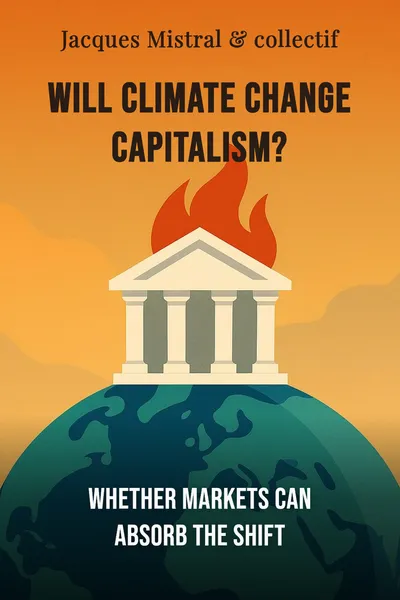
Will Climate Change Capitalism?
Whether markets can absorb the shift
Description
In 2015, in a conference room in Paris, negotiators from nearly two hundred countries agreed to hold global warming well below two degrees Celsius above pre-industrial levels. The agreement was celebrated as a diplomatic breakthrough. It was also, read closely, a statement about economics: to keep that promise, the world would have to leave most of its known fossil reserves in the ground, retire trillions of dollars of infrastructure early, and rewire the energy base of every economy on earth. The Paris Agreement set a target. It said almost nothing about who pays, in what order, and whether the system that produced the problem can be the one that solves it.
That silence is where the economist Jacques Mistral steps in. Alongside a group of contributors, he assembles a book that refuses the easy comfort of a single answer. The title is a deliberate pun: Will Climate Change Capitalism? Does the warming planet force a transformation of the market order, or can capitalism absorb the shift the way it has absorbed every previous shock, pricing the danger, reallocating capital, and moving on? The book gathers economists who disagree, and it does not pretend to referee the fight.
What makes the collection worth sitting with is that it treats the climate as a mirror. Ask an economist how to handle a warming planet and they will tell you, without quite meaning to, what they already believe about states, prices, and how strangers coordinate. The answers diverge not because the science is unsettled but because the economics never was.
The question we’re asking : Can the market order that produced climate change also be the one that resolves it, or does the shift demand something capitalism cannot deliver?What we’ll see : How a group of economists reads the same warming planet and comes away holding very different maps of the future.
Table of contents
01Chapter 1 — The price nobody wants to pay
The starting point for almost every economist in the book is a phrase coined nearly a century ago: externality. When a factory burns coal, the smoke costs something to everyone downwind, but that cost never appears on the factory's ledger. The market, left alone, treats the atmosphere as free. Arthur Pigou, writing in the 1920s, argued that the fix was a tax equal to the damage, forcing the polluter to feel the full weight of what they release. Climate change, in this reading, is the largest externality ever recorded, a market failure at planetary scale.
The economist's instinct, then, is not to abolish the market but to complete it. Put a price on carbon, and the invisible hand does the rest: firms that can cut emissions cheaply will do so, capital flows toward cleaner technology, and consumers adjust without anyone having to plan the transition from above. The elegance is real. It promises the biggest change in industrial history achieved by tweaking one number rather than by decree. Nicholas Stern's landmark 2006 review for the British government framed the whole crisis in exactly these terms: act now, and the cost is a manageable slice of global output; delay, and it balloons.

02Chapter 2 — The technocrat's bet on carbon
Mistral himself belongs, broadly, to the reformist camp, the economists who think capitalism can carry the load if it is steered with enough skill. Their wager is that the transition is fundamentally an engineering and financing problem, not a crisis of the system itself. Give investors a credible, rising carbon price and clear long-term rules, and the enormous pools of private capital sitting in pension funds and insurance balance sheets will move toward decarbonization because it becomes the profitable thing to do. The state sets the direction; the market supplies the horsepower.
This camp points to genuine momentum as evidence. The cost of solar power fell by roughly ninety percent over the 2010s, faster than almost any forecast predicted, precisely because subsidies and early markets pulled the technology down a steep learning curve. Wind followed. Electric vehicles, once a curiosity, became a category that established carmakers could no longer ignore. To the reformists this is capitalism doing what it does best: once the incentives point in a direction, innovation and scale arrive faster than planners can imagine. The job is to fix the incentives and hold the course.
03Chapter 3 — When markets aren't enough
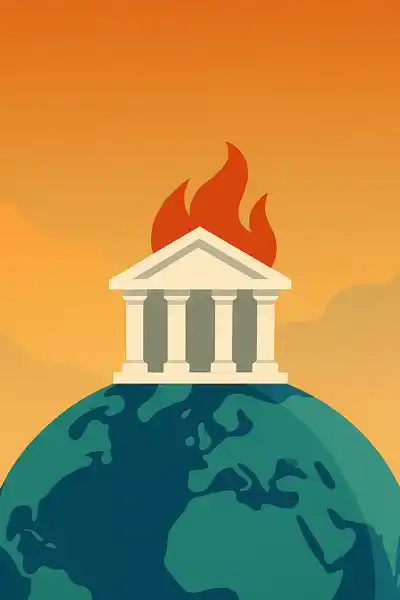
Against the reformists, the book sets a more radical current, economists who argue that pricing carbon inside the existing system is like adjusting the thermostat on a house that is already on fire. Their objection is not technical but structural. Capitalism, in this view, is built on compound growth, on the imperative to expand output and consumption year after year, and that imperative sits in permanent tension with a finite biosphere. You can green the growth, but you cannot green the growth forever. Sooner or later the arithmetic of endless expansion collides with the arithmetic of a single planet.
From this camp come the more disruptive proposals the book takes seriously: heavy public investment on the scale of wartime mobilization, direct regulation that simply bans the worst technologies rather than waiting for a price to nudge them out, and, at the edges, the degrowth argument that wealthy economies should deliberately shrink their material throughput. What unites these positions is a distrust of the idea that a decentralized market, however well-priced, will deliver a coordinated result on the timeline required. Some things, they argue, have to be decided and built, not merely incentivized.
04Chapter 4 — A book that refuses to end the argument
Step back from the individual positions and a pattern emerges that is more revealing than any of them. The climate does not so much create disagreement among economists as expose a disagreement that was already there. Confronted with a warming planet, each contributor reaches for the framework they trusted before the crisis arrived. The believer in markets sees a missing price. The believer in the state sees a coordination problem markets cannot touch. The believer in limits sees the growth machine finally hitting its wall. The same graph of rising temperatures reads as three different indictments depending on who is holding it.
This is why Mistral's collection resists the temptation to crown a winner. The point is not that the economists are confused, but that climate change has become the terrain on which the deepest fault line in economics is being re-fought. Is capitalism a flexible instrument that can be tuned to almost any social goal, or is it a system with a built-in direction that no amount of tuning can override? That question predates the industrial burning of coal by more than a century. The warming planet has simply raised the stakes of answering it until it can no longer be deferred.
05Conclusion
The Paris promise still stands on paper, and the gap between that promise and the machinery meant to keep it is exactly the gap Mistral's contributors spend the book measuring. They agree on the physics and on the scale of what is required. They part ways the moment the conversation turns to the economy that will have to do the work, because that is where their prior convictions were waiting all along. The book's title asks whether climate will change capitalism. Its honest answer is that we do not yet know, because we have not decided what we want capitalism to be.
Related books