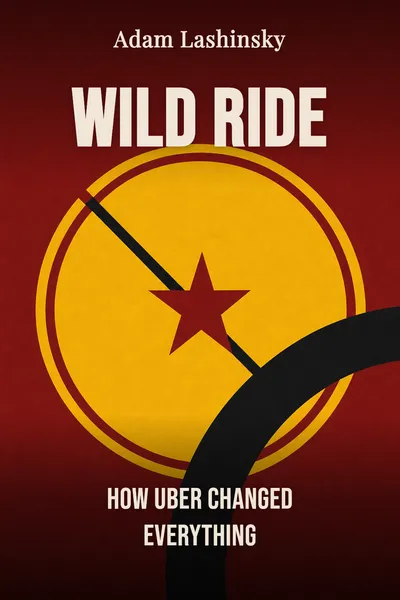
Wild Ride
How Uber changed everything
Description
On a snowy night in Paris in December 2008, two Americans couldn't get a cab. Travis Kalanick and Garrett Camp were in town for a tech conference, and the frustration of standing in the cold gave Camp an idea he'd been chewing on for a while: what if you could summon a car from your phone, the way you summon anything else, with a tap? By the time they flew home, the sketch of a company existed. Camp built the first version. Kalanick, who had already sold two startups and had the scars of a decade of fights with bigger players, came on as an adviser, then took the wheel entirely. The app launched in San Francisco in 2010 under the name UberCab, black town cars only, a luxury toy for people who found taxis beneath them.
Seven years later, the thing that started as a way to feel important in a Lincoln had become one of the most valuable private companies on earth, operating in hundreds of cities, worth tens of billions of dollars, and reviled by regulators and taxi drivers on nearly every continent. It also had a reputation for scorched earth. The word people reached for, over and over, was aggressive. Adam Lashinsky, a longtime Fortune editor who spent months inside the company, set out to figure out how a car-service app became a global force — and what kind of person builds a machine like that.
His answer, laid out in Wild Ride, is less about technology than about temperament, timing, and a particular reading of what cities are for. The car was always the easy part. The hard part was everything around it.
The question we’re asking : How did a black-car app for the well-off turn into global infrastructure — and what did it take, and cost, to get there?What we’ll see : The everyday magic of tapping a phone and having a stranger appear, and the harder story of the company, the founder, and the rules that all bent around it.
Table of contents
01Chapter 1 — The city built to move
Lashinsky opens with the deceptively simple thing Uber sells: friction removed. Before the app, hailing a ride meant standing on a corner, hoping, or calling a dispatcher and waiting for a car that might never come. The taxi was a scarce, regulated, oddly hostile product — a system where the customer had almost no leverage and no idea when help would arrive. What Uber did first was not build a car network. It built certainty. You could see the car coming on a map, you knew roughly when it would land, and you never touched cash. The payment happened invisibly, which turned out to matter enormously; removing the awkward end-of-ride transaction made the whole thing feel less like a service and more like a favor from a friend.

02Chapter 2 — A founder who liked to fight
The book's real subject is Kalanick, and Lashinsky is careful not to flatten him into a villain or a genius. He was, by every account, extraordinarily combative — a competitive obsessive who treated business as a contact sport and seemed to genuinely enjoy the conflict. Before Uber he'd run a file-sharing startup called Scour that was sued into oblivion by the entertainment industry for a reported quarter-trillion dollars in damages, and then a company called Red Swoosh that he sold to Akamai in 2007. He came to Uber having been ground down twice by incumbents with more money and better lawyers. He arrived determined never to be the one who loses that fight again.
03Chapter 3 — The math nobody had done before
Underneath the drama sits a genuinely novel piece of engineering, and Lashinsky spends real time on it. Uber's hardest problem was never getting one rider to one driver. It was balancing a marketplace with two sides that both had to show up, in the right numbers, in the right places, at the right times, or the whole thing broke. Too many drivers idling meant angry drivers earning nothing. Too few meant riders waiting and quitting. The company had to conjure supply and demand into equilibrium in thousands of neighborhoods at once, minute by minute.
The lever was pricing — specifically, surge pricing, the mechanism that raises fares when demand outstrips supply. It was, and remains, the most hated feature Uber ever shipped. Riders saw it as gouging, especially during storms or on New Year's Eve when everyone needed a car at once. Lashinsky lays out the company's defense without fully endorsing it: the higher price wasn't punishment, it was a signal. It told riders who could wait to wait, and it told drivers where the money was, pulling more cars onto the road exactly when they were needed. The ugliness of the number was, in the design, the point — it was the market doing its job in public, where people had never had to watch before.
04Chapter 4 — When one app rewires a habit
Step back from the fares and the fights, and Lashinsky's Uber is a case study in what happens when a private product quietly becomes public infrastructure. Nobody voted for Uber to reshape how cities move, but that's what it did. Once enough people stopped owning cars, stopped memorizing bus schedules, stopped worrying about parking, the app wasn't a convenience anymore — it was load-bearing. Emergency rooms noticed drunk-driving patterns shift. Real-estate listings started bragging about walk-and-ride scores. A generation of young people in dense cities simply never bought a car. That's not a feature. That's a change in how a society is arranged.
The trouble is that infrastructure comes with obligations a startup never signed up for. Roads, utilities, and transit are regulated precisely because everyone depends on them and the failures are collective. Uber grew into that role at a pace that left the rules years behind. The taxi medallion systems it disrupted were flawed and often corrupt, but they existed to answer questions Uber preferred not to answer: who bears the risk when a driver crashes, who guarantees service to the parts of town that aren't profitable, who makes sure a driver earns enough to live. Lashinsky's Kalanick treats those questions as friction to be routed around. History, by the time you read this, has been forcing them back onto the table.
05Conclusion
Wild Ride was written near a peak, before the reckoning that would push Kalanick out of the company he built in 2017, months after the book appeared. Lashinsky, reporting from inside, saw both the machine and its maker clearly enough to sense the storm coming without quite naming its shape. What he captured is the origin story with its ambitions intact: two men who couldn't find a cab in Paris, and a founder who turned that irritation into a company that treated the whole world as a market to be won, city by city, fight by fight.
Related books