

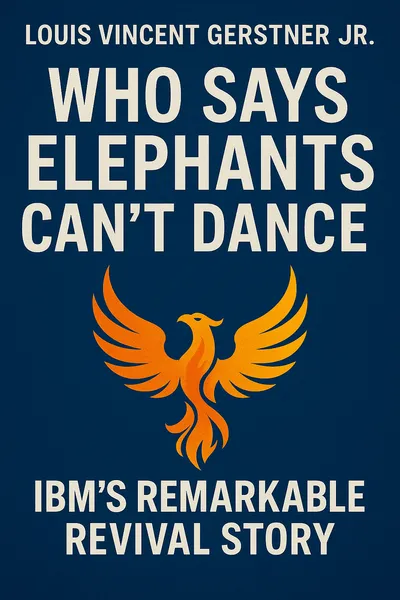
Who says elephants cant dance
Ibm's remarkable revival story
Description
During his tenure from 1993 to 2002 as the head of IBM, Lou Gerstner orchestrated a remarkable revival of the company's prospects. At the onset of his leadership, IBM faced potential collapse due to swift technological shifts.
Contrary to widespread expectations of IBM's disintegration, Gerstner, with his executive team, revitalized the corporation, re-establishing its dominance and influence in the tech sector. This turnaround is widely regarded as one of the most extraordinary recoveries in the annals of corporate history.
Table of contents
01Four pivotal choices
When Lou Gerstner took over as chairman and CEO of IBM on April 1, 1993, he was well aware of the monumental task ahead. IBM was on the brink of reporting a staggering $16 billion loss, and there was widespread skepticism about the company's survival in its existing form. The consensus was that IBM needed a major overhaul or breakup.
Gerstner, an outsider and the first to lead the tech giant, chose a measured approach, spending the initial months understanding IBM's vast operations, which included approximately 300,000 employees and several large divisions with multi-billion-dollar revenues. He recognized the state-of-the-art research labs and the potential of the technologies being developed.
By the end of July 1993, Gerstner had made several critical decisions. He chose to keep IBM intact, seeing the company's size and scope as a competitive edge. He aimed to transform IBM into a systems integrator that provided complete solutions rather than fragmenting into specialized segments.

02Two major future investments
In the transformative journey of IBM over the past decade, the narrative centers around two pivotal decisions: the anticipation of the industry's trajectory and the strategic redirection of IBM itself.
This story unfolds against the backdrop of IBM's historical success with the System/360 mainframe computer family, which had propelled the company into a conglomerate of multi-billion-dollar enterprises across various sectors such as semiconductors, hardware, software, sales, and support. By the 1990s, IBM was a dominant force in its field.
However, the advent of the UNIX operating system in the early 1990s marked a turning point, enabling companies to piece together solutions from different suppliers. This shift threatened IBM's mainframe dominance, as companies like Sun, Hewlett-Packard, Silicon Graphics, and Digital began to encroach on its territory. Concurrently, the rise of PCs suggested a move towards client/server models, further challenging IBM's position. Despite these challenges, under the leadership of Louis Gerstner, IBM embarked on a radically different path.
IBM's first strategic bet was on the future direction of the company, with a vision that the information technology industry would transition from being technology-led to services-led. IBM anticipated a demand for integrated, end-to-end solutions tailored to the specific processes of business enterprises, rather than disjointed offerings from multiple suppliers. This approach required a cultural shift within IBM, fostering an openness to recommend competitor products when they better served customer needs. This strategy proved successful, with IBM's service revenues soaring from $7.4 billion in 1992 to over $30 billion by 2001.
03Crafting business strategy
In the early 1990s, IBM found itself at a crossroads, grappling with the need to redefine its direction and strategy in an industry that was rapidly evolving. The company, once dominant in the realm of hardware, faced the challenge of transitioning into a software-centric business, amidst fierce competition and technological shifts.
This period marked a transformative era for IBM, under the leadership of Lou Gerstner, who steered the company through a series of strategic decisions that would redefine its future. One of the pivotal moves was the expansion of IBM's software business. Despite being the world's largest software seller in 1993, surpassing even Microsoft, IBM had not fully embraced its identity as a software developer.
The company's software was primarily designed for IBM mainframes and was not seen as a standalone product. This perception began to change as IBM aimed to rectify past mistakes, including the development of the OS/2 operating system, which failed to dethrone Microsoft in the PC market. Gerstner's decision to halt the OS/2 project marked a shift towards focusing on middleware, such as databases and transaction management software, which proved to be a more lucrative and strategic fit for IBM.
To consolidate and enhance its software offerings, IBM undertook a significant restructuring of its software development programs, bringing them under the purview of a single manager. This move streamlined the development process and allowed for a more focused approach to product selection. Additionally, IBM made strategic acquisitions, including the purchase of Lotus Development Corporation for $3.2 billion, which brought the Notes product into its portfolio, further strengthening its position in the software market.
04Transforming ibm's culture
Lou Gerstner, during his tenure at IBM, profoundly understood that the essence of any organization's success lies not just in its strategies or management systems but fundamentally in its culture. He believed that the collective ability of the people within an organization to create value is what truly defines it. This perspective highlights the critical role of culture in ensuring long-term success across various sectors, including business, government, education, and healthcare.
Gerstner's insights into corporate culture further delve into how it emerges and evolves within large institutions. He observed that successful organizations develop strong cultures that underscore their core strengths. However, these cultures, deeply rooted in the founder's values and beliefs, often struggle to adapt when external conditions change.
This was particularly evident in IBM's case, where the culture established by Thomas J. Watson Sr. initially drove the company to prominence but later hindered its ability to evolve with changing customer preferences.
IBM's early culture was built around three fundamental beliefs: excellence in everything, superior customer service, and respect for the individual. While these beliefs propelled IBM forward, they eventually led to a rigid corporate structure resistant to change. The pursuit of perfection slowed decision-making, the company's approach to customer service became prescriptive rather than responsive, and a culture of entitlement emerged among employees.
05Essential takeaways learne
Lou Gerstner's tenure at IBM unveiled three pivotal lessons on leadership and business success, emphasizing focus, execution, and leadership availability. Gerstner's insights reveal that successful leaders and businesses maintain a sharp focus, resisting the temptation to diversify into unfamiliar territories. This focus is crucial, especially during economic downturns, where the allure of new ventures can distract from core competencies, leading to further decline. Gerstner highlights the pitfalls of acquisition fever and the importance of understanding customer needs and economic realities. He argues that truly great companies concentrate on a few critical areas, allocating resources effectively to maintain their competitive edge.
Gerstner also underscores the significance of execution, noting that in most industries, success is driven by a few key factors. Companies that excel are those that outperform their competitors in these areas through superior execution. This involves demanding accountability, employing world-class processes, ensuring strategic clarity, and fostering a high-performance culture. Gerstner points out that execution is often overlooked but is essential for translating strategies into action and achieving business goals.