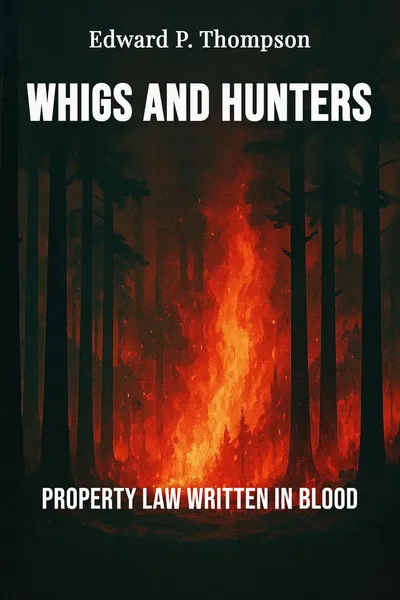
Whigs and Hunters
Property law written in blood
Description
In May 1723, the English Parliament passed a law so sweeping that it created some fifty new capital offences almost overnight. It was known as the Black Act, after the men who blackened their faces to poach deer and raid parks under cover of night. To carry a snare in the wrong wood, to fish a private pond, to cut down a young tree, to appear armed and disguised near a forest — any of these could now send a man to the gallows. The statute sailed through with almost no debate, and it stayed on the books, expanded and reinforced, for the better part of a century.
Two and a half centuries later, the historian Edward Thompson set out to understand why. He had come to the eighteenth-century forest expecting to write something narrow — a study of the crowd, of protest, of the tangled undergrowth of Windsor and Hampshire where deer-stealers and gamekeepers fought their quiet war. What he found instead pulled him toward a much larger question about what law actually is, who writes it, and whose interests it quietly encodes. The book that resulted, Whigs and Hunters, published in 1975, has stayed uncomfortable ever since — not least because Thompson refused the tidy conclusion his own evidence seemed to demand.
The forest, in the 1720s, was not empty scenery. It was contested ground, layered with old rights and new claims, where cottagers who had always taken wood and grazed animals suddenly found themselves branded as criminals. The Black Act did not descend from nowhere. It was written by particular men, for particular reasons, at a particular moment when a new kind of wealth was tightening its grip on the land.
The question we’re asking : What happens when a fresh ruling class decides that ancient customs are now crimes, and writes the death penalty into the trees?What we’ll see : How a hurried statute, a running conflict in the royal forests, and a historian's reluctant honesty converge on the oldest question about law — whose it is.
Table of contents
01Chapter 1 — A statute passed in a fortnight
The Black Act reached the statute book in the spring of 1723, and it arrived at speed. Where most legislation of the period was chewed over, amended and delayed, this one moved through Parliament in a matter of weeks with barely a recorded objection. Its official name — an act for the more effectual punishing of wicked and evil-disposed persons going armed in disguise — announced its target plainly enough. Its reach was another matter. By the time it was done, it had heaped capital penalties on a bewildering range of acts: hunting deer, breaking fishponds, cutting trees, maiming cattle, sending threatening letters, and simply being found armed and blacked in a forest or park.
The trigger was a run of disturbances in Windsor Forest and the Hampshire woods around Farnham and Waltham. Bands of men, faces darkened, had been taking deer, poaching game, and settling scores with keepers and gentry who had encroached on land they regarded as theirs by long use. To the government of the day, this looked like organised insolence — perhaps even Jacobite conspiracy, given the jittery politics of the young Hanoverian regime. The convenient assumption of a hidden plot helped justify a law of extraordinary severity for offences that were, in most cases, about deer and firewood.

02Chapter 2 — The foresters who refused to disappear
Before the statute, there was the conflict, and the conflict had roots that went down for generations. The people of the forest — cottagers, small farmers, artisans, labourers — had long lived off a web of customary entitlements. They gathered fallen wood, cut turf and bracken, grazed pigs and cattle on the wastes, took the odd deer in hard seasons. None of this was written down as a right in any deed; it was simply how the forest had always worked, an economy of use rather than of ownership.
That economy was under attack. Through the early eighteenth century, the men who controlled the forests were enclosing land, tightening game laws, planting timber for profit, and reasserting deer parks that had grown lax. Each move nibbled at the customary commons. When keepers fenced off grazing or prosecuted a man for taking wood his father had always taken, the forester did not experience this as the enforcement of law. He experienced it as theft — a slow, legal robbery of what had been his community's for as long as anyone could remember.
03Chapter 3 — The gallows and the paperwork
Once the Act existed, it had to be used, and its use is where the machinery becomes visible. Special commissions were set up, informers rewarded, suspects hunted across counties. The regime wanted examples, and it got them. Men were tried and hanged; others fled or turned king's evidence against their neighbours. The forest communities, already squeezed, now faced a legal apparatus that could translate a night's poaching into a corpse on a scaffold.
Thompson follows individual cases through the courts with the patience of someone who distrusts summaries. He watches how charges were framed, how the vagueness of the statute let prosecutors reach almost anyone, how the threat of capital punishment was used to extract confessions and cooperation. The law's breadth was not a drafting accident; it was a feature. A statute that criminalised being armed and disguised near a forest could catch a poacher, a protester, or an inconvenient enemy with equal ease.
04Chapter 4 — What the law is when we look closely
Having spent a whole book showing law serving one class against another, Thompson could have ended with the obvious verdict: that law is simply power in a wig, a mask over naked domination. Many of his own comrades on the left expected exactly that conclusion, and the final pages of Whigs and Hunters became famous precisely because he declined to give it. The Black Act was, without question, an instrument of class. But instrument, he insists, is not the whole story.
The reason is that law, to function as an instrument of rule, has to be more than a whim. If the powerful want to invoke the authority of law — to have their seizures called justice rather than robbery — they must submit, at least some of the time, to law's own logic. The rules have to apply generally, or they cease to look like rules. Procedures have to be observed, or verdicts lose their force. Occasionally, this means the ruled can hold the rulers to their own words: a jury acquits, a case collapses, a right is grudgingly upheld. The mask, worn long enough, constrains the face beneath it.
05Conclusion
The Black Act outlived the men it hanged. Passed in haste in 1723 to crush a handful of deer-stealers, it lingered on the books for a hundred years, expanded and repurposed, long after the blacked faces of Windsor had faded from memory. The foresters lost their war; the customary commons they defended were enclosed, timbered, and turned to private profit. The property the statute protected became, in time, simply the natural order of the countryside — as if it had never been fought over at all.
Related books