

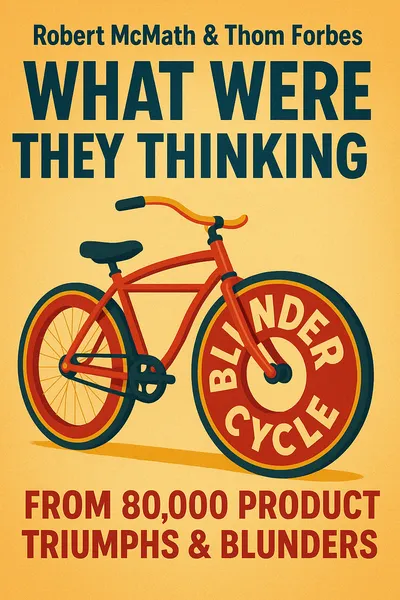
What were they thinking
From 80,000 product triumphs & blunders
Description
Companies repeatedly waste millions of dollars by failing to learn from past marketing mistakes. This cycle of repeated errors could be avoided if marketers studied previous failures to understand what went wrong. By analyzing past mistakes, strategies can be adjusted to increase the likelihood of success. For example, New Coke was launched in 1985 but quickly failed due to negative customer reaction. Coca-Cola Company lost millions and had to re-launch original Coke. Had they tested the new formula more rigorously with focus groups first, they could have anticipated the backlash.
Similarly, Burger King's 2021 International Women's Day campaign was seen as tone-deaf and sexist, resulting in public criticism and brand damage. More careful vetting of the messaging could have prevented this blunder.
In contrast, by looking at what works, success can be replicated. For instance, product giveaways generate interest and word-of-mouth marketing. Pre-launch contests have proven effective for many brands to create buzz.
While new products are inherently risky, marketers can tilt odds in their favor through careful testing, getting customer feedback early, and remaining nimble to make changes when needed. Learning from past mistakes and successes is key to avoiding the same expensive errors again.
Table of contents
01Satisfying millennial wants
Products that will succeed in the coming decades must meet or exceed customer expectations in areas like convenience, environmental soundness, ethnic diversity, fun, nutrition, packaging, sizing, and youth appeal. Consumers will pay more for time-saving conveniences that make life easier, prioritizing these over even political correctness, so genuine convenience gives sustainable competitive edge.
Most people now feel obligated to preserve the environment for future generations, within reason, so incorporating recycling and other eco-friendly processes can appeal while still producing quality goods and services. Due to health concerns and immigration, food tastes keep evolving toward spicier and more ethnic flavors, a trend expected to continue as consumers acclimate.

02Duplicate offerings spell failure
Me-too marketing, which involves selling products that are essentially copies of existing ones, often fails because it requires convincing consumers and retailers of the product's superiority, leading to high advertising costs and potential price wars.
Instead, creating innovative products that meet consumer needs and have a competitive edge is more effective. Many companies opt for line extensions, which are variations of existing products, as they are cheaper to launch and can test market trends. However, line extensions can dilute the brand, potentially steal sales from the company's own products, and may not always meet consumer desires.
03Learning from history
Learning from past failures is crucial in new product development to avoid repeating mistakes. However, many companies have downsized, leading to less job security and diminished loyalty, which in turn erodes corporate culture and traditions. As a result, the lessons from history are often forgotten.
The departure of long-serving employees due to downsizing means the loss of institutional memory, leading to products that replicate past failures, a lack of understanding of the impact of unsuccessful launches, and a disregard for target markets with unoriginal products.
04Excess expansion hampers innovation
Innovative products distinguish themselves by offering consumers significant new benefits over what's currently available in the market. However, as the number of products increases, the essence of true innovation often diminishes. To assess whether a product is genuinely innovative, five critical considerations are necessary.
Firstly, an innovative product should attract new consumers to the market, those who haven't previously engaged with the category, rather than just vying for a share of existing customers. Secondly, it should feature novel packaging that delivers real benefits to consumers, moving beyond traditional materials to more sustainable or functional alternatives.
05Explicitly state all benefits
Effective marketing hinges on transparently communicating the purpose and usage of your product to consumers. It's a mistake to assume that customers will automatically grasp how to use what you're selling. Without clear instructions and detailed explanations, your marketing efforts are likely to falter.
Providing comprehensive information about your product's features and uses not only gives consumers reasons to buy but also encourages quicker consumption and repeat purchases. However, it's important to recognize that consumers might use products in unexpected ways or form incorrect assumptions. For instance, when Planters introduced vacuum-sealed peanuts, many mistook them for a new coffee brand, leading to confusion and misuse.
06Tweaking top sellers invites decline
Companies often fall into the trap of altering their most profitable products and services during times of financial prosperity, a move that can lead to a decline in sales over time. This practice of meddling with what works well during periods of success is comparable to corporate self-sabotage, even for brands that have survived tough competition.
PepsiCo's recent endeavors serve as a warning, with the introduction of various stuffed-crust options and chicken wings through Pizza Hut, along with a clear cola drink named Crystal Pepsi, which diluted the brand without allowing new variations to make an impact. The $100 million investment in Crystal Pepsi was particularly detrimental as the product was not well-received for its taste, leading to confusion among consumers about the brand's qualities and associations.
07Brand image matters
Marketing fundamentally revolves around the concept of image, even when it paradoxically claims "image is nothing." When consumers invest in a product or service, they're not just purchasing the item itself but also the brand's narrative, emotional appeal, lifestyle aspirations, and the status it conveys.
Advertising focuses less on the product's specifications and more on how it positions consumers as trendy, innovative, and in tune with the current culture, achieved through the endorsement of the "right" brand. For instance, Sprite's 1990s campaign promoted an "anti-image" stance, encouraging consumers to "obey their thirst," resonating with the youth's disdain for imposed coolness.
08Trends versus passing interests
Distinguishing between trends and fads is essential in marketing, as trends are long-lasting while fads are fleeting. Many companies have incurred losses by investing in markets created by fads, mistaking them for enduring trends. This often leads to a situation where the expected market fails to develop, resulting in financial losses for all involved.
A notable example is the wine cooler craze of the 1980s, initiated by the introduction of the California Cooler. Despite the emergence of over 150 wine cooler brands by 1985, only a few survive today, primarily due to the intense competition from large corporations and a return to traditional drinking preferences.
09Superior offerings sell themselves
Distribution channels are essential for businesses to reach customers, allowing them to tap into new markets, enhance brand visibility, and cater to specific segments. Partners in distribution bring valuable insights and relationships that brands can utilize for effective positioning, especially on e-commerce platforms that provide access to diverse demographics and locations.
An advertising budget is integral to promotion, guiding where and how ads are placed based on goals from awareness to repeat sales. Companies monitor campaign data to optimize ad spend, with larger firms dedicating about 13% of annual revenue to marketing, half of which is expected to go towards digital due to its trackability and new opportunities.
10Know your customers
In the realm of product development, marketers often prioritize identifying a target market or niche. However, a more effective strategy involves delving into the needs and perspectives of individual customers. By viewing consumers as real people with unique desires, companies can create products that alleviate their daily challenges. This approach contrasts sharply with treating consumers as mere data points.
For instance, in 1980, Scott Paper launched ScotTowels Junior, a narrower version of their paper towel that required a special dispenser. This product failed because it did not offer any clear benefits to consumers. On the other hand, in 1994, Procter & Gamble introduced Bounty Select-A-Size, which featured more perforations, allowing users to choose the size of the sheet they needed. This product was successful because it catered to the consumer's desire for flexibility and control. The success of Procter & Gamble underscores the importance of empathy in product development, highlighting that the most effective products are those that resonate with consumer needs and desires.
11Leverage your key distinction
A unique selling proposition (USP) is a key benefit a company highlights to set its product or service apart from the competition. It's the cornerstone of advertising and marketing efforts, aimed at convincing consumers to prefer it over others. Famous USPs include M&M's claim that they "melt in your mouth, not in your hand" and Wonder Bread's assertion that it "helps build strong bodies twelve ways."
An effective USP can make a product seem superior, leaving competitors struggling to catch up. However, creating a meaningful USP is a complex task. Many attempts fail because they make irrelevant, dishonest, or easily matched claims. A successful USP must be truthful, addressing a real need or desire of the target audience.
12Honesty begets loyalty
Innovation is a demanding journey, often fraught with high costs and risks that many companies shy away from. Yet, it's the creativity and tenacity of individuals, whether part of a large organization or working solo, that drive progress. Embracing failure is a crucial step towards success, as history's marketing failures teach us as much as its triumphs. Learning from past mistakes is as important as keeping up with rapid product cycles. Innovations may come faster today, but lessons from history remain relevant.
When considering a product, it's essential to view it through the consumer's lens. Does it deliver on its marketing promises? If not, there's a pressing issue that needs addressing to ensure the business's survival and profitability. As both producers and consumers, we understand the disappointment of products that don't live up to their hype, and we're unlikely to trust that provider again.