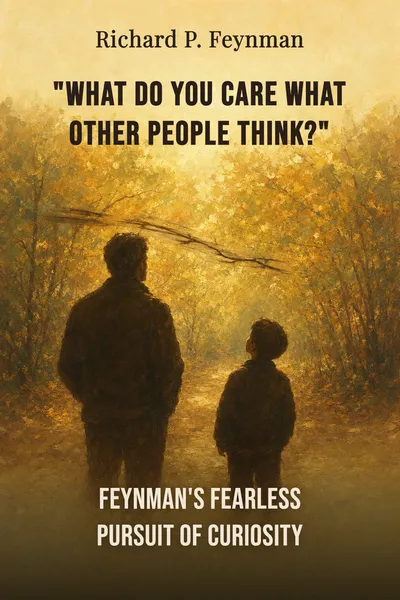
"What Do You Care What Other People Think?"
Feynman's fearless pursuit of curiosity
Description
Richard Feynman was one of the twentieth century's great physicists — a Nobel laureate, a builder of quantum electrodynamics, a man who could seem to solve problems by sheer intuition. But the book he published in 1988, a year before his death, isn't really about physics. "What Do You Care What Other People Think?" is a loose collection of stories, stitched together by his drumming partner Ralph Leighton, and it takes its title from something his first wife Arline used to say to him when he fretted about appearances. She had noticed, early, that Feynman was forever tangled up in what others might think of him. Her question was meant to cut him loose.
The book pairs the intimate with the public in a way that shouldn't work and does. The first half is memory: a father who turned walks in the woods into lessons in seeing, a young marriage marked by illness, a love letter written to a woman already dead. The second half is a document — Feynman's account of serving on the commission that investigated the 1986 Challenger disaster, where seven astronauts died seventy-three seconds after launch. Two registers, one voice.
What holds them together is a single habit of mind, carried from a Long Island kitchen table to a televised hearing in Washington. Feynman kept asking the same stubborn question of everything in front of him: is this actually true, or does it only sound true because everyone repeats it? The stories are the record of a man who would not take an answer on authority — not from a textbook, not from a bureaucracy, not from grief.
The question we’re asking : What does a physicist's book of personal stories reveal about the discipline behind his refusal to defer to other people's opinions?What we’ll see : How one habit — checking things against reality rather than against reputation — runs from a childhood lesson through a marriage into a national inquiry.
Table of contents
01 Chapter 1 — A father who taught him how to look
The book opens where Feynman's thinking opens: with Melville Feynman, a uniform salesman who never went to college and who raised his son to distrust the impressive surface of things. The stories from this stretch are small and precise, which is the point. Feynman remembers walks in the Catskills where other fathers pointed at a bird and named it, while his own father did something stranger. He would tell young Richard the name of the bird in several languages, then say that now you know nothing about the bird — you only know what people in different places call it. Look at what it does instead. Watch it peck at its feathers, and ask why.
That distinction — between knowing the name of something and knowing the thing — became the spine of Feynman's whole approach. His father dramatized it constantly. He would sit the boy on his lap with a set of bathroom tiles and arrange them in patterns, teaching sequence and rhythm before either of them called it mathematics. He read from the encyclopedia and translated its grand numbers into human scale: a dinosaur tall enough that its head would reach the second-floor window but too wide to fit through it. The facts were never left as facts. They were turned until they meant something you could feel.

02 Chapter 2 — Arline, and the phrase that stuck
The emotional core of the book is Feynman's account of Arline Greenbaum, whom he loved from adolescence and married in 1942 knowing she was dying of tuberculosis. He tells the story without melodrama, which makes it harder to read. They had grown up together on Long Island; she taught him that honesty was not negotiable, that saying what you actually thought was a form of respect. When his family pressed him not to marry a sick woman — the social pressure, the sensible advice, the fear of what people would say — it was Arline's spirit that answered. What do you care what other people think?
She meant it literally and he took it literally. The phrase was not a slogan about confidence. It was a tool she handed him for cutting through the fog of appearances, the same fog his father had taught him to distrust. Feynman recounts how, during the Manhattan Project, he would drive from Los Alamos to the sanatorium in Albuquerque to see her, carrying on a marriage conducted mostly in letters. Arline sent him puzzles and jokes, once flooding him with a printed message about how much she loved him, embarrassing him precisely because he still cared, a little, what the censors at Los Alamos would think.
03 Chapter 3 — The Challenger, and a scientist among managers
The second half of the book jumps forward four decades to 1986, when the space shuttle Challenger broke apart shortly after launch and Feynman, by then gravely ill with cancer, was asked to join the presidential commission investigating the accident. He nearly declined. His wife Gweneth told him that if he didn't go, there would be eleven people all going along the same track, and only he was odd enough to go off and poke around on his own. So he went, treating an official inquiry the way his father had taught him to treat a bird: ignore the names on the org chart, watch what the system actually does.
What he found troubled him. Talking directly to engineers rather than to their managers, he uncovered a striking gap. The engineers estimated the probability of catastrophic failure at roughly one in a hundred flights; management had been operating on a figure closer to one in a hundred thousand. The number had drifted upward not because anyone lied outright, but because each layer told the layer above it what that layer wanted to hear, until the reassurance had no contact with the hardware. It was the naming problem again, at institutional scale — a comforting figure repeated until it stood in for reality.
04 Chapter 4 — Curiosity as a way of standing in the world
Read as one object, the book makes an argument it never states outright: that integrity is not a heroic act but a daily habit, and that the habit is boring, repetitive, and available to anyone. Feynman's refusal to care what other people thought was never bravado. It was the practical consequence of caring intensely about something else — whether the thing in front of him was actually so. Once you have decided to check every claim against the world rather than against reputation, deference to opinion simply becomes a distraction, a source of error to be removed.
This is why the marriage and the space shuttle belong in the same volume. Arline's honesty and the O-ring in the ice water are the same instrument used on different problems. In both cases the surrounding voices offered a comfortable, socially approved answer — don't marry the sick girl; the shuttle is safe — and in both cases Feynman went and looked. The look was tender in one setting and lethal to a bureaucracy in another, but the motion was identical. He trusted the evidence of the thing over the consensus about the thing.
05 Conclusion
Feynman died in February 1988, months after the book appeared, the cancer he had lived with through the Challenger inquiry finally catching him. The book was never meant as a summing-up; it is too casual for that, too fond of the incidental joke. Yet the two halves end up describing the same person from opposite ends of a life — the boy learning to watch a bird, the dying man dropping rubber into ice water on television — and the phrase in the title turns out to fit both. Arline gave it to him as a way to survive other people's advice. He carried it into a room full of officials and used it to survive their reassurances.
Related books