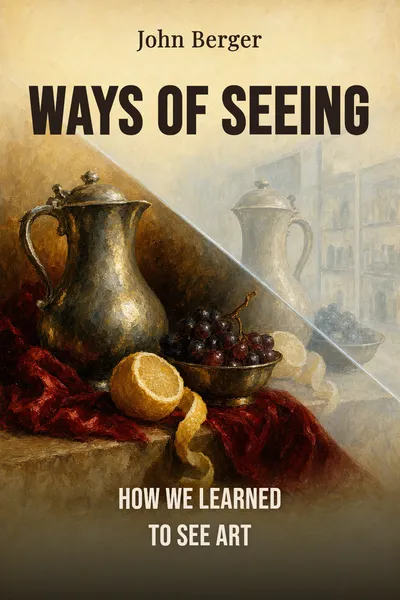
Ways of Seeing
How we learned to see art
Description
In January 1972, the BBC aired a thirty-minute program in which a man in a patterned shirt stood in front of a painting and, rather than admiring it, took a blade to the canvas of received wisdom. His name was John Berger, and the series was called Ways of Seeing. It was made partly as a rebuttal to Kenneth Clark's stately Civilisation, which had walked viewers through the great works as if through a cathedral. Berger walked them through the same works and asked a much ruder question: who is this beauty actually for, and who told us to feel it this way?
Later that year the series became a slim paperback, assembled with the designer Richard Hollis. Seven essays, three of them made only of images, no captions until the end. It cost almost nothing and read in an afternoon. Half a century on, it is still handed to first-year art students, still argued with, still quoted by people who have never opened it. Few books about looking have been looked at so much.
What Berger did was refuse to treat a painting as a sealed object floating above history. He treated it as something made by hands, owned by someone, reproduced by a camera, and seen by us under conditions we rarely notice. The result reads less like criticism than like a friend leaning over and saying: look again, and this time watch yourself looking.
The question we’re asking : When we stand in front of a painting and feel something, whose way of seeing are we actually using?What we’ll see : How Berger took the settled reverence around European painting apart, image by image, until the act of looking itself became the subject.
Table of contents
01 Chapter 1 — A book that answered back to the television
Ways of Seeing began as an argument with the culture that had produced it. By the early 1970s, the established way to talk about European painting was the one Kenneth Clark had perfected: hushed, appreciative, framing the masterpiece as a timeless deposit of human genius that the cultivated viewer learned to revere. Berger, a novelist and Marxist critic who had spent years reviewing shows for the New Statesman, found this posture not just dull but dishonest. It presented taste as natural when taste, he thought, was manufactured — and it flattered the viewer into silence.
The four half-hour episodes were built to break that silence. Berger opened the first one by literally cutting a figure out of a Botticelli, then showing how a detail, isolated and reframed, said something the whole painting never had. The point was blunt: the camera moves, crops, and recontextualizes, and in doing so it changes the meaning of what we thought was fixed. Reverence assumes the image sits still. It does not.

02 Chapter 2 — Reproduction unstitches the aura
The first essay makes a claim that sounds obvious and turns out not to be. A painting, before photography, existed in one place. You went to it; it did not come to you. Its meaning was inseparable from where it hung — a chapel, a palace, a particular wall — and from the fact that it was unique and unmovable. Then the camera arrived, and the image could travel anywhere, appear on a postcard, a book cover, a bedroom wall, a screen. The original stayed put, but its image multiplied without limit.
Berger, following Benjamin, argues that this transformation does something the art establishment prefers not to admit: it strips the original of what made it singular. Once a painting can be seen anywhere, its uniqueness becomes its only remaining claim, and that uniqueness gets recoded as market value and spiritual authority. We are told to feel awe in front of the original precisely because it is now surrounded by ten thousand copies. The awe is compensation for a loss.
03 Chapter 3 — The nude, and who the picture is for
The most quoted part of the book is the essay on the female nude, and it remains the sharpest. Berger draws a line most viewers had never thought to draw: the difference between being naked and being nude. To be naked is simply to be without clothes, to be oneself. To be nude, in the European tradition of oil painting, is to be seen naked by others and arranged for their looking. The nude is not a state of the body; it is a form of address.
And the person being addressed is almost always a man. Berger points out that the woman in these paintings is composed for a male spectator who stands outside the frame, imagined as its owner. She often looks out at him, or holds a mirror, or turns her body toward a viewer she cannot see. Her nakedness is offered up; her own desire is rarely the subject. Even the mirror, Berger notes, is a piece of hypocrisy — the painter shows a woman gazing at herself and calls the painting Vanity, condemning her for a vanity he staged for his own pleasure.
04 Chapter 4 — Oil paint and the price of things
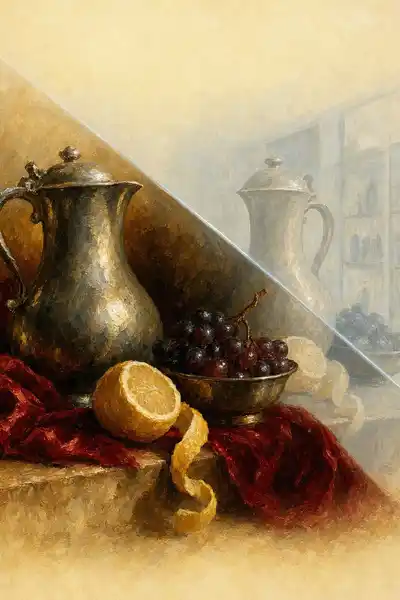
Step back from the individual essays and Berger's larger claim comes into focus: seeing is never innocent, because every image carries the interests of whoever made and owned it. Nowhere is this clearer than in his essay on oil painting itself. The medium, he argues, flourished from roughly 1500 to 1900 not because it was uniquely beautiful but because it was uniquely good at one thing — depicting the texture, sheen and solidity of possessions. Oil paint could render fur, silver, marble and skin as things you could almost touch, and therefore almost own.
This, for Berger, is the buried subject of a great deal of European art. The genre painting of fine objects, the portrait of the landowner standing on his land, the still life of game and fruit — these are celebrations of property, of what the sitter has. He reads a famous double portrait of a couple in a landscape and points out that the field behind them is not scenery; it is their estate, and the painting exists partly to say so. The picture is a receipt as much as a likeness.
05 Conclusion
The man in the patterned shirt died in 2017, having spent most of his later life in a small French Alpine village, writing about peasants and drawing and the dignity of manual work. Ways of Seeing was never his own favourite among his books, and he was quick to say it was a collaboration and that its ideas were partly borrowed. But it did the thing he most wanted done: it took the authority to interpret images out of the hands of the experts and handed it to whoever was looking.
Related books