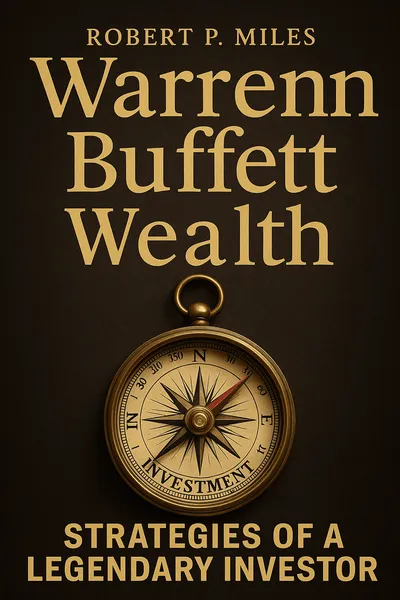
Warren buffett wealth
Strategies of a legendary investor
Description
Warren Buffett believes in buying quality companies trading at discounts to intrinsic value and holding them long-term. He seeks companies with strong fundamentals, competitive advantages, talented management, and good growth prospects. Buffett diversifies across industries but concentrates his bets into his best ideas.
He takes a business owner mentality, evaluating companies as if buying them outright. Patience, discipline, and tuning out market noise are critical to allow the power of compounding to work over decades. Rather than constantly trading in and out, Buffett builds conviction in a few great companies and sticks with them through ups and downs. He waits for the right price to buy more.
Buffett recommends focusing on your circle of competence, understanding businesses, and thinking independently. He sees market downturns as opportunities, letting fear and greed drive neither buys nor sells. Compounding wealth over a lifetime requires perseverance, rationality, and the right mindset.
Table of contents
01 Study the best
Warren Buffett, renowned for his unparalleled success in investing, attributes his achievements to lessons learned from high achievers in various fields. He believes that understanding the traits that lead to excellence in any domain can be applied to investing.
Buffett's strategy revolves around the principle of wealth creation through business ownership, where he reinvests earnings from successful ventures into other promising businesses, thus compounding returns over time. His focus is on excelling in investing, which has been instrumental in building significant wealth for himself and Berkshire Hathaway shareholders.

02 Know yourself
To emulate Warren Buffett's success as an investor, it's essential to first identify your investment style. Are you inclined towards a passive approach or do you prefer active involvement? Do you see yourself holding investments for the long term or are you after quick gains?
Buffett, known for his long-term, value-driven strategy, focuses on acquiring companies with strong leadership, avoiding startups or businesses in need of a turnaround. He emphasizes the importance of buying well-managed businesses at fair prices rather than hunting for bargains. A key to Buffett's method is the ability to differentiate between a company's intrinsic value and its book value, aiming to purchase stocks when they are undervalued. This requires doing your own research, understanding your investments deeply, and being patient.
03 Create your philosophy
Warren Buffett's investment strategy is famously simple yet deeply insightful, emphasizing the importance of not losing capital and always remembering this cardinal rule.
Initially, Buffett adopted a "cigar butt" approach, targeting undervalued companies with limited future prospects, exemplified by his early investment in Berkshire Hathaway's textile mills. However, his strategy evolved to focus on acquiring world-class businesses at prices below their intrinsic value, prioritizing understanding, long-term potential, ethical management, and attractive pricing, as highlighted in his 1997 letter to shareholders.
04 Understand what you own
Warren Buffett, a renowned investor, advocates for a deep understanding of the businesses behind stocks. He suggests focusing on company fundamentals and long-term potential rather than reacting to short-term market fluctuations. According to Buffett, conducting your own research and analysis is crucial, rather than following market sentiment. He advises investors to stay within their "circle of competence," typically investing in domestic companies due to the complexities of international markets.
Buffett also recommends a concentrated portfolio of well-understood companies over broad diversification, emphasizing the value of in-depth knowledge in stock selection. Continuous learning is key in Buffett's philosophy. He encourages investors to read extensively about their investments and business principles, blending academic financial theory with practical business insights. A solid grasp of accounting basics, such as compound interest, present and future value calculations, inflation, and financial statement analysis, is essential for evaluating companies' true worth.
05 Invest locally
Main Street and Wall Street investors have distinct approaches to investing, with the former taking a long-term perspective, often holding onto investments for years or decades, while the latter typically engages in frequent trading, with turnover rates of 200% on the NASDAQ and 100% on the NYSE.
Wall Street's focus is on short-term profits through buying low and selling high, treating stocks as vehicles for quick trades. In contrast, Main Street investors see themselves as part-owners of the businesses they invest in, aiming for sustained growth and compounding returns over time.
Executive compensation also differs, with Wall Street CEOs often receiving stock options that incentivize short-term share price increases, whereas Main Street managers prioritize long-term business value, making stock splits less relevant. Wall Street's primary concern is stock price movements, leading to technical analyses based on price and volume. Main Street, however, emphasizes customer service and product quality, conducting fundamental analyses of a company's competitive edge, management, and market potential.
06 Buy and hold
Warren Buffett's investment philosophy is distinguished by a focus on acquiring a select portfolio of high-quality companies and maintaining ownership indefinitely. This approach, which diverges from the common practice of diversification and timely selling, has been a cornerstone of his success. Buffett emphasizes the importance of exhaustive research prior to investing, likening it to the due diligence one would undertake before marriage.
He values management teams and business models that prioritize long-term growth over short-term gains. A key aspect of his strategy involves investing in businesses within his expertise, characterized by straightforward operations, exceptional management, and reasonable pricing. Buffett steers clear of companies undergoing turnarounds, viewing them as largely unsuccessful ventures. He also practices a hands-off approach with the management of the companies he invests in, including those under Berkshire Hathaway, to avoid micromanaging.
07 Learn from mistakes
Warren Buffett, renowned for his investment prowess, has openly acknowledged his past mistakes, learning from them to avoid repetition. His early error in acquiring Berkshire Hathaway in 1965, a textile company then facing stiff overseas competition, is a case in point. Buffett's initial oversight led to the closure of the textile mills in 1985, but he strategically shifted the company's focus to insurance and investments, transforming Berkshire Hathaway into a financial powerhouse.
08 Avoid myths
Warren Buffett, one of the most successful investors in history, has generated immense wealth for himself and Berkshire Hathaway shareholders, debunking the myth that his success is merely a product of luck. His investment strategy involves a meticulous evaluation of companies based on their fundamentals and market valuations, demonstrating a blend of skill and discipline rather than chance.
Contrary to the belief that Buffett's approach falters in down markets, historical evidence shows that market downturns have often presented opportunities for him to invest in high-quality companies at lower prices, capitalizing on these moments to enhance returns.
09 Work with allies
Lou Simpson champions the idea that investors should rely on their own thorough research rather than blindly following popular opinion. He echoes Warren Buffett's sentiment that the best investment opportunities often lie with undervalued companies that aren't in the limelight. Simpson advises against taking conventional wisdom at face value and instead advocates for a critical approach to evaluating investments, fostering a space for contrarian thinking.
In his search for companies that are likely to benefit shareholders, Simpson looks for businesses that demonstrate robust cash flows and high returns on invested capital. He also values management teams that have a significant ownership interest, clear communication with shareholders, a disciplined approach to selling off unprofitable segments, and smart use of surplus cash for share buybacks. These factors are indicative of skilled management that can allocate capital effectively.
10 Live a full life
Warren Buffett, one of the world's wealthiest and most esteemed investors, attributes his success to a set of fundamental principles deeply rooted in value investing. He adheres to the Benjamin Graham philosophy, seeking out high-quality companies at reasonable prices by thoroughly analyzing their financial health, management caliber, competitive edge, and growth prospects.
Buffett's strategy involves investing in stocks that are undervalued relative to their intrinsic worth and holding onto them for the long term, leveraging the power of compounding to accumulate wealth. Buffett approaches investments with a business owner's mindset, evaluating companies as if he were buying them outright, which guides him towards judicious, informed decisions based on solid business fundamentals.
Related books