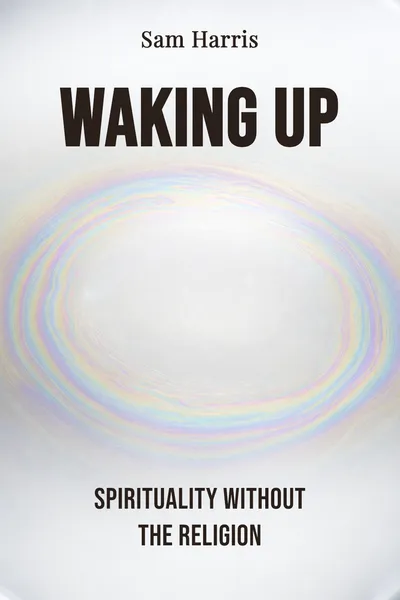
Waking Up
Spirituality without the religion
Description
Sam Harris made his name, in the mid-2000s, as one of the loudest voices arguing that religion is a bad idea. The End of Faith came out in 2004, a few years after September 11, and it treated belief in God the way a prosecutor treats a suspect. So when the same author published a book in 2014 with the word "spirituality" in the subtitle, a lot of readers assumed something had softened. It hadn't. Waking Up is not a retreat from that earlier position. It's an attempt to rescue something Harris thinks religion has been holding hostage.
His claim is blunt: there is a genuine, describable range of human experience — states of deep calm, of dissolved boundaries, of clarity that feels like waking from a dream — and religions did not invent it. They found it, wrapped it in doctrine, and then told us we had to accept the doctrine to get the experience. Harris, trained as a neuroscientist and a philosopher, thinks the wrapping and the contents can be separated. You can have the contemplative life, he argues, without believing anything false.
The trick is that he refuses the easy exits. He won't say meditation is nice because it lowers your blood pressure, and he won't say all religions are secretly pointing at the same truth. He wants something harder to hold: a way of looking directly at the mind that survives scientific scrutiny and still delivers what people have gone to monasteries for. Whether that's possible is the whole book.
The question we’re asking : Can the experiences people call spiritual survive once you strip away the beliefs that usually come attached?What we’ll see : A neuroscientist's argument that the deepest thing religion offers has nothing to do with faith — and everything to do with paying attention.
Table of contents
01 Chapter 1 — The word he refused to give up
"Spiritual" is a word Harris admits he dislikes. It drags in incense, crystals, vague talk of energy, and the whole apparatus of belief he spent years attacking. He keeps it anyway, because the alternatives are worse. There is, he insists, a real phenomenon it points to — the direct, felt discovery that our ordinary sense of being a self behind the eyes is not the whole story — and English has no better term for it. He traces the word back to its Latin root, spiritus, breath, and notes with some irony that the thing itself is more concrete than the vocabulary that surrounds it.
The book's project sits in the gap this word marks out. On one side, Harris has no patience for religious metaphysics: no soul, no afterlife, no divine authorship of morality that can survive honest examination. On the other, he thinks the New Atheist crowd he belongs to has made a real mistake by treating the entire contemplative tradition as embarrassing superstition. Somewhere in that dismissal, he argues, they threw out data. People really do have transformative experiences in meditation. Those experiences change lives. Pretending otherwise is not rational; it's just incurious.

02 Chapter 2 — A self that isn't there
The center of Waking Up is a proposition that sounds absurd until you sit with it: the self you take yourself to be — the little observer perched somewhere behind your face, thinking your thoughts and running the show — does not exist. Not in the sense of being a philosophical error you could argue your way out of, but in the sense that if you look for it directly, carefully, you can't find it. There is experience. There is no experiencer separate from it.
Harris builds the case from two directions. The first is philosophical: the feeling of being a unified, continuous "I" is a construction, and a leaky one. Thoughts appear without your permission. You don't decide the next word in your own inner monologue before it arrives; it just shows up, as if from nowhere. If you were truly the author of your mind, you'd know what you were about to think before you thought it. You never do.
03 Chapter 3 — What sitting still is actually for
When Harris talks about meditation, he is careful to strip away the associations that make people either roll their eyes or reach for a scented candle. He is not selling relaxation, though calm may come. He is not selling productivity, and he's openly hostile to the way mindfulness got repackaged as a tool for better focus at work. Meditation, in his framing, is a method of investigation — a way of turning attention back on itself to check whether the claims about the self and consciousness actually hold up in your own experience.
The basic practice he describes is unglamorous. You sit, you attend to the breath or to the field of sensation, and when the mind wanders — which it will, constantly — you notice that it has wandered and return. What that repetition slowly reveals is the texture of thought: that thoughts arise on their own, that you are not thinking them so much as witnessing them, and that the gap between a thought appearing and being lost in it is where all the leverage lives. Most of us live almost entirely lost in it, narrating our lives from inside a story we mistake for reality.
04 Chapter 4 — The bad trips and the false gurus
What keeps Waking Up from becoming just another gentle invitation to meditate is Harris's refusal to lower his standards once he crosses into spiritual territory. This is where the book steps back from technique and makes its larger case: leaving religion behind does not mean you get to stop asking whether things are true. The contemplative life, he argues, is exactly the domain where people most readily abandon their critical faculties — and exactly where they can least afford to.
He is unsparing about the danger of gurus. The literature of Eastern spirituality is full of enlightened masters who turned out to be predators, frauds, or both, and Harris tells some of these stories directly, including cases involving teachers he once admired. The problem, he argues, is structural: the moment you decide that a teacher has access to a truth beyond ordinary judgment, you have handed over the one tool that could protect you. A student convinced their master is beyond ethics will excuse almost anything. The experience of transcendence is real, but it confers no moral authority whatsoever, and treating it as if it does is how spiritual communities become cults.
05 Conclusion
The book that many expected to be a softening turns out to be the opposite. Harris does not make peace with religion; he tries to take the one thing worth keeping and set it on firmer ground. The self is a construction, consciousness is the only thing we can't doubt, and the deepest states people have chased through faith are available to anyone willing to look closely and skeptically at their own mind. None of it, in his telling, requires believing a single thing that isn't so.
Related books