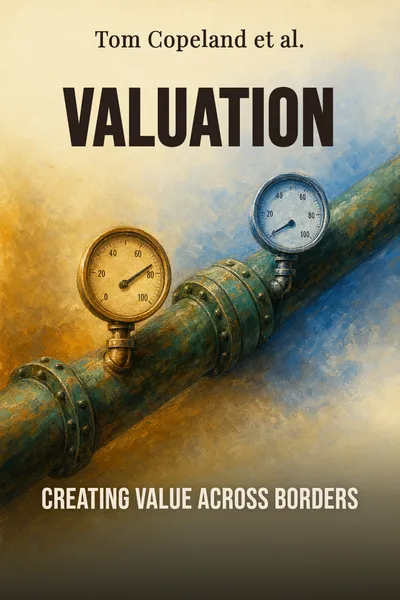
Valuation
Creating value across borders
Description
In the early 1990s, three consultants at McKinsey — Tom Copeland, Tim Koller, and Jack Murrin — put their name to a book with a plain title and an unfashionable premise. Valuation argued that a company is worth the cash it will generate over its life, discounted back to today, and almost nothing else. Not its reported earnings, not the multiple its rivals traded at, not the story the annual report told. Cash, and the timing of cash. The book landed at a moment when that idea was moving from the finance department to the corner office, and it became the manual a generation of managers reached for.
The timing was not an accident. Money had started moving. A pension fund in Boston could put capital into a firm in Frankfurt or Osaka almost as easily as one down the road, and it went wherever the return looked best. That freedom put every management team on the same global scoreboard, judged by the same question — how much value are you actually creating? — even though the accounting rules, taxes, and cost of capital differed sharply from one country to the next.
Copeland, Koller, and Murrin set out to make that scoreboard legible. Their book is where corporate strategy and corporate finance stop being separate departments and become the same conversation. It treats valuation less as an accountant's chore than as a way of thinking — a discipline for deciding which businesses to keep, which to sell, and what a merger is really worth before anyone signs.
The question we’re asking : If a company is worth the cash it will generate, how do managers measure that — and why does the same business come out worth different amounts in different countries?What we’ll see : How the book rebuilds value from cash flows up, turns the number into a way to run a company, and then tries to make it travel across borders.
Table of contents
01Chapter 1 — Why cash flow beats earnings per share
The book opens by picking a fight with the number most managers were trained to worship: earnings per share. For decades, corporate America ran on it. Boards were paid on it, analysts forecast it, and executives shaped decisions around whether this quarter's EPS would beat the last. Copeland, Koller, and Murrin argue this is a mistake baked into the accounting itself. Reported earnings are a bookkeeping convention, full of choices — how fast to depreciate a factory, when to recognize a sale, how to treat a write-off — that change the number without changing the business one bit.
Cash is harder to fake. A company can boost earnings by stretching depreciation schedules or booking revenue early, but it cannot conjure cash it did not collect. So the authors rebuild the definition of value on free cash flow: the money a business throws off after paying for new equipment, extra inventory, and the working capital it needs to keep growing. That last part matters. A company can report handsome profits while quietly starving for cash, because growth itself eats money before it returns any.

02Chapter 2 — The discounted-cash-flow machine, from the inside
Having declared what value is, the book has to show how to compute it, and this is where Valuation earns its reputation as a manual rather than a manifesto. The core engine is discounted cash flow: forecast the free cash a business will generate year by year, decide what that future cash is worth in today's money, and add it all up. Simple to state, unforgiving in practice, because every step hides a judgment call that can swing the answer by a wide margin.
The forecast comes first. The authors insist it be built from the operating drivers of the business — sales growth, operating margins, the capital each dollar of revenue requires — rather than pulled from thin air. A forecast that does not tie back to how the company actually competes is decoration. They also stress that most of a company's value usually sits beyond the explicit forecast years, in what they call the continuing value: a disciplined estimate of the steady state the business settles into once the detailed projections run out.
03Chapter 3 — Turning a number into a way to run the company
The book's larger ambition is not to produce a valuation but to change how a company is managed. The authors give the approach a name: value-based management. The idea is that discounted-cash-flow logic should not sit in a spreadsheet consulted once during a deal. It should run through the organization, shaping which businesses get capital, how managers are measured, and what the people running each unit are rewarded for.
Start with the portfolio. A diversified company is really a collection of businesses, and the same valuation lens can be turned on each one separately. Some units earn well above their cost of capital and deserve more investment; others consume capital and return less than they cost, quietly dragging down the whole. The book pushes managers to value each piece as if a buyer were looking at it, because someone might be. A unit worth more to another owner than to you is one you should probably sell.
04Chapter 4 — When the same company is worth different things in different places
The expanded edition's real addition is a reckoning with borders. When capital roams the globe for the best return, valuation stops being a domestic exercise, and the authors confront an awkward fact: the same business, analyzed by the same discounted-cash-flow method, can come out worth different amounts depending on where you analyze it. The method is universal; the inputs are stubbornly local.
Accounting is the first culprit. What counts as an asset, how goodwill is treated, when a cost hits the income statement — these vary from the United States to Germany to Japan, so the reported figures a valuer starts from are not speaking the same language. The book's remedy is to translate everything back to cash, which travels better than earnings, but it warns that the translation is real work. A number lifted from a foreign annual report without adjustment is a trap.
05Conclusion
Copeland, Koller, and Murrin set out to answer one question — what is a company actually worth? — and ended up rewriting how managers think about their own companies. Their answer never wavered: a business is worth the cash it will generate, discounted at the cost of the capital it uses, and value appears only when returns clear that hurdle. Everything else, from the mechanics of the discount rate to the discipline of value-based management, is machinery built to serve that single idea and push it out of the finance department into daily decisions.
Related books