
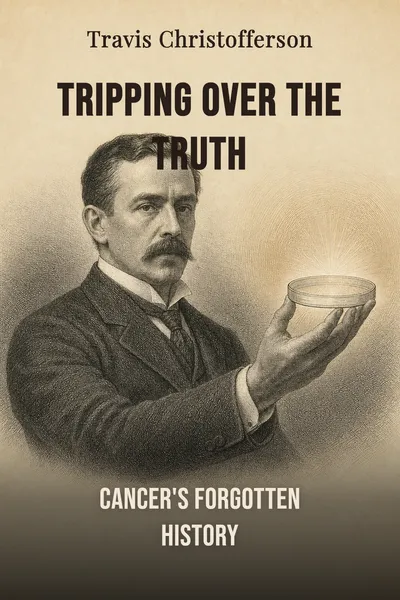
Tripping Over the Truth
Cancer's forgotten history
Description
In 2005, the American cancer establishment launched what was meant to be the endgame. The Cancer Genome Atlas — a project modeled on the Human Genome Project, funded to the tune of hundreds of millions of dollars — set out to sequence the DNA of thousands of tumors and read, at last, the instruction set of the disease. The logic was clean and confident. Cancer was understood to be a disease of mutated genes; sequence enough tumors and the recurring mutations would light up like a constellation, pointing straight at the drugs that would switch them off. A decade of the smartest people in biology, the best machines, and effectively unlimited money were pointed at a single target.
What came back was not a map. It was closer to static. Tumors of the same type carried wildly different mutations; a single tumor could contain dozens of subclones, each mutated differently from the cell beside it. There was no shared master switch, no legible wiring diagram, no small set of culprits. Some cancers barely had the mutations the theory required. The atlas had done exactly what it promised and delivered, in the words of more than one researcher, chaos. The roadmap to a cure did not appear, and the field was left holding an enormous amount of data and a theory that the data refused to simplify.
That failure is where Travis Christofferson's Tripping Over the Truth begins — not as an ending, but as an invitation to reopen a case that most of biology considered closed. Long before anyone talked about oncogenes, a different explanation for cancer existed, championed by one of the towering figures of German science, then quietly buried. Christofferson tells that story the way you'd tell a detective novel: a promising lead, a wrong turn, a decades-long cover of silence, and a handful of researchers who kept returning to the discarded file.
The question we’re asking : If the gene theory of cancer is right, why did the biggest sequencing project in history fail to hand us a cure?What we’ll see : How an idea about cancer's fuel supply was raised, buried, and dug back up — with the story of the people who did the digging.
Table of contents
01Chapter 1 — The atlas that mapped everything and explained nothing
To understand why the Cancer Genome Atlas landed like a disappointment, it helps to see how much certainty went into it. By the early 2000s, the reigning view was the somatic mutation theory: cancer is what happens when a cell accumulates enough DNA damage to override the brakes on its own division. Find the mutations, find the disease. The sequencing project was the natural conclusion of that logic — an industrial-scale effort to catalogue every mutation in every major tumor type and let the pattern reveal itself.
The pattern never cohered. Instead of a handful of shared drivers, the project surfaced staggering heterogeneity. Bert Vogelstein at Johns Hopkins, one of the architects of the mutation model, was among those confronting the mess: the same cancer in two patients could look genetically unrelated, and within a single tumor the cells were a shifting mosaic. A few mutations recurred often enough to matter, but most were scattered, and some tumors carried surprisingly few. The clean causal chain the theory predicted was nowhere to be found.

02Chapter 2 — Otto Warburg and the engine that stalled
Otto Warburg was, in the first half of the twentieth century, one of the most decorated scientists alive. A Nobel laureate in 1931 for his work on cellular respiration, he ran a lavishly funded institute in Berlin and was regarded, not least by himself, as biology's leading mind. Working with delicate slices of tissue, he noticed something strange about cancer cells: they behaved as if starved of oxygen even when oxygen was plentiful. Rather than burn glucose efficiently in their mitochondria, tumor cells fermented it, the wasteful way a cell copes when air runs short.
Healthy cells generate most of their energy through respiration in the mitochondria, extracting a great deal of usable energy from each unit of sugar. Fermentation yields far less, which is why it is normally a fallback for oxygen-starved conditions, like a muscle sprinting past its air supply. Cancer cells, Warburg found, fermented compulsively, gorging on glucose. This preference for fermentation in the presence of oxygen became known as the Warburg effect, and it is so reliable that modern PET scans locate tumors precisely by their appetite for sugar.
03Chapter 3 — How the gene became the whole story
The eclipse of the metabolic idea was not a single decision but a change in the current of biology. After 1953, the gene became the unit through which almost everything living was explained, and disease was no exception. When researchers in the 1970s found that certain viruses could turn cells cancerous by inserting genetic material, and then that cancer-causing genes had counterparts sitting in normal human DNA, the somatic mutation theory acquired its foundation. Cancer was a genetic disease. The idea was elegant, testable, and immediately generative.
It also fit the funding and the technology. Molecular biology had the momentum, the tools, and the prestige. A theory that turned cancer into a problem of readable code promised targeted drugs and a clear finish line, and the money followed the promise. Warburg's odd fact about fermentation didn't disappear — it was simply reframed as downstream housekeeping, a consequence of the mutations doing the real work, not a cause of anything. The engine, in this telling, was just responding to instructions from the blueprint.
04Chapter 4 — Feeding the tumor, or starving it
Step back from the science and the deeper subject of Christofferson's book comes into view: how a field decides which question is worth asking. The metabolic theory didn't lose because it was disproven. It lost because it belonged to a discredited personality, arrived just as a rival paradigm caught fire, and lacked the tools and the funding to compete. Warburg's fermentation was never refuted — it was simply outshone, then re-labeled as a footnote. For roughly half a century a plausible explanation of cancer sat in the wrong drawer, not because the evidence closed the case but because the incentives did.
That is the uncomfortable through-line. Science likes to imagine itself as evidence sorting itself out over time, but the metabolic story shows how much prestige, momentum, and money shape which theories get to run and which get quietly shelved. The gene theory wasn't wrong so much as it was the version that happened to have the machines and the grants behind it. When a paradigm has that kind of gravity, contrary observations don't get pursued — they get filed as anomalies and left for someone stubborn to rediscover decades later.
05Conclusion
The book ends more or less where the Cancer Genome Atlas left off — with a field holding vast amounts of data and a theory that never delivered the map it promised. Christofferson doesn't claim the gene story is worthless; he claims it was crowned too soon and defended too hard, and that the failure of the biggest sequencing effort in history is reason enough to look again at the explanation biology set aside a century ago. Warburg's starving, sugar-hungry cell turns out to be the thread that runs from a Berlin laboratory in the 1920s to modern experiments with diet and metabolism.