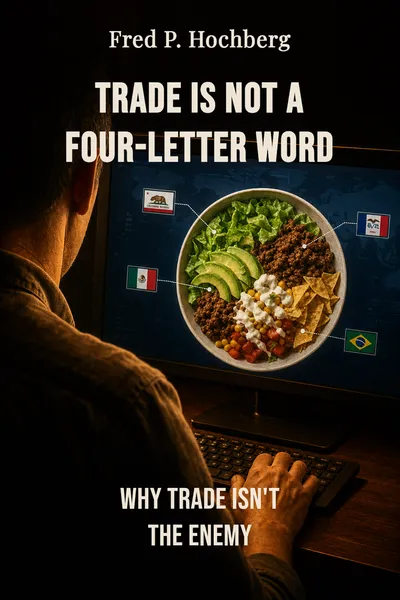
Trade Is Not a Four-Letter Word
Why trade isn't the enemy
Description
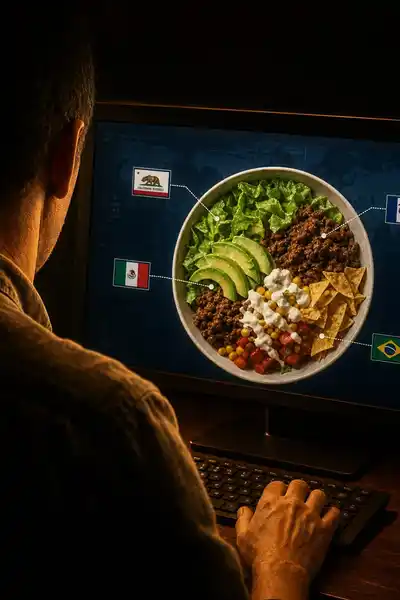
Order a taco salad in an American strip mall and you're eating an argument. The lettuce might be from California, the avocado from Mexico, the beef from a feedlot in the Midwest fed on soy that traveled halfway across a continent, the shell fried in oil pressed somewhere else entirely. Nobody planned it that way. It just is that way, because a thousand separate decisions about cost, season, and taste quietly assembled themselves into lunch. Fred P. Hochberg, who ran the Export-Import Bank of the United States for most of the Obama years, opens his book with exactly this kind of object — familiar, cheap, and secretly international.
His timing was deliberate. By the late 2010s, trade had curdled into something close to a curse word in American politics. On the right, it was the story of factories shipped overseas and towns hollowed out. On the left, it was the story of workers sold out by corporations and the politicians who served them. NAFTA, the North American Free Trade Agreement, became a punching bag both sides could swing at. A president tweeted that trade wars were "good, and easy to win." Hochberg wrote to argue, patiently and with a lot of grocery-store examples, that almost none of this was as simple as the slogans promised.
The book is not a defense of every trade deal ever signed, and it is not a pep talk about globalization. It is closer to a guided tour of how ordinary things reach us, told by someone who spent years watching the machinery up close and came away convinced that the machinery is badly misunderstood — by the people who love it and the people who hate it in roughly equal measure.
The question we’re asking : If trade genuinely lowers prices and widens choice, why has it become the thing so many people on both sides agree to blame?What we’ll see : How a handful of everyday objects — starting with a strip-mall lunch — reveal what trade actually does, who it hurts, and why the blame rarely lands where the slogans point.
Table of contents
01 Chapter 1 — The taco salad has no country
Hochberg likes objects because objects don't argue. A taco salad can't tell you it's for or against globalization; it can only show you where its parts came from if you bother to ask. And when you ask, the answer is almost never a single place. The dish that feels quintessentially American — invented, more or less, in the United States as a Tex-Mex hybrid — turns out to depend on ingredients that cross borders as a matter of routine. The avocado is the clearest case. For years, Mexican avocados were effectively banned from the American market over pest-control fears, and the fruit was a rare, expensive thing. Once that changed in the 1990s and 2000s, prices dropped, supply exploded, and guacamole became a Super Bowl staple.

02 Chapter 2 — Why NAFTA became everyone's villain
No three letters in American political life have taken more of a beating than NAFTA. Signed in the early 1990s and in force from 1994, the agreement knitted the United States, Canada, and Mexico into a single trading zone. Within a couple of decades it had become the rare thing both parties could agree to campaign against — the right blaming it for lost factory jobs, the left blaming it for gutting labor protections and rewarding capital over workers. Hochberg's argument is not that NAFTA was flawless. It's that it became a symbol carrying far more weight than the actual policy ever did.
Part of the trouble is that big economic shifts have many parents, and trade agreements make an unusually convenient one. When a factory town declines, the causes are tangled — automation, changing consumer habits, corporate consolidation, currency swings, the rise of China as a manufacturer, which had little to do with NAFTA at all. But automation doesn't hold a press conference and you can't vote against a robot. A three-letter treaty with a signing ceremony is a target you can name. Hochberg walks through how the auto industry actually reorganized across the three countries, with parts crossing borders multiple times before a finished car rolls off the line, and how untangling that would raise costs rather than restore a lost world.
03 Chapter 3 — The ten-dollar banana
The banana is Hochberg's favorite thought experiment, and it's a good one. A banana in an American supermarket costs less, in real terms, than it did decades ago, despite being grown thousands of miles away, harvested by hand, shipped in refrigerated holds, ripened on schedule, and trucked to a store near you. It is arguably the most logistically demanding cheap thing you can buy. And it is cheap precisely because trade lets a fruit that grows only in specific tropical climates reach a country that can't grow it at all.
Now imagine cutting that chain. Suppose, in the name of protecting domestic production, the United States tried to grow its own bananas at scale, or slapped heavy tariffs on imported ones. The fruit doesn't get more American. It gets more expensive — Hochberg raises the specter of the ten-dollar banana, a small joke that carries a real lesson. Tariffs are often sold as taxes on foreigners. In practice, much of the cost lands on the shopper at the register, who pays more for the same item, and on domestic companies that rely on imported inputs.
04 Chapter 4 — The parts of an iPhone nobody can trace
If the banana shows what trade delivers, the iPhone shows how impossibly tangled the delivery has become. Hochberg uses it to dismantle the fantasy that products have a home. The phone is designed in California, assembled in China, and stuffed with components — chips, screens, sensors, rare-earth elements — from Japan, South Korea, Taiwan, Germany, and a dozen other places. The famous "Assembled in China" line captures only the last, cheapest step. Most of the value was created elsewhere, long before the parts reached the factory floor. Ask where an iPhone is "from" and the honest answer is: everywhere, in fractions.
This is the broader thing the book keeps circling back to. Trade in the twenty-first century is not countries swapping finished goods across a border. It's a single manufacturing process spread across the planet, where the same component might cross frontiers several times before it's done. That reality makes the political language of trade — us versus them, ours versus theirs, winners versus losers by nation — almost useless for describing what's actually happening. The nation is no longer the unit the economy runs on.
05 Conclusion
Six ordinary objects, and each one refuses to behave the way the slogans need it to. The taco salad has no clean nationality. NAFTA turned out to be less a policy than a symbol carrying other people's grievances. The banana proves that tariffs are a tax on the shopper. The iPhone shows that "made in" is a fiction. What ties them together is Hochberg's steady insistence that trade is not a moral force to be worshipped or a villain to be defeated, but a system — one we already live inside, whether we approve of it or not.
Related books