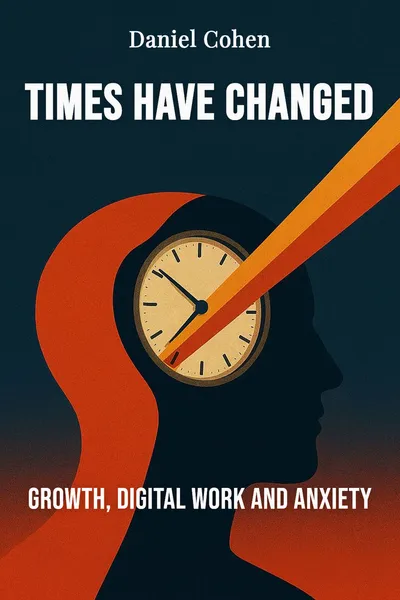
Times Have Changed
Growth, digital work and anxiety
Description
In 2018, the French economist Daniel Cohen published a short book with a deceptively plain title: Les Temps modernes, which appeared in English as Times Have Changed. Cohen, who died in 2023 and spent decades at the École normale supérieure and the Paris School of Economics, had a habit of asking a simple question that turned out to be enormous. This one went roughly like this: why, in the richest societies that have ever existed, with more comfort and more tools than any previous generation, do people feel so uneasy? The economies kept producing. The gadgets kept arriving. And the mood kept souring.
His answer refuses the easy villains. It isn't that we've become spoiled, or that the internet rotted our brains, or that a particular government mismanaged a particular decade. Cohen's move is to connect three things we usually keep in separate drawers: the slowdown of economic growth since the 1970s, the transformation of work by digital technology, and a diffuse, low-grade anxiety that sits under contemporary life. Put them in the same frame, he argues, and each one starts to explain the others. The machines changed. So did the bargain that machines used to come with.
What makes the book worth sitting with is that Cohen was an optimist by temperament writing a fairly dark account. He had spent his career believing that growth could be humane, that economics was finally a moral science. Here he's watching the ground shift under that belief, and trying to name what replaced the old industrial promise — without pretending the replacement is working.
The question we’re asking : Why do societies that have never been richer feel more anxious, and what do growth and digital work have to do with it?What we’ll see : How Cohen ties the stalling of growth to the reshaping of work by digital technology, and to the unease that now runs under prosperity.
Table of contents
01Chapter 1 — The engine that stopped lifting everyone
Cohen starts with a fact that still surprises people: the long postwar boom was an exception, not a rule. In the three decades after 1945 — what the French call les Trente Glorieuses — growth in the industrial world ran at rates that lifted ordinary wages year after year, built the welfare state, and made it reasonable for a factory worker to expect that his children would live better than he did. Productivity rose, pay rose with it, and the whole arrangement felt less like luck than like a law of nature.
Then, around the mid-1970s, the engine changed pitch. Growth slowed across the rich world and never fully recovered, even as the economies kept expanding in absolute terms. Cohen is careful here: we did not get poorer. We got richer more slowly, and — more importantly — the gains stopped being shared the way they had been. Productivity and wages, which had risen together for a generation, began to drift apart. The pie grew; most people's slice stopped growing with it.

02Chapter 2 — When the factory became a network
The digital economy, Cohen argues, does not simply speed up the industrial one — it reorganizes it. The twentieth-century factory was a place: walls, a clock, a hierarchy you could see, a line of workers doing one defined thing. Its logic was concentration. The digital firm runs on a different logic — the network — where value comes from connection, information and coordination rather than from stacking workers in one building. And a network behaves very differently from a factory when it comes to who gets paid.
He leans on an uncomfortable feature of digital goods: they cost a fortune to make once and almost nothing to copy. The first unit of software is expensive; the millionth is nearly free. This produces winner-take-most markets, where a handful of firms and a handful of stars capture enormous returns while the broad middle of skilled workers is squeezed. The factory needed many hands of roughly comparable value. The network rewards a few nodes spectacularly and treats the rest as interchangeable.
03Chapter 3 — The office that never closes
If the first consequence of the network is economic, the second is intimate: it gets into how we feel at work and after it. Cohen observes that digital tools, sold as liberation from the drudgery of the factory, often reintroduce its discipline in subtler form. The assembly line set the pace with a conveyor belt. The digital workplace sets it with metrics, notifications, dashboards and the quiet expectation that you are reachable. The clock came off the wall and moved into the phone in our pocket.
He connects this to a real strand of occupational health research — the rise of burnout, chronic stress, the sense of a job that colonizes the hours that used to be your own. The boundary between work and life, which the industrial factory kept crude but clear, becomes porous. You can work anywhere, which quietly means you can be asked to work everywhere. Autonomy and surveillance arrive in the same package, and it is often hard to tell which one you are experiencing.
04Chapter 4 — Prosperity without the promise
Step back, and Cohen's real subject comes into focus. Industrial capitalism was hard, but it ran on a set of compensations: rising wages, expanding security, public institutions that spread the gains, and above all the credible promise that effort today bought a better life tomorrow — for you and for your children. Those compensations were what made the bargain tolerable. Cohen's argument is that digital capitalism has kept the demands while quietly letting the compensations lapse.
Growth no longer reliably raises the median income. The ladder of secure, progressing employment has thinned. And the generational promise — the single most powerful anesthetic of industrial society — has gone into reverse in much of the rich world, where parents now doubt that their children will do better than they did. That doubt is not a mood; it is, in Cohen's reading, the honest reading of the numbers. When the compensations fail, the hardship that remains has nothing to pay for.
05Conclusion
Cohen opened with a paradox — societies richer than any before, and uneasier than they should be — and his book spends its length refusing to resolve it with a slogan. The uneasiness is real, he insists, and it is not a failure of gratitude or a trick of the media. It is what remains when an economy keeps the discipline of industrial work, adds the exposure of the network, and withdraws the promise that once made the whole arrangement feel like a climb rather than a loop.
Related books