

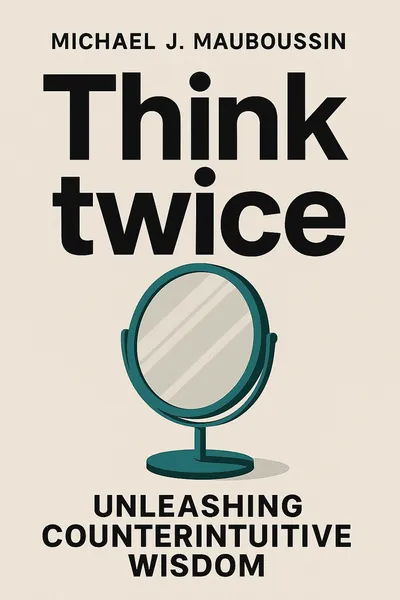
Think twice
Unleashing counterintuitive wisdom
Description
Smart individuals can often make surprisingly poor decisions, particularly in critical situations. This phenomenon can be attributed to the inherent limitations of the human brain's "mental software," which is not optimally designed to tackle many of today's complex challenges.
People tend to perceive the world in a way that aligns with their desires, ignoring facts that contradict their worldview. Holding onto false beliefs, even when they are clearly illogical, is not uncommon.
Additionally, there's a tendency to act on impulse rather than taking the time to evaluate the available evidence and make informed decisions. To minimize errors, it's beneficial to reconsider your choices carefully. This involves a three-step process:
Table of contents
01Common decision making errors and solutions
Believing problems are unique
Corporate mergers and acquisitions, a multi-trillion-dollar industry, often fail to create shareholder value despite the high costs and intentions behind them. Executives, driven by optimism and an inside perspective, believe in the synergies of combining companies, overlooking the frequent reality that these deals don't meet expectations.
To counteract this, a three-step process is advised: preparing by learning from others' experiences, recognizing the influence of optimism, and applying a decision-making framework based on comprehensive data and statistical analysis. Incorporating an outside view involves selecting relevant data, analyzing outcomes to identify success patterns, making informed forecasts while acknowledging potential biases, and continuously refining predictions with new information. Emphasizing the importance of leveraging similarities rather than focusing solely on unique aspects, this approach encourages making informed, effective decisions by drawing on a broader spectrum of comparable experiences.
Ignoring alternative options
Anchoring is a cognitive bias where an initial piece of information serves as a reference point for subsequent judgments and decisions. This often leads to tunnel vision, limiting our ability to consider a wider range of possibilities. For example, when estimating the freezing point of vodka, many might start with water's freezing point as a reference, leading to inaccurate estimates. Similarly, real estate agents given different listing prices for the same house tend to appraise its value based on the initial price provided, demonstrating how anchors can influence our perception of value. In negotiations, the first offer can significantly shape the outcome, especially in ambiguous situations.
To combat tunnel vision, it's crucial to actively seek out and consider a broad spectrum of alternatives, encourage and listen to dissenting opinions, keep a record of decisions to understand biases, avoid making decisions in emotional states, and be mindful of how incentives might influence decisions. By being aware of these biases and taking steps to mitigate them, we can make more informed and objective decisions.
Overvaluing expert opinions
Experts and computers each have their roles in decision-making. Experts excel in navigating uncertain situations with multiple outcomes, establishing the rules. Once these rules are clear, computers can efficiently apply them. The wisdom of crowds, aggregated by computers, often surpasses individual expert predictions. However, neither experts nor collective wisdom should be solely relied upon.
Decisions should be evaluated on their own merits, sometimes requiring expert insight, other times benefiting from the crowd's perspective, or a combination of both. To effectively use experts, one should match the problem to the solution, seek diverse perspectives, and leverage technology for repetitive tasks. Recognizing when to go beyond experts is crucial, as they maintain advantages in certain areas despite our reservations about computer-generated outcomes. The challenge lies in knowing when and how to utilize experts or the collective wisdom for better decision-making outcomes.
Influenced by others' actions
Decision-making is often swayed by social pressures and environmental factors, such as the desire to align with influential peers, the influence of recent events, or the framing of choices. Emotional states and group dynamics can also affect our choices. Additionally, organizational inertia, with a mindset of "we've always done it this way," can lead to poor decisions. To improve decision-making, one should be aware of these influences and strive to create a positive environment that encourages good processes and stress management. It's crucial to analyze the situation before considering individual motives, challenging the western focus on individualism.

02Enhance decision making skills
In the realm of business and beyond, the art of decision-making is both crucial and complex. It's a skill that, despite its importance, is often overlooked in formal education and professional training. Michael Mauboussin, a prominent thinker in the field of decision analysis, highlights a paradox: decision-making is universally acknowledged as vital, yet few people actively cultivate this skill. This oversight is surprising, given that the outcomes of our decisions are shaped by three intertwined factors: our thought processes, our actions, and the unpredictable element of luck.
To navigate the intricate landscape of decision-making, it's essential to first raise our awareness of the common pitfalls in our thinking and operational processes. Recognizing and addressing these mistakes is the first step toward clearer, more effective decision-making. One such pitfall is hindsight bias, the tendency to believe, after an event has occurred, that we could have predicted the outcome. This bias can cloud our judgment, leading us to overlook the complexity of decision-making in real-time.
Empathy plays a crucial role in enhancing our decision-making abilities. By putting ourselves in the shoes of others who have faced similar challenges, we can learn from their experiences and avoid repeating their mistakes. Understanding the perspectives and potential impacts of our decisions on others enriches our decision-making process, ensuring that we make informed choices with a comprehensive view of the situation.
Acknowledging the role of luck is another critical aspect of sound decision-making. Distinguishing between outcomes influenced by skill and those determined by chance can help us make better evaluations of both our own decisions and those of others. It's important to remember that luck can sway outcomes in the short term, but over time, skill is more likely to produce consistent results. This understanding prevents us from mistaking luck for skill, especially when assessing performance.