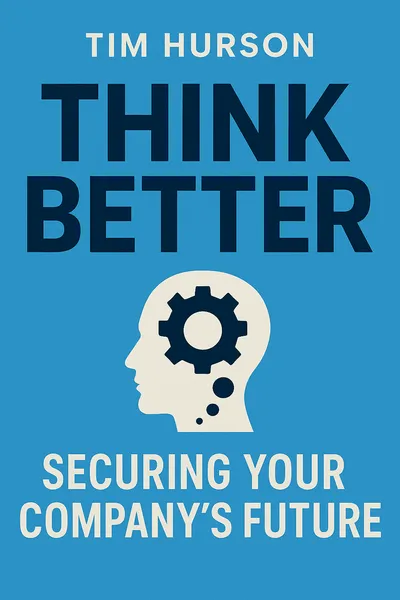
Think better
Securing your company's future
Description
Enhancing your productive thinking skills leads to better options and solutions. The more adept you become at productive thinking, the richer your life. Productive thinking combines creative and critical thinking. Creative thinking generates new ideas. Critical thinking analyzes ideas to determine which ones are viable.
Together they help you envision and create the future you want. Productive thinking brings innovation skills out of the abstract and makes them practical. It's a learnable skill that helps you think, work, and live better. Regardless of your starting point, you can develop your mind's potential. Start now to benefit sooner from improved productive thinking.
Table of contents
01 Step 1: context
To think productively, it's essential to invest time in setting the context before diving into generating solutions. Many people quickly jump into brainstorming without fully defining the problem, which can lead to efforts being misdirected at incorrect issues. A deliberate approach that starts with framing the situation is key to developing solutions that are both targeted and effective.
Tim Hurson suggests a five-step process for establishing context. It begins with a thorough identification of every possible source of dissatisfaction with the current state, including those that are not immediately apparent. This involves looking deeper to find significant but less visible issues. After creating an extensive list, focus on the one or two issues that are most critical.

02 Step 2: future vision
Defining success is essential when tackling a problem or striving for a goal. Crafting a compelling vision of the future, known as "Future Pull," propels progress by clearly defining the ideal outcome. Future Pull involves two main elements: vividly imagining the desired future state and establishing specific success criteria to assess solutions.
To start, envision in detail what life would look like with the problem resolved or goal met. This mental exercise ignites creativity and opens up possibilities by picturing the end goal. Techniques include writing a future annual report, crafting a press release, or describing in the past tense as if the goal has already been achieved. The objective is to create a detailed, enticing image that motivates action towards solving the problem.
Following this, apply the DRIVE framework to set measurable success indicators. DRIVE stands for Do, Restrict, Invest, Values, and Essential Outcome. On a paper, create five sections for each DRIVE element and fill them out accordingly: The "Do" section should include all the solution should achieve. The "Restrict" section details what to avoid. The "Invest" section notes the resources—time, money, people—you're ready to allocate. The "Values" section captures the principles that must remain intact.
03 Step 3: key question
The Productive Thinking Model's third step is crucial for achieving your desired future state, as it involves crafting a "catalytic question." This pivotal question guides you towards the best solution by setting the right direction for inquiry. To formulate such a question, the process begins with a divergent phase where a wide array of potential questions are generated, focusing on quantity over quality.
These questions often start with "How might I..." or "How might we..." and utilize the AIM tool to delve deeper by asking different questions, inverting thinking, and ensuring practicality. Following this, the process converges through a method known as C5, which refines the list by eliminating questions that resemble answers, clustering and removing duplicates, combining related questions into a broader one, clarifying each cluster's theme to remove overlaps, and finally selecting the most critical one or two questions that consistently emerge. This ideally results in a singular catalytic question that addresses the core issue, although sometimes a few final questions may also suffice. This approach of diverging and then converging is designed to identify the essential question that will lead to achieving the target future scenario.
04 Step 4: solution ideas
Generating potential solutions to a key question or issue is a crucial phase in the problem-solving process, often referred to as brainstorming. This stage involves generating a wide range of ideas without initial judgment or evaluation, aiming to unleash creativity and consider all possible answers, no matter how rational, irrational, conventional, or outlandish they may seem. The approach starts with diverging thought processes, opening up to a multitude of possibilities from various perspectives, and imagining a scenario with no constraints related to resources, feasibility, or social norms. The objective is to list every conceivable idea, variation, or combination, prioritizing quantity over quality as there are no bad ideas at this juncture.
Following the generation of a broad list of ideas, the next step is to converge this list into a more manageable number of promising options for further evaluation. This involves grouping similar ideas, eliminating those that appear too unrealistic, clarifying and labeling each group, and identifying common principles or themes. From this process, 3-6 ideas are selected for development, focusing on original, unconventional concepts over safe, mundane ones. This approach allows for revisiting the initial list for alternatives if the selected ideas do not prove fruitful later on. Historical figures such as Thomas Edison, Richard Feynman, Linus Pauling, and Dee Hock have all emphasized the importance of generating a wide range of ideas and selecting the best ones, highlighting the necessity of creative thinking and the avoidance of premature self-editing.
05 Step 5: best solution
Effective communication is the cornerstone of resolving conflicts and nurturing healthy relationships. By employing the right communication strategies, it's possible to transform conflict resolution processes, leading to understanding, reconciliation, and stronger connections. One of the most crucial strategies is to encourage active listening, which involves giving the speaker undivided attention, withholding judgment, and empathizing with their perspective.
This approach fosters a safe environment for open dialogue, enabling mutual understanding and the discovery of common ground. Selecting the appropriate time and place is also vital for successful conflict resolution. Choosing a neutral and private setting where both parties can express themselves freely and honestly contributes significantly to the resolution process. It's important to ensure that both individuals have the chance to speak and that the discussion remains focused on resolving the issue.
Asking thoughtful questions can demonstrate a genuine interest in understanding the other person's viewpoint, which helps build empathy and pave the way for compromise and reconciliation. Clarifying understanding by periodically restating or summarizing key points helps both parties to address any miscommunications and reach a shared understanding. Ensuring that each person has equal time to share their perspective without interruption prevents dominance in the conversation and makes both parties feel heard.
06 Step 6: implementation
Productive thinking is a comprehensive six-step method designed to foster effective problem-solving and solution development. It begins with a clear definition of the problem, setting a vision for success and establishing a goal for the future. The next step involves gathering diverse perspectives, including those from experts, stakeholders, supporters, and critics, to enrich understanding.
The third phase is about brainstorming, encouraging the generation of creative ideas without immediate judgment, followed by a careful analysis of these options. In the fourth step, alternatives are evaluated against set criteria to identify the best solution. The fifth step focuses on pinpointing the necessary actions and resources for implementing the chosen solution. The final step ensures the alignment of organizational resources to effectively execute the plan.
This framework emphasizes that planning should be a dynamic, ongoing process rather than a static document. It acknowledges the need for adaptability in response to changing conditions, while still progressing towards the established goals. Within the final stage of alignment, two critical sub-steps are highlighted: developing a detailed timeline for all necessary tasks and employing the EFFECT framework to ensure each task is adequately resourced, covering aspects such as energy, funds, expertise, conditions, and materials. This approach also involves tracking progress through observable outcomes, identifying potential supporters and detractors early on, and strategizing accordingly.
Related books