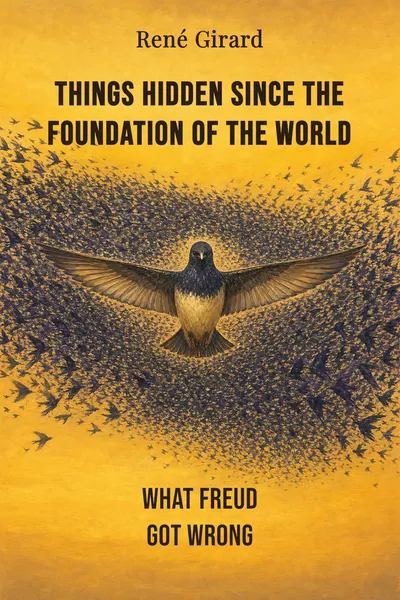
Things Hidden Since the Foundation of the World
What Freud got wrong
Description
In 1978, a French literary critic turned anthropologist named René Girard sat down with two psychiatrists, Jean-Michel Oughourlian and Guy Lefort, and talked for the length of a book. The result, published that year as Des choses cachées depuis la fondation du monde, was not a treatise built from footnotes but a conversation — Girard laying out, question after question, a claim about human beings so total that it swept literature, primitive religion, the founding of cities, and the Christian Gospels into a single argument. The title comes from the Gospel of Matthew: things hidden since the world began, now brought to light. Girard meant it literally. He thought he had found the thing.
The thing is a mechanism, and the mechanism is about wanting. We imagine desire as something private, welling up inside us toward objects we've freely chosen. Girard says the opposite. We desire what others desire, because they desire it; we borrow our wanting from models we imitate. And borrowed desire, spread through a group, turns rivals into a mob that discharges its tension onto a single victim — the scapegoat — whose killing restores a strange peace. On this one hinge, Girard tried to hang the whole of human culture.
That ambition invites an obvious comparison, and Girard courts it. Freud had done something similar in Totem and Taboo, tracing religion and law back to a primal murder of the father. Girard admires the daring and rejects nearly everything else, dismantling the Oedipus complex and the unconscious with a polemic bluntness that leaves little room to shrug. You finish the book owing it an answer.
The question we’re asking : If desire is not our own but copied from others, what does that do to everything we've built on top of it — myth, sacrifice, and the religions that grew from them?What we’ll see : How one man read the deepest patterns of culture off a single mechanism, and made refusing Freud part of the argument.
Table of contents
01 Chapter 1 — Desire is borrowed, not born
Girard began, decades before this book, as a reader of novels. Studying Cervantes, Stendhal, Flaubert, Proust, and Dostoevsky, he noticed the same shape recurring under wildly different plots. Don Quixote does not simply want adventures; he wants what the knight Amadis of Gaul wanted, and imitates him down to the gestures. Emma Bovary desires the life she has read about in romantic fiction. In every case a third figure stood between the character and the object of desire — a model, a mediator, someone whose wanting taught the character what to want. Girard called this mimetic desire, and he insisted the great novelists had grasped it while the philosophers and psychologists had missed it.
The claim overturns a flattering picture we hold of ourselves. We like to think we want things because of what the things are — a person, a career, an object — and that our desires express who we uniquely are. Girard argues that the object is almost incidental. What we really track is the desire of the model. We want the thing because someone we admire, or envy, or measure ourselves against, appears to want it too. Desire is triangular, never a straight line from self to object.

02 Chapter 2 — The crowd finds a victim
Girard's answer is the scapegoat. A community consumed by mimetic conflict, on the edge of tearing itself apart, does not resolve its rivalries by negotiation. It resolves them by conversion. The generalized hostility of all against all suddenly collapses into the hostility of all against one. A single victim is singled out, blamed for the crisis, and killed or expelled. And because the violence now has one target instead of many, the fighting stops. The community that a moment before was at war with itself is united — over a corpse.
The victim, Girard stresses, is chosen almost at random, or by marks that make selection easy: the stranger, the disabled, the king, the one who is somehow both inside and outside the group. What matters is not guilt but availability, and the group's absolute conviction that this one is responsible. That conviction is the engine. The persecutors genuinely believe the victim caused the plague, the drought, the disorder. They are not cynics performing a ritual; they are a mob that has found its culprit and feels, in the killing, a real and bewildering relief.
03 Chapter 3 — The Gospels take the victim's side
Most books of anthropology would stop with the mechanism. Girard does not, and this is where Things Hidden became notorious. He argues that the scapegoat mechanism worked for as long as it stayed hidden — as long as everyone, persecutors included, believed the victim was truly guilty. Myth is the record of that belief. Read a myth and you are reading the persecutors' version, in which the killing was deserved and the victim was a genuine threat. The lie is what makes the peace hold.
The biblical texts, Girard claims, do something no myth had done. They tell the same story of collective violence against a victim, but they take the victim's side and declare the victim innocent. Already in the Hebrew scriptures — Joseph thrown in the pit, Job accused by his friends, the suffering servant of Isaiah — the perspective begins to shift toward the one the crowd condemns. Then the Gospels complete the reversal. The Passion is a textbook scapegoating: a crowd, a contagious accusation, an execution that briefly unites the mob. But the text insists, flatly, that Jesus is innocent and the crowd is wrong.
04 Chapter 4 — A theory of everything, minus the couch
What kind of book is this, in the end? Girard offers a single mechanism — mimetic desire tipping into rivalry, rivalry discharged onto a scapegoat — and asks it to explain the origin of religion, the structure of myth, the function of ritual, the meaning of the Gospels, and, along the way, the errors of psychoanalysis. That is the ambition of a system-builder, and it belongs to a nineteenth- and twentieth-century tradition of grand unifying theories of the human: Marx with class, Freud with the unconscious, now Girard with imitation. The scope is what makes the book exhilarating and what makes it easy to distrust.
The confrontation with Freud is not a side quarrel; it is where Girard defines himself. He grants Freud the crucial intuition — that culture rests on a founding act of violence — and then removes the machinery Freud built around it. No unconscious as a hidden reservoir of repressed drives, no Oedipus complex, no libido as the engine of everything. Where Freud saw a desire welling up from within the individual toward the parent, Girard sees desire arriving from outside, copied from a model, with the object almost interchangeable. The whole architecture of psychoanalysis, on his account, mistook a triangular structure for a private drama between a person and their wishes.
05 Conclusion
The book takes its title from a promise: things hidden since the foundation of the world, now brought into the light. Girard believed the hidden thing was a mechanism we had been running blindly for as long as there had been human groups — copying each other's desires until we fought, then closing ranks around a victim and calling the peace sacred. Myth kept the secret; the Gospels, he argued, gave it away. Whether or not one follows him to that conclusion, the shape of the claim is unforgettable, and the conversation with two psychiatrists made it feel less like a thesis defended than a discovery narrated aloud.
Related books