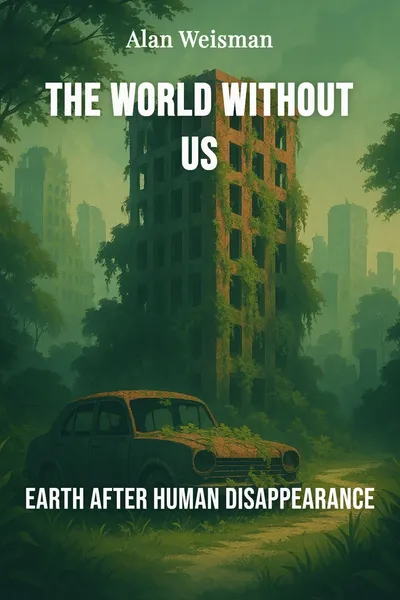
The World Without Us
Earth after human disappearance
Description
Around 2007, a journalist named Alan Weisman published a book built on a single, deliberately absurd premise: suppose every human being vanished tomorrow. Not a war, not a plague with corpses to account for — just a clean disappearance, everyone gone at once, the lights still on for a moment and then nobody left to notice them go out. Weisman wasn't interested in how it might happen. He wanted to know what would happen next. What would the planet do with the space we'd been occupying, and how quickly would it start reclaiming it?
He assembled the answer the way a good reporter does — by asking the people who would actually know. Structural engineers who understand exactly how a roof holds up water. Botanists who have watched forests eat abandoned farmland. The men who keep New York's subway tunnels from flooding, who told him how long the pumps would last with nobody to run them. Wildlife biologists standing inside the exclusion zone around Chernobyl, watching what a landscape does when we simply stop coming. Out of these conversations came a strange, precise portrait: the world, without us in it.
The exercise sounds morbid, and it is at moments, but it lands somewhere else entirely. Subtract the observer and you see the thing more clearly — you find out what was holding up what, what depended on daily human attention, and what would carry on with total indifference to whether we were ever here at all. The disappearance is a trick of the light. What it illuminates is us.
The question we’re asking : If every person vanished overnight, how fast would the planet erase the evidence — and what part of us would refuse to disappear?What we’ll see : A guided tour of the aftermath, from the first leak in the roof to the traces still legible long after the cities are gone.
Table of contents
01Chapter 1 — The house goes first
Weisman starts small and close to home, with an ordinary house, because the collapse begins somewhere unglamorous: the roof. A house is a machine for keeping water out, and it runs entirely on maintenance. Stop cleaning the gutters, stop replacing the shingles, and within a couple of years the first leak reaches the wood. Water gets into the frame, the wood swells and rots, mold does its work, and the structure that felt so permanent turns out to have been in a slow argument with the weather that only our attention was winning.
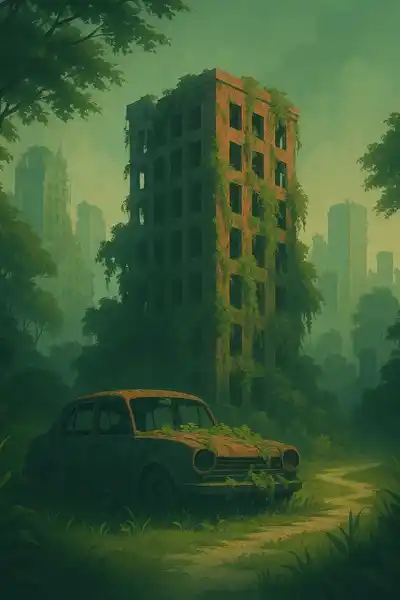
From there the sequence is quick and almost tidy. In cold climates, water freezes in the walls, expands, and cracks them open. Once the roof is compromised, the interior is exposed, and a house that took months to build comes apart over a decade or two. Weisman's engineers walk him through it without drama — this is simply what happens to a wooden box left in the rain. The lawn goes feral first, then saplings push through the floorboards, and the line between house and forest quietly dissolves.

02Chapter 2 — When the wild walks back in
If the buildings come down fast, the living world moves back in even faster, and this is where Weisman's book turns almost hopeful. Nature does not wait respectfully for us to finish leaving. The moment the mowing and spraying and paving stop, the green begins its advance. Weeds crack the asphalt, roots widen the cracks, and what looked like a permanent surface becomes, within a few growing seasons, a seedbed. The reclamation is not gentle so much as relentless.
For a picture of what this looks like at scale, Weisman goes to the places we have already abandoned. The Korean Demilitarized Zone, sealed off by conflict for decades, had quietly become one of the richest wildlife refuges on the peninsula, home to cranes and other rare species precisely because people stopped going in. And Chernobyl — the exclusion zone we fled after 1986 — filled back up with wolves, boar, and moose, animals that apparently found the radiation less hostile than they found us. The lesson lands hard: for a great many creatures, the most dangerous thing in the landscape was the human being.
03Chapter 3 — The things that refuse to rot
Then Weisman turns the story around. If nature is fast at erasing houses and roads, it is strikingly bad at erasing some of the specific things we made — and this is the part of the book that unsettles rather than consoles. Certain materials have no natural predator, nothing evolved to break them down, and so they simply persist, accumulating in a world that has no idea what to do with them.
Plastic is his central exhibit. It is a young material, barely older than a century, and nothing in nature knows how to digest it. Instead sunlight and waves grind it into ever-smaller fragments — the microplastics now found in ocean water, in sediment, in the bodies of fish and birds. These do not go away; they only get smaller and spread further. Long after the last human, Weisman argues, the plastic we produced would still be circulating through the sea, an artificial residue with no expiry date we can meaningfully imagine.
04Chapter 4 — The oldest thing we left behind
Step back from the demolition sequence and the book is measuring something more precise than our fragility. It is measuring an asymmetry. The things that feel most permanent about us — cities, highways, the whole solid architecture of daily life — turn out to be the most perishable, dependent on constant upkeep and gone within a few human lifetimes. Meanwhile the things we barely notice, the molecules and isotopes and drifting fragments, are what would actually last. Weisman's experiment quietly inverts our sense of what we are made of.
Follow that inversion far enough and it reaches something almost geological. The plastics settling into ocean sediment, the altered chemistry of the atmosphere, a thin scattered layer of our synthetic materials pressed into the rock — these are the kind of signals that, millions of years hence, would still mark that something happened here. Not the pyramids, not the skyscrapers, but a stratum. Weisman is essentially describing the fingerprint of what geologists now call the Anthropocene: an age legible in the earth itself, long after its authors have gone.
05Conclusion
Weisman never tells us how the disappearance happens, and by the end it is clear he never needed to. The vanishing was only a lens, a way to hold the world still long enough to see which parts of it were really ours and which were merely borrowed. The house rots, the pumps fail, the forest walks back in, and above all that quiet reclamation the atmosphere keeps its altered chemistry and the sea keeps its plastic. The picture that emerges is not of a species that dominates the planet but of one that leans on it, held up by maintenance, leaving a residue far more durable than anything it intended.
Related books