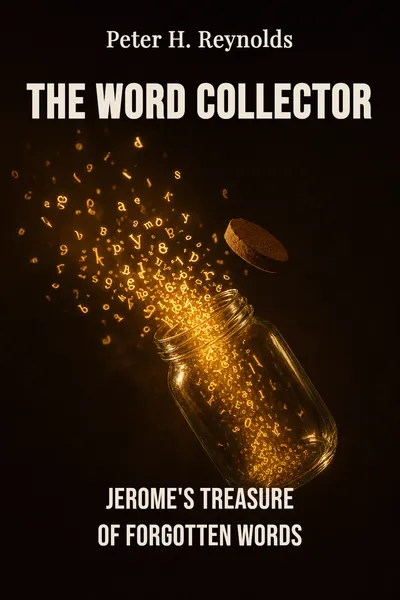
The Word Collector
Jerome's treasure of forgotten words
Description
Some children collect stamps. Others go for rocks, or coins, or the small plastic figures that come free in cereal boxes. In Peter H. Reynolds's 2018 picture book The Word Collector, a boy named Jerome collects something you can't hold, can't trade at a fair, and can't line up on a shelf: words. He hears one he likes, he sees another on a passing sign, he reads a third in a book, and he catches it the way another kid might net a firefly. Then he keeps it. His collection grows the way any collection grows — one small find at a time — until Jerome has more words than he quite knows what to do with.
Reynolds, the illustrator and author behind The Dot and Ish, tells the story in watercolor and ink and very few sentences. There is almost no plot in the conventional sense. Jerome gathers words, sorts them, admires them. And then something happens to the collection — an accident, a spill, a scattering — that turns a story about accumulation into a story about what accumulation is for. That turn is the whole book, and it arrives without a single line of instruction.
On its surface this is a book about vocabulary, the kind a teacher might reach for to encourage a class to love language. But the reason it has stayed on shelves and reading lists is that it is quietly about something larger than words: about the difference between having a thing and doing something with it. Jerome's treasure is real. What he eventually does with it is the point.
The question we’re asking : What does a boy who hoards words end up learning about why he was collecting them in the first place?What we’ll see : How a small picture book turns a private habit of gathering into something Jerome decides, one afternoon, to give away.
Table of contents
01Chapter 1 — A boy who kept what other people let slip by
Jerome is not a remarkable boy in any obvious way. He is not the fastest or the loudest, and Reynolds draws him small, round-headed, glasses slipping down his nose, entirely absorbed in his own quiet project. What makes him himself is that he pays attention to a thing most people walk straight past. Words are everywhere — on cereal boxes, in overheard conversations, in the songs that play in the next room — and almost everyone lets them pass. Jerome catches them.
The words arrive from every direction. Some he hears; some he sees; some he reads. Reynolds lets Jerome sort his finds into loose categories, and the categories themselves tell us how the boy's ear works. There are short and sweet words. There are two-syllable words that feel good to say out loud. And there are the long ones — the multisyllabic marvels that sound like small pieces of music before you even know what they mean. Jerome doesn't collect words because they're useful. He collects them because they're beautiful, or funny, or strange in the mouth.

02Chapter 2 — The moment the jars fell
Then Jerome trips. Carrying his scrapbooks one day, he stumbles, and the words go flying — the carefully sorted categories scattering into the air, mixing together, landing in a jumble on the ground. It's the kind of small domestic catastrophe any collector dreads: the ordered thing suddenly disordered, the labels no longer matching the contents. For a boy whose whole pleasure was in the sorting, the spill should be a disaster.
But Reynolds turns it into the opposite. In the mess, Jerome notices words touching that never touched before. Ones he had filed in different scrapbooks now lie side by side, and the accidental pairings are more interesting than the neat piles ever were. A simple word next to a grand one. A sad one leaning against a bright one. The collapse of his careful system produces combinations he would never have arranged on purpose, and Jerome — instead of rushing to re-sort everything — starts to play.
03Chapter 3 — Words that don't behave the way you expect
What Jerome learns in the aftermath of the spill is something writers know and rarely say out loud: words are not interchangeable tokens, and they don't sit still. Reynolds has fun with this. Jerome finds that some of his favorites don't do what their size suggests. Small, plain words can carry enormous weight. Fancy, complicated ones can turn out to say very little. The value of a word, it turns out, isn't in how impressive it looks on its own — it's in what it does when placed next to other words.
So Jerome starts arranging. He climbs to a high place with his words and lets them go — Reynolds gives us a scene of the boy on a hilltop, releasing his collection into the wind like seeds. It's a striking image because it's the reverse of hoarding. The whole logic of a collection is to hold on. Jerome does the opposite: he scatters, on purpose this time, and watches the words travel out into the world where other people can catch them, the way he once caught them himself.
04Chapter 4 — What a collection is actually for
Step back from Jerome for a moment and the book reveals what it's really turning over. Most stories about collecting are stories about acquisition — the thrill of the find, the completeness of the set, the satisfaction of ownership. Reynolds tells one of the few that treats acquisition as the beginning rather than the point. Jerome's words matter not because he has amassed them but because he eventually decides to release them. The moral center of the book is not the hoard; it's the giving.
That reframes something we usually take for granted about language itself. We tend to talk about a rich vocabulary the way we might talk about a full bank account — as a private asset, a measure of how learned or capable someone is. Reynolds quietly disagrees. In his telling, a vocabulary that stays inside a person is a vocabulary that hasn't done its job. Words are for reaching across the space between one person and another. Jerome's treasure only becomes treasure at the moment he spends it on somebody else.
05Conclusion
The Word Collector ends where a lesser version of it might have begun — with Jerome having given his words away and finding, to no one's surprise but somehow to our satisfaction, that he is happier for it. Reynolds closes on the boy at his most generous and his most complete, still holding every word he ever caught, and now sharing them freely. The spill that once looked like a catastrophe turns out to have been the best thing that happened to him. It broke open a habit of keeping and taught him a habit of giving.
Related books