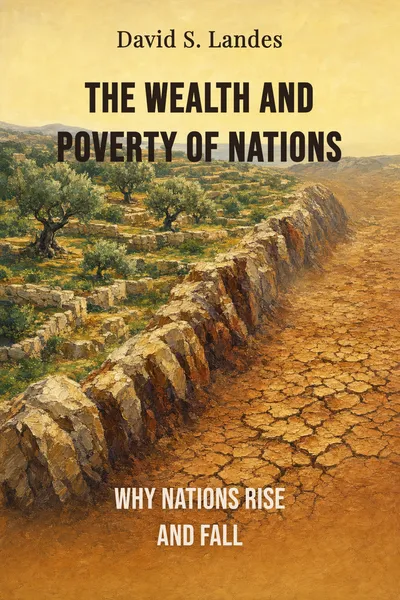
The Wealth and Poverty of Nations
Why nations rise and fall
Description
In 1998, a Harvard economic historian named David S. Landes published a book with a title borrowed, deliberately, from Adam Smith. The Wealth and Poverty of Nations ran to more than five hundred pages and asked the oldest question in economics in the bluntest possible form: why are some countries so rich and others so poor? Landes was seventy-four, had spent a career studying clocks, factories and the Industrial Revolution, and had no patience for the polite hedging that had come to surround the subject. He wanted to know why northwestern Europe pulled ahead of the rest of the world around 1750, and why the gap between the richest and poorest nations had grown, on his own reckoning, to something like four hundred to one.
The book landed as a provocation. It was learned, sprawling, and openly unfashionable. At a moment when much of the profession preferred to explain development through institutions, incentives and colonial exploitation, Landes insisted on adding the one factor most scholars had quietly retired: culture. He argued that values, habits, work discipline and attitudes toward knowledge were not decorative footnotes to economic growth but central to it. Reviewers called it iconoclastic and refreshing; others called it worse. Few called it dull.
What makes the book worth revisiting is not that Landes settled anything. He didn't, and he knew it. He was reopening a fight the field had tried to avoid, staking out a position that was hard to prove and harder to ignore. He assembled centuries of evidence to defend a claim that, stated plainly, still makes people uncomfortable: that some societies were better equipped than others to seize the modern world, and that the reasons were partly of their own making.
The question we’re asking : Why did some nations grow rich while others stayed poor — and how much of it comes down to something as slippery as culture?What we’ll see : How Landes rebuilt the case for wealth as the product of geography, history and, above all, the habits of mind a society carries with it.
Table of contents
01 Chapter 1 — A geography nobody wants to name
Landes opens where polite economics fears to tread: with the map. Wealth and poverty, he notes, are not scattered randomly across the globe. The rich nations cluster in the temperate zones; the poorest sit, overwhelmingly, in the tropics. This correlation is old, stubborn, and, to Landes, impossible to wave away as coincidence or as the mere residue of colonialism. He wanted to ask what the heat and the disease and the rhythm of the tropics actually do to the societies that live in them.
His answer is careful, and he is at pains not to slide into the crude climatic determinism of earlier writers who used heat to rank races. Tropical climates, he argues, impose real burdens: parasites and diseases that thrive in warmth and drain human energy, agricultural cycles vulnerable to drought and flood, the sheer physical cost of labor in extreme temperatures. Cold, by contrast, kills pathogens and imposes a discipline of forethought — you store food, you plan for winter, you cannot simply pick fruit off the tree year-round.

02 Chapter 2 — The European accident that became a system
The heart of the book is a long argument about why Europe, and specifically its northwestern corner, became the launchpad of sustained economic growth. Landes rejects the idea that Europe was simply luckier, or simply more brutal. He builds instead a picture of a continent that, almost inadvertently, assembled the conditions under which invention could compound on itself and enrich a whole society rather than a narrow elite.
Fragmentation is central to his story. Europe never congealed into a single empire the way China did under its dynasties. It stayed a mess of competing kingdoms, city-states and principalities, and that competition, Landes argues, was productive. A ruler who taxed his merchants into the ground or persecuted his best craftsmen watched them cross a nearby border and enrich a rival. Talent and capital could vote with their feet. Political division, usually treated as European weakness, becomes in his telling a source of restless dynamism that no unified empire could match.
03 Chapter 3 — Culture as the variable economists dropped
Here Landes plants his flag, and here the book earned most of its enemies. If we want to know why the machinery of European growth turned over while other engines stalled, he argues, we cannot stop at geography and institutions. We have to talk about culture — the values, habits and attitudes a society transmits, the things that decide whether people work, save, innovate, trust strangers and educate their children. He quotes Max Weber's old thesis about the Protestant ethic not to endorse every word of it but to defend its instinct: that beliefs shape economies.
This is the claim that made the profession wince, because culture is hard to measure, easy to caricature, and dangerously close to the language of prejudice. Landes knew it. He argued anyway, on the grounds that pretending culture doesn't matter is not neutrality — it is a different kind of error. What counts, in his account, is a cluster of dispositions: a respect for work as dignified rather than degrading, a willingness to defer gratification and reinvest, an openness to instruments and evidence over inherited authority, and an honesty in dealings that lowers the cost of doing business.
04 Chapter 4 — The debate Landes reopened
Step back from the particular quarrels, and what Landes really did was reignite the biggest argument in the human sciences: how we are allowed to explain the gap between rich and poor nations at all. Every explanation carries a politics. If poverty is caused by geography, nobody is to blame and little can change. If it is caused by colonial theft, the rich owe the poor restitution. If it is caused, even partly, by culture, then the causes reach inside societies themselves — and that is the version almost nobody wants to say out loud, because it sounds like blaming the victim.
Landes accepted that risk deliberately. His wager was that intellectual honesty required naming factors that were unflattering, and that refusing to do so out of decency actually helped no one, least of all the poor. A development policy that ignores how a society works, he implies, will pour resources into a shape that cannot hold them. His critics answered, fairly, that culture is a slippery and self-serving category, that yesterday's despised trait becomes today's admired one whenever fortunes reverse, and that his story often read Europe's success backward into flattering origins.
05 Conclusion
David Landes died in 2013, having spent his final decades as one of the most combative and admired economic historians in the English-speaking world. The Wealth and Poverty of Nations was his summa — the book in which the clock historian, the factory scholar and the lifelong contrarian folded everything he knew into one enormous, quarrelsome argument. It sold well, was translated widely, and irritated exactly the people it set out to irritate. It never became consensus, which is more or less what its author intended.
Related books