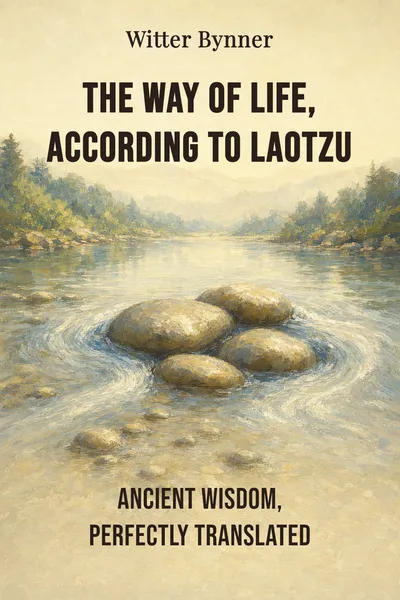
The Way of Life, According to Laotzu
Ancient wisdom, perfectly translated
Description
In the early 1940s, the American poet Witter Bynner published a slim book with a long title: The Way of Life, According to Laotzu. It was his rendering of the Tao Te Ching, the Chinese classic traditionally attributed to a sixth-century-BCE sage named Laotzu — a figure so shadowy that scholars still argue over whether he existed at all. Bynner had spent time in China in 1917, traveling with the sinologist Kiang Kang-hu, and the encounter never left him. He was not a scholar of classical Chinese. He was a poet who had fallen for a text, and he spent decades listening to it before he dared to put it into English.
The result reads unlike most translations of the period. Where earlier English versions leaned on the vocabulary of comparative religion — heavy with capital-letter abstractions, footnotes, and reverence — Bynner's Laotzu speaks plainly. The eighty-one short chapters come across as sayings a person might actually turn over in the mind, clear and unshowy. When the critic John Haynes Holmes called the sayings gems cut clear in every facet, and the book the perfect rendering of a classic, he was pointing at exactly this: a text that had been made to sound like itself, not like a Western sermon about the East.
But calling any translation perfect raises a stubborn problem. The Tao Te Ching is famously the book that opens by warning that the way which can be spoken is not the true way. How does a poet carry across a text that begins by doubting words — and doubting, in a sense, translation itself? That tension sits at the center of what Bynner attempted, and of why the book still gets read.
The question we’re asking : How does a poet render into English a Chinese classic that begins by warning that the truth cannot be put into words?What we’ll see : A book about the limits of language, and the man who spent decades trying to carry it faithfully across one.
Table of contents
01 Chapter 1 — A poet meets a Chinese classic
Witter Bynner was, by the time he took on Laotzu, an established figure in American letters — a poet, a translator, a fixture of the circles that ran through Santa Fe and the literary magazines of the early twentieth century. His route to the Tao Te Ching ran through a friendship. In 1917 he traveled in China with Kiang Kang-hu, a Chinese scholar with whom he would later produce a celebrated anthology of Tang poetry, The Jade Mountain. That collaboration gave Bynner something most translators of the period lacked: not fluency in classical Chinese, exactly, but long, patient exposure to how a Chinese sensibility handled a line.
The Tao Te Ching he inherited was a text wrapped in centuries of commentary and, in the West, in a particular kind of solemnity. Nineteenth-century translations tended to treat it as scripture, and rendered it accordingly — dense, archaic, freighted with the machinery of Victorian religiosity. The Tao became The Way with a capital everything, and Laotzu came out sounding like a mystic delivering pronouncements from a great height. Bynner found this false to the plainness he heard underneath.

02 Chapter 2 — The way that cannot be named
The book opens with the sentence that has defeated and delighted translators for centuries: the way that can be told is not the eternal way; the name that can be named is not the eternal name. Everything that follows is shadowed by that warning. Laotzu is about to spend eighty-one chapters describing something he has just told us cannot be described. The Tao — Bynner mostly keeps the word as the way of life — is the source and pattern of everything, present in all things yet graspable by none of them. To point at it directly is to miss it.
Bynner's rendering leans into this by staying concrete. Where the text reaches for the ineffable, he reaches for images a reader can hold. Laotzu's favorite figures are humble and physical: water, which yields to everything and yet wears down stone; the empty hub that makes a wheel useful; the uncarved block; the valley; the newborn child. These are not decorations. They are the argument. The Tao works through softness, lowness, and emptiness — the qualities a striving person is trained to despise — and Bynner keeps the images plain enough that their strangeness lands.
03 Chapter 3 — Governing by leaving alone
It is easy to read the Tao Te Ching as private wisdom — a manual for the inner life. But a striking share of its chapters are about power. Laotzu addresses rulers directly, and his political counsel follows straight from wu wei: the best government is the one that governs least, the sage-ruler who is barely felt. When the work is done, Bynner renders, the people say we did it ourselves. Leadership, in this vision, succeeds by disappearing.
The logic is consistent with everything else in the book. Force provokes counter-force; sharp laws breed clever criminals; the more prohibitions there are, the poorer the people become. A ruler who grasps at control produces the very disorder he fears, because he acts against the grain. The one who trusts the natural order, who does not meddle, who keeps his own ambitions small, allows things to find their own balance. Laotzu even praises the small state with few people, content and unhurried, uninterested in conquest.
04 Chapter 4 — What a translation is for
Bynner never called his book a translation in the strict sense; he preferred to describe it as an interpretation, an American version of Laotzu. That modesty points at something larger than one poet's method. A classic like the Tao Te Ching does not reach us as itself. It reaches us only through hands — through the choices of whoever carries it across the gap between a sixth-century-BCE Chinese and a twentieth-century English reader. There is no transparent window onto the original. There are only versions, each shaped by the sensibility of the one who made it.
This is an uncomfortable truth for a text that so distrusts language, and Bynner seems to have felt it. His answer was not to claim fidelity to the words, which he knew he could not guarantee, but to aim at fidelity to the tone — the plainness, the unforced quality, the way Laotzu seems to say the most while insisting on the least. He judged that a version which sounded lofty and scriptural in English betrayed the original more deeply than one which took liberties with the letter but kept the spirit. Better to lose the exact character than to lose the voice.
05 Conclusion
Bynner spent decades with Laotzu before he let the book go, and the patience shows. What he left behind is not the most literal English Tao Te Ching, and it was never meant to be. It is the one that sounds least like a lecture and most like a person speaking — eighty-one short sayings that a reader can carry around and turn over, cut clear enough to catch the light from several angles at once.
Related books