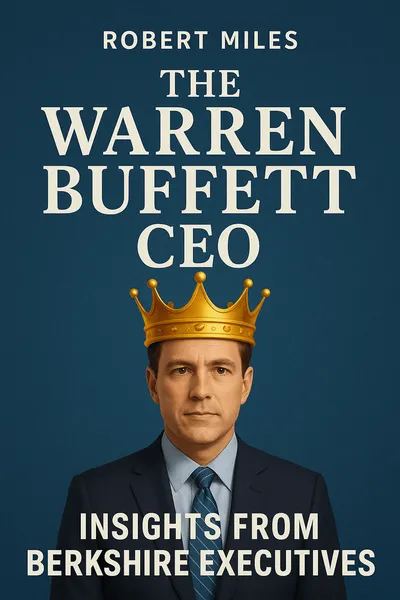
The warren buffett ceo
Insights from berkshire executives
Description
Berkshire Hathaway's success stems from Warren Buffett's business philosophy. He only buys wonderful companies with great management that he intends to own forever. Buffett lets the managers continue running operations with autonomy. Each subsidiary CEO has a compensation tied to performance and can allocate capital to expand.
Subsidiary CEOs have freedom from headquarters oversight on reporting and press. Buffett expects high ethics and integrity. He only buys from sellers passionate about their business. Subsidiaries operate as if they independently owned the business forever. This philosophy creates an ideal home for acquired businesses and reassures sellers their legacy is in good hands with Berkshire. Buffett takes stewardship of acquired companies very seriously.
Table of contents
01 Tony nicely geico insurance ceo
GEICO, a leading auto insurer headquartered in Maryland, has grown significantly under CEO Tony Nicely's leadership. Nicely, who joined GEICO in 1961 and worked his way up, played a pivotal role in the company's turnaround from near bankruptcy in the 1970s to its current success.
His strategy involved reorganizing the business and attracting investment from Warren Buffett, leading to Berkshire Hathaway acquiring a significant stake in GEICO. Nicely's management philosophy emphasizes understanding customers, providing excellent service, and initiatives to save money, fostering loyalty through word-of-mouth.

02 Lou simpson, investment manager at geico
Lou Simpson, renowned for his tenure as the head of investments and CEO of capital operations at GEICO, has a notable investment record, often outperforming giants like Warren Buffett and Peter Lynch.
Beginning in the early 1980s, he significantly increased the equity investments portion of GEICO's portfolio, achieving substantial growth by 1995 through a strategy focused on investing in undervalued companies with strong management. Simpson emphasizes long-term investments, minimal transaction costs, and a concentrated portfolio to maximize returns.
03 Ajit jain, berkshire reinsurance head
Ajit Jain, originally from India, pursued further education in the US before taking the helm of Berkshire Hathaway's reinsurance division in 1986. His leadership is marked by a pragmatic acceptance of losses, prioritizing swift decision-making over exhaustive analysis, and a keen instinct to avoid unwise commitments.
04 Rose blumkin, founder of nebraska furniture
Rose Blumkin, an immigrant who arrived in America with nothing at 16, founded Nebraska Furniture Mart by borrowing $500 in 1937. Her strategy was simple yet effective: offer high-quality goods at low prices by minimizing costs and passing the savings to customers.
Despite legal challenges from suppliers, Blumkin's aggressive pricing prevailed in court. She was a firm believer in direct customer engagement, building loyalty through personal interactions and honest service, encapsulated in her motto, "Sell cheap and tell the truth."
05 Al ueltschi, founder of flightsafety aviation training
FlightSafety International, established in 1951 by former Pan Am pilot Al Ueltschi, initially struggled but eventually flourished by providing pilot training and building simulators. Ueltschi, who had mortgaged his home to fund the venture, worked as a pilot to support his living expenses while reinvesting all profits into the company. His commitment to industry leadership, cost discipline, and community contribution shaped the company's ethos.
06 Rich santulli, founder of netjets company
Richard Santulli left his promising career at Goldman Sachs in 1979 to start RTS Capital Services, a helicopter lease financing business. Quickly, he built the world's largest helicopter fleet, leasing to offshore oil companies. In 1984, Santulli acquired Executive Jet Aviation, leading to the creation of NetJets in 1986 after he innovated the fractional jet ownership concept.
07 Don graham, former washington post publisher
Warren Buffett's Berkshire Hathaway acquired a 10% stake in The Washington Post Company in 1973 for $10.6 million, or $6.14 per share. This investment has grown more than a hundredfold, now valued at over $1 billion in Washington Post shares, and yields about $9 million annually in dividends.
Buffett's role extends beyond investor to being a long-standing adviser to the company's CEO, Don Graham. Graham's leadership approach is marked by several core principles. He prioritizes stringent cost management, investing in quality only when necessary while keeping other expenses low.
08 Irvin blumkin, nebraska furniture president
Nebraska Furniture Mart, founded by Rose Blumkin in 1937, continues to thrive under the leadership of her grandson, CEO Irvin Blumkin. Since taking the helm in 1983, Irvin has significantly grown the company by maintaining his grandmother's founding principles of affordability, honesty, and customer service, while also embracing innovation to meet changing consumer needs.
09 Frank rooney, former ceo of h.H. Brown shoes
H.H. Brown, a leading American manufacturer of steel-toed work boots, western, and casual footwear, was founded in 1883 by Henry H. Brown. It changed hands within the family, eventually being acquired by Berkshire Hathaway in 1990 for $200 million. Under CEO Frank Rooney, the company thrived by adhering to a management philosophy that emphasized simplicity, profit-sharing, delegation, and enjoyment at work.
10 Bill child, founder of r.C. Willey home furnishings
At 22, Bill Child took over a modest electrical appliance shop from his father-in-law in 1954 and transformed it into Utah's premier home furniture and appliance retailer over four decades. Upholding integrity, customer satisfaction, and instinctual decision-making, he grew the business significantly. When Warren Buffet acquired the 11-store, $400 million R.C. Willey chain in 1995, he set a new goal for Child: reach $1 billion in sales.
11 Melvyn wolff, former ceo of star furniture
Melvyn Wolff stepped into the furniture business unexpectedly to support his ailing father, who owned half of Star Furniture, in 1950. Initially planning to help for only a year and interrupting his law studies, Melvyn ended up leading the company from a single store in downtown Houston to a chain of nine stores generating over $110 million in sales by 1997.
12 Eliot and barry tatelman, founders of jordan's furniture
Eliot and Barry Tatelman, leading Jordan's Furniture in Natick, Massachusetts, have revolutionized the retail experience with their innovative business philosophy. They prioritize exceptional customer service and a fun shopping environment, treating their 1,200 employees to trips and generous bonuses to foster a positive work culture.
13 Stan lipsey, publisher of the buffalo news
Warren Buffett's acquisition of The Buffalo News in 1977 for $32.5 million led to Stan Lipsey taking the helm as publisher. A Pulitzer Prize winner, Lipsey was deeply committed to his role, embodying management principles that prioritized employee empowerment and high standards. He approached technology adoption with caution, ensuring thorough research, staff training, and smooth transitions.
14 Chuck huggins, president of see's candies
Charles See established See's Candies in California in 1921, and by the time he passed away, the company had flourished to include 78 stores and a workforce of 2,000. The growth trajectory continued, leading to its acquisition by Berkshire Hathaway in 1972 for $25 million. At the point of sale,
See's was generating about $4 million in annual revenue, and Charles "Chuck" Huggins took the helm as CEO. Huggins' tenure was marked by the adoption of core business philosophies that prioritized customer satisfaction, managerial autonomy, and the appreciation of accumulated experience.
15 Ralph schey, former ceo of scott fetzer
Ralph Schey led the Scott Fetzer group for over three decades, retiring in 2000 at age 76. Under his guidance, the company became a diverse conglomerate with over 20 brands, including Kirby Vacuum and World Book Encyclopedia. Acquired by Berkshire Hathaway in 1986 for $230 million,
16 Susan jacques, ceo of borsheim’s jewelry
Susan Jacques, originally from Zimbabwe, began her illustrious career in the jewelry industry at Borsheim's Fine Jewelry in Omaha, Nebraska, in 1982. She climbed the ranks to become president and CEO in 1994, a position she held for 20 years, during which she transformed Borsheim's into a successful retailer with annual sales surpassing $130 million.
17 Jeff comment, former president of helzberg diamonds
Helzberg Diamonds, established in 1915 in Kansas, has become a prominent jewelry retailer with over 200 stores across 38 states, boasting annual sales above $500 million and pretax profits surpassing $50 million. The company saw significant growth under Jeffrey Comment, who served as CEO from 1988 for 16 years.
Related books