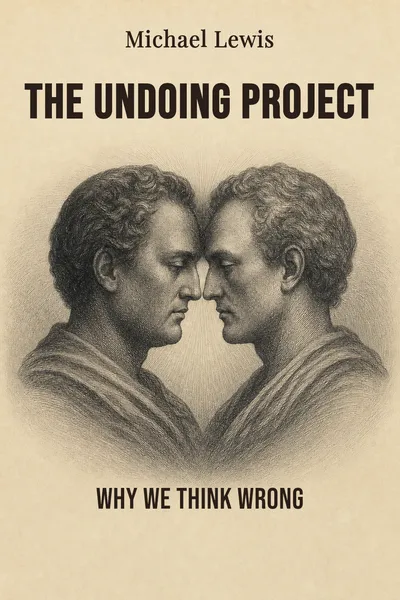
The Undoing Project
Why we think wrong
Description
Michael Lewis found his subject by accident. He had written Moneyball, a book about how the Oakland A's used numbers to spot value that scouts' gut instinct kept missing. A review pointed out that Lewis had told a story about human misjudgment without seeming to know that two Israeli psychologists had already mapped the whole territory decades earlier. Their names were Daniel Kahneman and Amos Tversky. One of them, Kahneman, had by then won a Nobel Prize in economics — a strange honor for a man who had never taken a single economics class. The other, Tversky, had died in 1996 and so could not share it. Lewis went looking for the story behind the science, and found something he hadn't expected: a love story between two brains.
The work itself had already quietly reorganized several fields. Starting in the late 1960s, the two men ran deceptively simple experiments that showed something unsettling — that the human mind, faced with uncertainty, does not calculate. It reaches for shortcuts. Those shortcuts usually work, which is why we have them, but they fail in patterned, predictable ways. People misjudge risk, overweight vivid stories, fear a loss far more than they crave an equal gain. Doctors, generals, investors, and juries all made the same mistakes in the same directions. What Kahneman and Tversky proved was that error was not random noise. It had a grammar.
But Lewis is not really writing a psychology textbook. He is writing about the two men who could finish each other's sentences in two languages, who laughed together behind closed office doors until colleagues wondered what was so funny, and who eventually could barely speak. The ideas came out of the friendship, and the friendship is where the book keeps returning.
The question we’re asking : How did two psychologists prove that the mind misjudges in predictable ways — and why does Lewis frame their discovery as inseparable from their bond?What we’ll see : A partnership, a set of experiments that unsettled how we understand our own choices, and the human cost of thinking that closely with another person.
Table of contents
01 Chapter 1 — Two minds that shouldn't have fit
Kahneman and Tversky were, by temperament, near opposites, and Lewis lingers on the contrast because it explains everything that followed. Danny Kahneman was a survivor of Nazi-occupied France, a boy who had learned early that the world was dangerous and people unreadable. He grew into a man riddled with doubt, changing his mind constantly, treating every idea he had — including his best ones — as probably wrong until proven otherwise. Amos Tversky was sunlight to that shadow: a former Israeli paratrooper, brilliant, cocky, magnetic, a man who slept when he wanted and worked at night and radiated certainty. People said the smartest test of your own intelligence was how quickly you realized Amos was smarter.
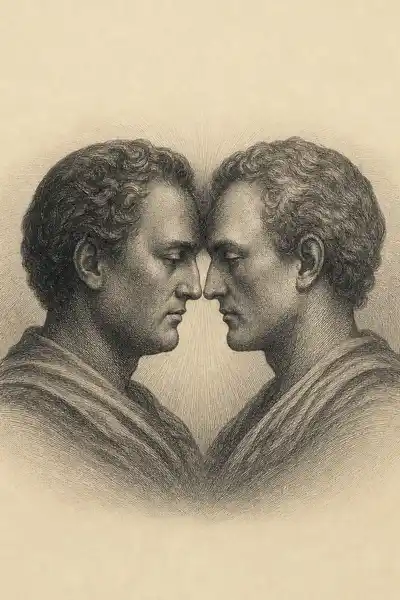
They met at the Hebrew University of Jerusalem in the late 1960s. Kahneman, teaching a seminar, invited Tversky to speak, then tore his talk apart. Rather than resenting it, Tversky seemed delighted. Something clicked. They began meeting for hours, then whole days, sharing a single desk, writing papers one sentence at a time, arguing over each word until neither could remember who had thought of what. Colleagues learned to leave them alone. The sound coming through the door was usually laughter.

02 Chapter 2 — The tricks the mind takes
The experiments that made their name were often no more than a paragraph on a page. In one, they described a woman named Linda — thirty-one, single, outspoken, deeply concerned with social justice, a former philosophy student who had marched against nuclear power. Then they asked which was more probable: that Linda was a bank teller, or that she was a bank teller and active in the feminist movement. Most people chose the second. But a subset of a group can never be more likely than the group itself — every feminist bank teller is already a bank teller. People weren't calculating probability at all. They were judging how well the story fit.
Kahneman and Tversky called this the representativeness heuristic: we estimate how likely something is by how much it resembles our mental picture of it, ignoring the cold arithmetic underneath. A description that sounds like a librarian makes us guess librarian, even when farm workers vastly outnumber librarians. The vivid stereotype crowds out the base rate. It felt, when you were doing it, exactly like reasoning. That was the disturbing part. The shortcut was invisible from the inside.
03 Chapter 3 — Losses loom larger than gains
The idea that reached furthest beyond psychology was prospect theory, published in 1979. Classical economics had long assumed people were rational calculators of self-interest, weighing odds and outcomes to maximize expected value. Kahneman and Tversky showed that real people do nothing of the sort. What they respond to is not final wealth but change — gains and losses measured against wherever they happen to be standing at the moment.
And the two are not symmetric. Their experiments showed, again and again, that a loss hurts roughly twice as much as an equivalent gain pleases. Offered a coin flip to win $150 or lose $100, most people refuse, even though the math favors playing. The threat of the hundred looms larger than the promise of the fifty extra. This loss aversion, they argued, is one of the deepest grooves in human decision-making, and it warps behavior in ways a rational model could never predict.
04 Chapter 4 — When a friendship becomes a method
Step back from the experiments and a larger claim comes into focus, one Lewis builds patiently across the book: what Kahneman and Tversky really discovered was not a list of human defects but the architecture of an ordinary mind doing its best. The biases are not bugs bolted onto otherwise perfect reasoning. They are the reasoning — the same machinery that lets us cross a street, read a face, or make a snap judgment that keeps us alive. The tragedy and the comedy of being human is that the tool built for speed cannot be switched off when the situation calls for slow arithmetic instead.
That is why the work unsettles more than it flatters. It says the errors are not other people's — the credulous, the innumerate, the poorly educated. They are everyone's, including the two men who found them, who caught themselves falling for their own examples. There is no clean vantage point outside the mind from which to correct the mind. The best one can do is learn the patterns and build systems — checklists, statistics, second opinions — that catch what intuition cannot.
05 Conclusion
The partnership that produced all this did not last. As Tversky collected honors — a MacArthur grant, a growing legend — Kahneman felt increasingly erased, treated as the junior partner to a man he considered his equal. The doubt that had made their science great turned inward and corrosive. They drifted, argued about credit, nearly stopped speaking. Then, in 1996, Tversky was diagnosed with terminal cancer. In his last months he called Kahneman, and something of the old closeness returned before the end. Kahneman would win the Nobel six years later, and spend the speech naming the friend who could not stand beside him.
Related books