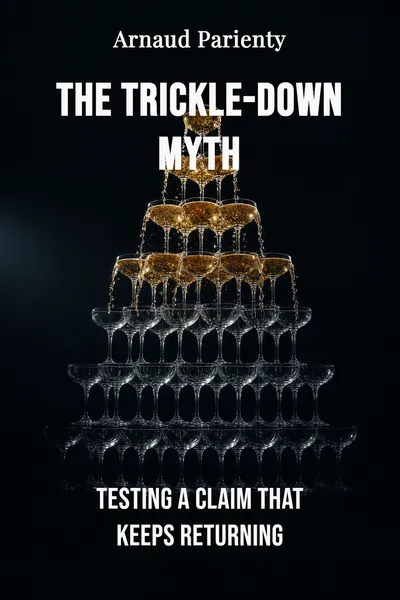
The Trickle-Down Myth
Testing a claim that keeps returning
Description
The expression has a strange status. Almost no serious economist defends "trickle-down economics" by name, and almost no politician admits to practicing it. Yet the idea it describes keeps coming back, decade after decade, dressed in fresh vocabulary. Cut taxes at the top. Loosen the rules on business. Reward the people who invest and take risks. The wealth they generate, the argument goes, will eventually reach everyone below — through jobs, wages, new activity. The rich get richer first, and the rest of us get richer afterward. It is one of the most durable promises in modern political economy, and one of the most slippery to pin down.
The French economist Arnaud Parienty set out to do exactly that — to pin it down. In his book on the subject, he treats trickle-down not as a slogan to mock but as a claim to test. Does money given to the top actually flow downward? If so, through what channels, and at what speed? And if the evidence is thin, why does the belief survive every government that tries it and quietly moves on? Parienty's method is unglamorous and effective: take the argument at its strongest, follow the mechanism it proposes, then check what the data say happened.
What makes the exercise worthwhile is that the idea is neither pure cynicism nor pure nonsense. There is a real economic intuition buried inside it, one that a careful person can state without blushing. The trouble starts when the intuition is asked to carry a policy program it was never built to support.
The question we’re asking : When wealth is handed to the top, does it really flow down to everyone else — and if not, why does the promise keep returning?What we’ll see : How Parienty takes the claim seriously, follows its proposed mechanism, measures it against the record, and asks what keeps it alive.
Table of contents
01Chapter 1 — A phrase nobody admits to using
The first thing Parienty notices is that "trickle-down" is an insult before it is a doctrine. Nobody builds a research program around it. You will not find a textbook chapter titled "Trickle-Down Theory," nor an economist who lists it on a CV. The term is almost always used by critics, pointing at someone else's policy. This makes it a moving target: the moment you describe it, a defender can reply that this is a caricature, that no one ever claimed wealth simply drips from the wealthy to the poor like water through rock.
The phrase itself has a folksy American lineage. It is often traced to the humorist Will Rogers, who in the 1930s joked that money handed to the top would, with luck, trickle down to the needy. Ronald Reagan's critics revived it in the 1980s to attack his tax cuts, and it has been a term of abuse ever since. George H. W. Bush once called a related idea "voodoo economics" before he became Reagan's running mate. The vocabulary keeps shifting precisely because the label is toxic.

02Chapter 2 — What the theory actually claims
The honest version goes like this. Wealthy households and firms are the ones with money to save and invest. If the state takes less of that money in tax, they will have more to put to work — building factories, funding start-ups, hiring staff, expanding operations. That investment raises productivity, creates jobs, and lifts wages across the board. Lower taxes at the top, in this telling, are not a gift to the rich but fuel for the engine that eventually enriches everyone. The key word is incentive: lighter taxation, the argument runs, makes people work harder, risk more, and produce more.
There is a second strand, more academic, that Parienty takes care to separate out. Supply-side economists in the 1970s and 1980s, and the famous Laffer curve in particular, argued that tax cuts could so stimulate activity that they would pay for themselves — the government would collect as much, or more, from a smaller slice of a bigger pie. This is a stronger and more testable claim than the vague promise of downward flow, and it has the advantage of being falsifiable. Either the revenue comes back or it doesn't.
03Chapter 3 — When the numbers come in
The evidence, Parienty argues, is remarkably unkind to the strong version of the claim. The most natural laboratory is the United States, where top tax rates were cut sharply under Reagan in the 1980s and again under George W. Bush and Donald Trump. If trickle-down worked as advertised, these decades should show a surge of broadly shared prosperity. Instead they show the opposite pattern: growth that was real but unexceptional, and gains that concentrated heavily at the very top. The share of income captured by the richest one percent climbed steeply while median wages stagnated for long stretches.
The self-financing promise fares no better. Tax cuts, in the historical record, mostly cost revenue rather than generating it — the Laffer logic holds only at tax rates far above those actually in force in rich countries. A much-cited study by the economists David Hope and Julian Limberg, looking across eighteen advanced economies over five decades, found that major tax cuts for the rich reliably raised the top income share and did little measurable good for growth or employment. The money, in other words, arrived at the top and largely stayed there.
04Chapter 4 — The idea that refuses to die
Here is the puzzle that most interests Parienty. If the evidence is this consistent, why does the belief survive? Governments try a version of it, inequality grows, the broad gains fail to materialize — and a few years later another administration proposes something that walks and talks the same way. The idea behaves less like a scientific hypothesis, which dies when falsified, and more like a myth: a story that endures because of what it does for the people who tell it, not because of what it predicts.
Part of the answer is that trickle-down is politically convenient in a way few economic claims are. It lets a government reward its most powerful supporters while describing the reward as a benefit to everyone. Cutting taxes on the wealthy sounds selfish; cutting taxes to "create jobs and growth" sounds public-spirited. The myth supplies a moral cover story. It converts a transfer upward into an act of collective generosity, and that translation is valuable enough that no amount of disappointing data will retire it.
05Conclusion
Parienty's verdict is measured rather than scornful. The intuition inside trickle-down is not insane: incentives exist, investment matters, and no one wants to tax effort out of existence. What fails is the leap from that intuition to the policy promise — the claim that generosity at the top reliably reaches the bottom. Follow the mechanism and it leaks; check the record and the gap widens rather than the floor rising. The strong version, the one that wins budgets, simply does not do what it says.
Related books