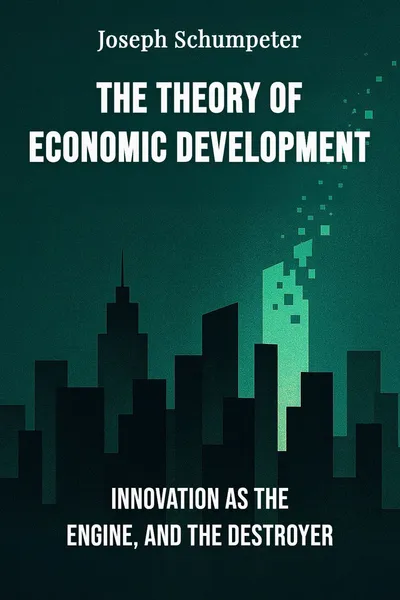
The Theory of Economic Development
Innovation as the engine, and the destroyer
Description
In 1911, a twenty-eight-year-old Austrian economist published a book that quietly disagreed with almost everything his discipline had settled on. Joseph Schumpeter called it Theorie der wirtschaftlichen Entwicklung — the theory of economic development — and its target was the reigning picture of the economy as a smoothly turning wheel. The economists of the day, following Léon Walras, had built elegant models in which supply met demand, prices found their level, and everything came to rest in equilibrium. Schumpeter admired those models. He just thought they described a world that never actually moves.
His question was disarmingly simple. If the economy always tends back toward balance, where does growth come from? Not the slow drift of population or savings — the real thing, the leaps that turn candlelight into electric grids and stagecoaches into railways. The standard answer treated such change as a shock arriving from outside: a war, a discovery, a harvest. Schumpeter refused that. Development, he insisted, comes from within. The system generates its own ruptures, and it does so through a specific figure and a specific mechanism that the equilibrium models had no room for.
That book, revised and translated across the following decades, planted the seeds of ideas we now toss around casually — the entrepreneur as agent of change, innovation as competitive weapon, and later the phrase that became his signature. Schumpeter was writing in Vienna before the First World War, before Silicon Valley, before the word disruption meant anything. Yet the machinery he described reads like a diagnosis of the century that followed.
The question we’re asking : If the economy naturally settles into balance, where does the change that actually transforms it come from?What we’ll see : How Schumpeter located the source of growth not in outside shocks but inside the system — in one restless figure and the money that backs the bet.
Table of contents
01Chapter 1 — The economy that only ever repeats itself
Schumpeter begins by taking the equilibrium picture seriously — more seriously, in a sense, than its own defenders. Imagine an economy that has found its balance. Farmers grow what they grew last year, in the same quantities, sold to the same millers, who sell to the same bakers. Everyone knows their role because they inherited it from the season before. Prices cover costs and no more; there is no profit beyond the wage of management, no surplus lying around. Schumpeter calls this the circular flow, and the key word is circular. Nothing is created, nothing is destroyed, the stream simply runs its accustomed course and returns to where it began.
In this world, economic life is essentially a matter of adaptation. People respond to conditions rather than shaping them. A manager here is not a bold visionary but a careful steward, keeping the machine running as it always has. Even change, when it comes, is gradual and reactive — the population grows a little, tastes shift a little, and the whole system adjusts smoothly, sliding from one point of rest toward another without any drama. This is growth of a kind, but it is the growth of a tree adding rings, not the growth that remakes a landscape.

02Chapter 2 — The one who breaks the loop
That something, for Schumpeter, is a someone. He introduces the entrepreneur — der Unternehmer — as the figure who steps out of the circular flow and forces it onto a new path. Crucially, the entrepreneur is not defined by owning a business, inventing a gadget, or bearing financial risk. Schumpeter is precise about this in a way that still surprises. A person who runs a firm along established lines is a manager, not an entrepreneur, however large the firm. An inventor who tinkers in a workshop has produced nothing economic until someone carries the invention into use. The entrepreneur is defined by a single act: carrying out new combinations.
A new combination means putting the elements of production together in a way they had not been put together before — and doing it against the grain. This is where Schumpeter's psychology gets interesting. The entrepreneur is not merely clever; he is someone able to overcome the enormous inertia of the accustomed. Everyone around him knows how things are done, has interests bound up in how things are done, and will resist the person who proposes doing them otherwise. Habit is not just laziness; it is the accumulated confidence of an entire environment. Breaking it takes a temperament Schumpeter describes almost romantically.
03Chapter 3 — Five ways to blow up an equilibrium
Schumpeter does not leave new combinations as a vague slogan. He spells out the forms they can take, and the list is broader than most people's picture of innovation. The first is the introduction of a new good, or a new quality of a good — something consumers had not previously encountered. The second is a new method of production, a new way of handling a commodity commercially, which need not rest on any scientific discovery at all. Reorganising how work is done counts. The novelty lives in the doing, not necessarily in the lab.
The remaining three widen the frame further. There is the opening of a new market, one a given branch of industry had not entered before, whether or not that market previously existed. There is the conquest of a new source of supply of raw materials or half-manufactured goods, again regardless of whether the source was already there or had to be created. And there is the carrying out of a new organisation of an industry — the creation of a dominant position, or the breaking up of one. Innovation, on this account, is as much about arrangement and access as about invention.
04Chapter 4 — The gale that never quite stops
Step back from the entrepreneur and a larger claim comes into view — the one that makes Schumpeter's little book still worth arguing with. Capitalism, on his reading, is not a system that seeks equilibrium and occasionally gets knocked off it. It is a system whose normal condition is upheaval. The moments of balance the classical economists prized are the exception, the brief pauses between disturbances. Development is not something that happens to the economy; it is what the economy is. To describe capitalism by its resting points is to describe a river by its still pools and miss the current entirely.
This reframing has an uncomfortable edge. If growth and destruction are the same process, then the pain is not a malfunction to be legislated away — it is the price of the mechanism working. The bankrupt firm, the obsolete skill, the town whose industry moved on: these are not accidents befalling an otherwise smooth system. They are the shadow cast by every genuine advance. Schumpeter did not celebrate this coldly, but he refused the comforting idea that one could keep the creation while sparing the destruction. The two arrive together or not at all.
05Conclusion
Schumpeter wrote his theory before the world it would help explain had arrived. The young economist in Vienna, sketching the entrepreneur against the placid backdrop of the circular flow, could not have named the industries that would later illustrate his argument. But the shape he drew has held: growth that comes from inside the system, delivered by restless figures who force new combinations against the resistance of habit, funded by credit that lets the future be paid for in advance. The entrepreneur breaks the circle; the banker hands over the tools; the old arrangement is ruined so the new one can exist.
Related books