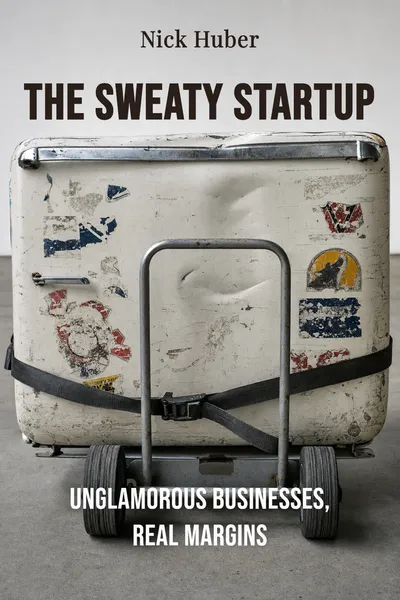
The Sweaty Startup
Unglamorous businesses, real margins
Description
In the mid-2000s, a college athlete named Nick Huber started a business moving and storing other students' furniture over summer break. It was called Storage Squad, and it was about as unglamorous as work gets: cardboard, box trucks, sweat, and the logistics of hauling mini-fridges out of dorms in June and back in August. It grew across dozens of campuses. Then Huber pivoted the same instinct into commercial self-storage — buying and building the plain metal buildings you drive past without noticing — and turned it into a portfolio worth tens of millions. None of it looked like a startup. That was the point.
Huber later wrote it all down in a book called The Sweaty Startup, and the argument runs against almost everything the last fifteen years of business culture has celebrated. The heroes of that culture raise venture money, chase billion-dollar markets, and build apps that might change the world and might burn a hundred million dollars trying. Huber's pitch is the opposite: skip the app, skip the investors, skip the world-changing. Go clean gutters. Go haul junk. Go rent people a locked room to keep their stuff in. The businesses nobody wants to post about, he argues, are the ones with real margins and almost no competition.
It's an easy argument to dismiss as folksy contrarianism — the guy who got rich telling everyone else to get their hands dirty. But underneath the plain talk sits a specific claim about where money is actually made, and why so many smart, ambitious people walk straight past it toward the shinier thing that ruins them. That claim is worth taking seriously on its own terms.
The question we’re asking : Why do so many capable people chase glamorous businesses that lose money while the unsexy ones quietly print it?What we’ll see : How a furniture-hauling operation became a case for boring, capital-light service work — and the arithmetic that makes it hold up.
Table of contents
01Chapter 1 — The business nobody wants to brag about
Huber's central move is to redefine what counts as a good opportunity. The instinct most people have is to chase the exciting market — the restaurant, the clothing line, the app, the coffee shop. These are the businesses people fantasize about owning, which is precisely the problem. Everybody wants them. When everybody wants to do something, the competition is brutal and the margins collapse. A restaurant is a beautiful idea and a terrible business: long hours, thin returns, a graveyard of owners who loved food and lost their savings.
The businesses Huber points to instead are the ones nobody dreams about. Commercial cleaning. Landscaping. Junk removal. Portable toilet rental. Pressure washing. Self-storage. Tree trimming. These share a family resemblance: they're physically demanding, socially invisible, and faintly embarrassing to describe at a dinner party. Nobody grows up wanting to own a gutter-cleaning company. And that, in Huber's telling, is the entire edge. The embarrassment keeps the ambitious, credentialed people away, which keeps the field clear for whoever is willing to do the unglamorous thing well.

02Chapter 2 — The self-storage arithmetic
Self-storage is Huber's favorite example, and it's worth walking through why. A storage facility is, in the most literal sense, a box of smaller boxes. There's almost nothing to it: a plot of land, some steel buildings partitioned into units, a gate, a security camera, and a website that lets people rent online. Once it's built and full, the operation runs on very little. There are no employees restocking shelves, no perishable inventory, no complicated supply chain. A single facility can be managed remotely, part-time, with the tenant doing all the moving and the software handling the billing.
The financial shape of the thing is what makes it sing. The costs are mostly fixed and mostly upfront — buy or build the facility. After that, each additional occupied unit is almost pure margin, because renting out a room that already exists costs you nearly nothing. A well-run facility can throw off operating margins that would be unthinkable in a restaurant or a retail store. And unlike a business that lives or dies on constant new sales, storage tenants tend to stay. Once someone has filled a unit with their belongings, the friction of moving it all out is high enough that they keep paying, month after month, often for years, sometimes long after they've forgotten what's even in there.
03Chapter 3 — Cheap to start, hard to quit
The other half of Huber's thesis is about how you get in. Venture-backed startups begin by raising money — burning capital in pursuit of scale before the business makes a dollar. Huber's model is the reverse: start capital-light, get cash flowing early, and grow out of your own profits. A cleaning business needs a vacuum, some supplies, and a first client. A junk-removal operation needs a truck and a phone number. You can start most of these on nights and weekends while keeping the job that pays your bills, testing whether the thing works before betting your life on it.
This changes the risk profile completely. The founder who raises a seed round has to make it big or the whole thing collapses, and along the way answers to investors who need a giant exit to justify their portfolio math. The sweaty-startup founder has no such pressure. A landscaping business that clears a modest but real profit every month is a failure by venture standards and a genuine success by Huber's — it feeds a family, employs a few people, and belongs entirely to the person who built it. The absence of investors isn't a limitation; it's the freedom to run a business that only has to work for you.
04Chapter 4 — When boring is the whole point
Step back from storage units and junk trucks and the sweaty startup makes a broader claim about where returns actually live: not in the businesses that get admired, but in the ones that get overlooked. There's a persistent gap between what looks like a good business and what is one. The gap exists because attention is a crowd, and crowds destroy margins. The moment a field becomes aspirational — the trendy restaurant concept, the direct-to-consumer brand, the startup category everyone's funding — capable people flood in, and the returns get competed away. The unglamorous corners stay profitable precisely because nobody's fighting over them.
Huber's argument is really a bet against status as a guide to opportunity. Most people choose businesses the way they choose clothes — for how they'll be perceived. They want to tell people they own a coffee roastery, not a portable-toilet company. But the market doesn't reward you for the prestige of your industry; it rewards you for solving a problem in a space where you're not being undercut by a thousand equally motivated rivals. The willingness to do work that others find beneath them is a genuine and underpriced competitive advantage, and it's available to almost anyone, because it requires ego rather than genius.
05Conclusion
Nick Huber started with a box truck and a summer's worth of student furniture, and the business he built from it looks, from the outside, like nothing worth writing about. That's the joke at the center of The Sweaty Startup, and also the argument. The furniture-hauling operation and the self-storage portfolio that followed weren't successful despite being boring; they were successful because of it. The unsexiness kept the competition thin, the demand stayed durable, and the margins did the rest.
Related books