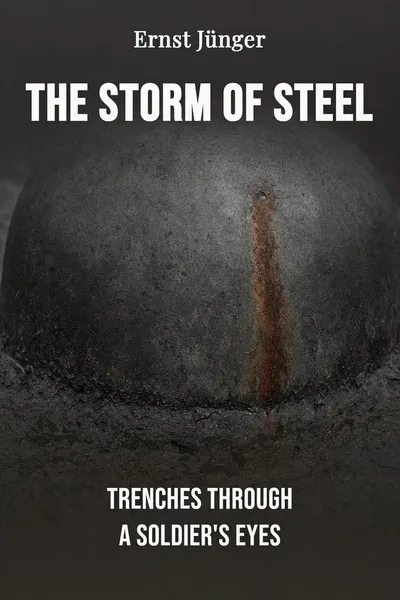
The Storm of Steel
Trenches through a soldier's eyes
Description
In the winter of 1914, a nineteen-year-old German named Ernst Junger arrived at the Western Front, part of a generation that had left the lecture hall and the family table convinced that war would be a great cleansing adventure. He had, a few months earlier, run off to join the French Foreign Legion out of pure restlessness; his father had to pull strings to get him back. When the war came, he volunteered at once. What he found in Champagne, and then across four years of fighting in France and Flanders, was not the war his schoolbooks had promised. It was mud, lice, artillery that fell for days, and men who disappeared without a body to bury.
Out of that experience Junger kept a diary. He kept writing in it through fourteen wounds, through the loss of nearly everyone he served alongside, through offensives that gained a few hundred meters and cost thousands of lives. In 1920 he turned those notebooks into a book, In Stahlgewittern — The Storm of Steel. It went through many revisions across the decades, and the version many English readers first met was the 1929 translation. It became one of the strangest war memoirs ever published: unsparing about the horror, yet oddly unwilling to condemn the thing that produced it.
Most of what we think we know about the trenches comes from writers who wanted us to be appalled. Junger is not quite one of them. He watches industrialized killing with the eye of a naturalist and the nerve of a professional, and he leaves the moralizing to us. That is exactly what makes the book so uncomfortable, and so lasting.
The question we’re asking : What does the First World War look like when the man writing it down refuses to tell us how to feel about it?What we’ll see : How a young volunteer's diary became the war memoir that describes everything and judges nothing.
Table of contents
01Chapter 1 — A volunteer walks into a war that no longer wants heroes
Junger belonged to a cohort raised on the idea that a great European war would be brief, glorious, and personally transformative. He describes leaving for the front in a mood close to elation, surrounded by young men singing, certain they had been handed the defining experience of their lives. The book opens in that register on purpose. It lets us feel the enthusiasm before it dismantles it, without a single line of commentary telling us the enthusiasm was foolish.
The dismantling is quick. His first real taste of the front is not a charge but a bombardment — the unit huddled while shells come down, a comrade killed near him almost immediately, blood and confusion and no enemy in sight to fight. This is the central shock of the memoir's opening chapters: the discovery that in this war, courage and skill barely matter against artillery. A shell does not care whether you are brave. It falls where it falls, and the men it kills are chosen by geometry, not merit.

02Chapter 2 — The trench as a place you learn to live in
Much of The Storm of Steel is not battle at all. It is waiting. Junger devotes long passages to the ordinary life of the trench, and these are among the book's most vivid pages precisely because they resist drama. He describes the geography of a dugout, the routines of sentry duty, the rats, the smell, the way men adapt to conditions that would have seemed unendurable a year earlier. War, in his account, is mostly the slow business of existing in a hole in the ground while occasionally something tries to kill you.
He is unusually attentive to comradeship, and it is one of the few things the book treats with open warmth. The men he serves with are named, remembered, mourned. A trusted subordinate killed on patrol lands harder in the prose than any statistic of casualties. Junger's world is small — a section, a company, the few faces you trust to hold the line beside you — and its shrinking is part of what he is documenting. The nation that sent him to war is far away. The man in the next traverse is everything.
03Chapter 3 — The moment the shell decides everything
If the memoir has a climax, it is the great battles of 1917 and 1918 — the industrial set pieces where artillery reaches a scale that overwhelms description, and Junger's prose strains to keep up. He writes of barrages that turn the earth into a boiling sea, of landscapes reduced to craters and stumps, of men vaporized so completely there is nothing to recover. Here the naturalist's calm meets its limit. The observer keeps observing, but what he observes is a machine for producing death at a rate no individual can influence.
This is the section where the book's deepest argument surfaces without ever being stated. The First World War, Junger shows, dissolved the old idea of the soldier as an agent of his own fate. A man could do everything right and still be erased by a shell fired from miles away by someone who never saw him. Skill bought you marginal odds; it did not buy you safety. The scale of the firepower had rendered the individual almost irrelevant, and Junger registers this not as tragedy but as a new condition of existence to be understood.
04Chapter 4 — What the diary refuses to explain
The most striking thing about The Storm of Steel is what it leaves out. There is no thesis. Junger does not tell us the war was a crime, or a waste, or a necessary sacrifice. He does not blame the generals, the Kaiser, the enemy, or the civilization that produced the slaughter. Where his contemporaries wrote to warn, to accuse, or to grieve, Junger wrote to describe. The book ends more or less where it began in tone: composed, exact, unwilling to draw the lesson the reader keeps waiting for.
This refusal is not an oversight; it is the book's entire posture. Junger seems to have believed that turning the war into an argument would falsify it. The men in the trench did not experience the war as a moral proposition. They experienced it as weather, as luck, as the man beside them, as the sound of an incoming shell. To editorialize would be to impose a shape the experience never had. So he holds back, and the restraint gives the descriptions a terrible authority — we trust what he shows precisely because he is not trying to move us.
05Conclusion
Junger survived the war he was statistically supposed to die in, and lived, remarkably, to the age of a hundred and two, revising his account across the whole of a long century. The book kept changing shape, but its core never did: the diary of a man who went to the front young and enthusiastic, learned that the war did not care about his courage, and chose to record the experience rather than explain it. The notebooks he carried through fourteen wounds became the most granular eyewitness testimony the conflict produced.
Related books