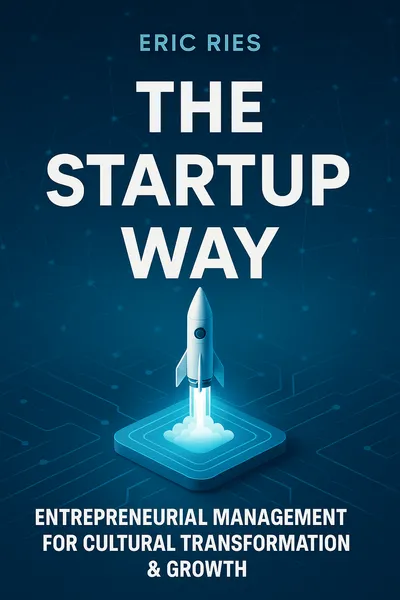
The startup way
Entrepreneurial management for cultural transformation & growth
Description
Eric Ries is an entrepreneur and author who created the Lean Startup methodology for new product development. He has founded several startups, including IMVU where he was CTO. After IMVU, Ries joined Kleiner Perkins to advise startups on applying Lean principles which eliminate waste. In 2011, he wrote the bestselling book The Lean Startup explaining his methodology of rapid prototypes and customer feedback loops.
The Lean Startup promotes continuous innovation adapted from lean manufacturing. Ries wants entrepreneurs to scientifically test their ideas through build-measure-learn cycles instead of long business plans. His Lean Startup movement aims to improve startup success rates through iterative development with early customer validation. The methodology is now widely used in startups and large companies to launch new innovations faster and more successfully. Ries continues to spread Lean Startup principles as an advisor and speaker.
Table of contents
01 Creating the modern company – embracing change
In today's rapidly changing marketplace, traditional management practices are increasingly becoming obsolete. The advent of globalization, technological advancements, and evolving consumer preferences have introduced a level of volatility and unpredictability that traditional management tools, which rely on forecasting, incremental improvements, and preset objectives, struggle to navigate. These tools are less effective in the face of uncertainty, and rigid, top-down leadership is losing its effectiveness.
Modern companies are now required to focus on continuous innovation aimed at long-term gains. This involves the formation of cross-functional teams that engage in iterative experimentation to better serve customers and create value. All internal functions within an organization must align to enhance customer service, tapping into the collective brainpower and ideas of employees. Successful organizations are integrating entrepreneurship through multiple internal teams that constantly test potential high-growth concepts. However, this approach presents challenges in organizing these teams, containing risk, tracking progress, and scaling successful initiatives. Internal startups have emerged as a means to pioneer improvements within larger organizations, but they face persistent issues such as providing experimental space without significant liability, allocating funding without return-on-investment projections, setting realistic targets and milestones, offering development coaching for corporate entrepreneurs, composing optimal teams, and incentivizing intrapreneurs while enabling career growth. Silicon Valley's thriving startup ecosystem offers valuable models for addressing these challenges.

02 A framework for continuous transformation
Transforming an organization into a more entrepreneurial entity involves three key stages: first, "unfreezing" current mindsets and processes; second, embedding entrepreneurial principles like creative problem-solving and innovation into daily operations; and finally, sustaining these behaviors long-term through training, feedback loops, and aligned incentives.
Laying a foundation centered on experimentation
Introducing startup way principles into an established company begins with gaining momentum and securing support from senior leadership. The strategy involves starting with a few innovative projects that can demonstrate the effectiveness of internal entrepreneurship. These initial successes are crucial for showcasing the benefits of startup thinking within the corporate environment. For instance, general electric's approach to developing the series x diesel engine illustrates this tactic. Initially, ge planned a 5-year development with substantial investment. However, by adopting startup way principles, they shifted focus to whether the engine should be built at all. They created a prototype for a niche market, which led to an order for five engines within six months. This approach allowed ge to test assumptions and gather customer feedback, refining their business plan with practical data.
Key strategies for these pilot projects include forming a small, diverse team of passionate individuals who can later advocate for the startup approach. Experiments should be thoughtfully designed with clear hypotheses and structured tests to validate assumptions, avoiding large-scale plans at the outset. It's important to measure progress with new metrics that reflect validated learning, such as user sign-ups and retention rates. Additionally, it's beneficial to have executives on board who can navigate conflicts arising from new methods challenging the status quo. They can ensure that while some rules may be flexible, significant changes are not made prematurely. As the process evolves, it's also necessary to adapt the language and tools of entrepreneurship to fit the company's specific context. By carefully choosing impactful projects and focusing on small wins, these efforts lay the groundwork for convincing executives and building a supportive base for the startup culture. This paves the way for broader implementation in subsequent phases of the integration process.
03 From innovation to transformation
In the dynamic landscape of modern business, the concept of The Startup Way, as introduced by Eric Ries, emerges as a vital framework for fostering continuous innovation and transformation across organizations of varying sizes. Central to this approach is the understanding that in the face of today's swiftly evolving market conditions, no enterprise can sustain long-term success through a singular innovation breakthrough. Instead, there's a pressing need for companies to integrate entrepreneurship, experimentation, and learning into their core operations on a continuous basis.
This paradigm shift begins with empowering every employee to adopt an entrepreneurial mindset, enabling them to tackle challenges and unearth new opportunities proactively. The traditional notion that innovation is the sole province of R&D departments or the executive echelon is outdated. With the right culture and processes in place, innovative ideas can surface from any corner of the organization. It's crucial for teams across the board to engage in identifying assumptions, testing hypotheses, gathering customer feedback, and refining their ideas based on the insights gained.
To support this culture of innovation, the appointment of an executive-level "chief entrepreneurship officer" (CEO) is advocated. This role is pivotal in ensuring that entrepreneurship is woven into the fabric of the company's operations. The chief entrepreneurship officer is tasked with mentoring budding internal entrepreneurs, creating pathways for their development, and championing entrepreneurial initiatives at the policy-making level. Moreover, The Startup Way emphasizes the importance of periodically reassessing and evolving the company's structure and processes in light of the lessons learned from internal innovation efforts. When a new breakthrough is validated and achieves scalability, it may necessitate the integration of these new methods into the organization's broader operational DNA. This could involve updating workflows, metrics, and training programs, or it might call for a complete overhaul of certain operations to better align with current market demands.
Related books